
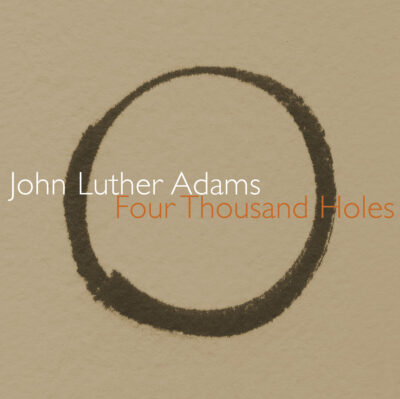
If minimalist music is like lying back in the grass, waiting and noticing as the stars appear one by one, then the titular piece of John Adam’s latest CD, Four Thousand Holes, could be said to keep rolling back that moment to the appearance of the first star, repeating richly the significance of the single burst against a darkening background.
The piece features pianist Stephen Drury, percussionist Scott Deal on vibraphone and orchestral bells, with Adams himself contributing an “electronic aura.” In the liner notes Adams describes his musical materials: “I limited myself to the most basic elements of Western music—major and minor triads and four-bar phrases—sculpting these found objects into lush harmonies and rhythmically complex fields of sound.” In consequence, each discreet pressing on the piano keys registers as a distinct and noteworthy event. The piece sustains its amazing capacity to astonish over its full thirty-two minutes and fifty-one seconds.
The second piece on the CD, . . . and bells remembered . . ., features Drury in charge of the Callithumpian Consort, a larger group featuring orchestra bells, two vibraphones, and bowed crotales. An ostinato bell timbre chimes different tones and the other instruments reply, sketching a system of memory distorted and occasionally enriched.
Andrew Hamlin was born and raised in Seattle, Washington, USA, where he resides today. He attended the Evergreen State College in Olympia where he wrote and edited arts coverage for the Cooper Point Journal. He began writing professionally about music and the arts in 1992. He is the film critic for the Northwest Asian Weekly, and his work has appeared in the Village Voice, Rolling Stone Online, Seattle Times, San Diego Reader, Goldmine, Seattle Weekly, The SunBreak, and other publications.
He has still never found anyone who loves the Happy Flowers nearly so much as himself.