
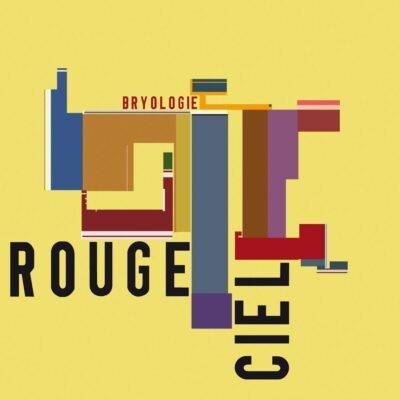
Bryologie, named intriguingly for the study of mosses, is the third CD by the Montreal quartet Rouge Ciel, founded in 2001. When the group began recording, some of the members were around twenty years of age, and the band maintains that same personnel, with Guido Del Fabbro on violins, banjo, and programming; Simon Lapointe on piano and keyboards; Antonin Provost on acoustic and electric guitars; and Némo Venba on trumpet and drums. Perhaps it’s the combination of relative youth and the longevity of the band, along with Del Fabbro and Lapointe’s compositional input, but Rouge Ciel has forged a distinct identity—a cinematic combination of prog-rock, improvisation, and soundscape, that plays with conventional musical signs. There’s bombast here, like the reiterated keyboard line in Antimémoire; but when it finally gives way, it does so to a dissonant music-box treble variant, drained of all mass. Venba’s composition Tess has a mock-orchestral feel to the arrangement, but the melody has a folk-like delicacy. Compositions attributed to the entire band include segments of often acoustic free improvisation, but these are likely to merge with looming ostinatos. The combination of stadium theatricality and subtle deconstruction gives Ciel Rouge a fascinating weirdness, a sense that the players are willing to try anything. In the process, they create some genuinely unusual and sometimes arresting music, as in the polyvalent and multi-methodological conclusion, Jubilation protozoaire, a kaleidoscope of rock and free improv. The principle at work here is reminiscent of Frank Zappa, but the symbol-set is quirkier still.
Stuart Broomer has written extensively on music, mostly improvised, for both general and specialist publications, and his liner essays have appeared on CDs by musicians from some 20 countries. The author of Time and Anthony Braxton (Mercury, 2009), he is currently writing a fantasia on the life of Memphis disc jockey Dewey Phillips. He has been intermittently active as an improvising musician since 1965; his composition Found Theme for the Age of Reason appeared in Musicworks 112. He lives in Toronto.