
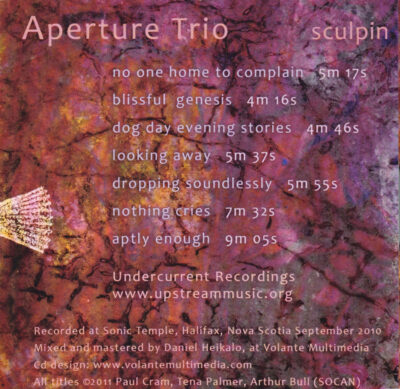
The Aperture Trio consists of singer Tena Palmer, saxophonist Paul Cram, and guitarist Arthur Bull, three imaginative improvisers residing in or hailing from Nova Scotia, where the group first came together. The CD’s namesake—sculpin—is an ancient bottom-dwelling fish with venomous spines, whose strongest similarity to this music lies in the element of surprise. That quality will strike a listener within moments of the opening No One Home to Complain: each musician seems to improvise independently of the group and yet what emerges is a complex tapestry of ultimately interconnected bits, each performer feeding, anticipating, and ignoring his or her partners at the same time. A common stylistic element shared by the three is a fondness for the string of discontinuous events and timbres, a special kind of linearity that creates a sense of continuous and unpredictable sonic collisions, each one yet possessing a sculptural sense of integrity. The musicians’ speed of thought is something to behold, as is the expressive range, from guttural emissions—Cram’s instruments include a duck call—to sweetly liquid lyricism, such moments often occurring in close conjunction.
Stuart Broomer has written extensively on music, mostly improvised, for both general and specialist publications, and his liner essays have appeared on CDs by musicians from some 20 countries. The author of Time and Anthony Braxton (Mercury, 2009), he is currently writing a fantasia on the life of Memphis disc jockey Dewey Phillips. He has been intermittently active as an improvising musician since 1965; his composition Found Theme for the Age of Reason appeared in Musicworks 112. He lives in Toronto.