
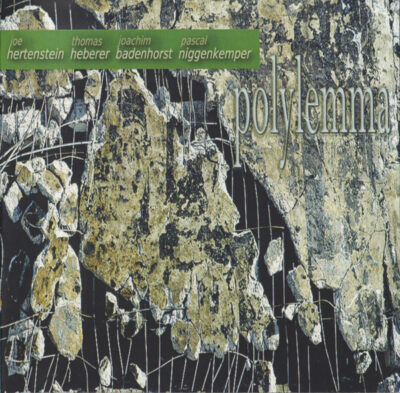
Drummer Joe Hertenstein defines polylemma as “a choice from multiple options, each of which is (or appears) equally (un-)acceptable or (un-)favourable.” He then applies the term to one of his compositions here and also to the group, a quartet of European musicians—Germans Hertenstein, quarter-tone trumpeter Thomas Heberer (best known for his subtle presence in Amsterdam’s comic and explosive Instant Composers Pool), and bassist Pascal Niggenkemper, plus the Belgian bass clarinettist Joachim Badenhorst—whose paths have intersected in New York in the past three years, building on previous associations. Rooted in free jazz, the four explore various ways of combining composition and improvisation with techniques that include unusual meters, twelve-tone rows, graphic notation, and such interactive prods as Hertenstein’s Sugar’s Dilemma, in which individual musicians complete one another’s phrases. The composers Hertenstein and Heberer consistently construct materials that challenge and inspire each other and their partners. Among the highlights on this CD are Heberer’s Garden, an extremely quiet piece distinguished by continuous movement, and Hertenstein’s Crespect, in which improvisation and composition constantly interweave. There are multiple lines of affinity here, Badenhorst and Niggenkemper contributing as much as the composer to the ultimate realization of a dense and spontaneous work such as Stratigraphy, with Polylemma ultimately constructing a distinct group idiom.
Stuart Broomer has written extensively on music, mostly improvised, for both general and specialist publications, and his liner essays have appeared on CDs by musicians from some 20 countries. The author of Time and Anthony Braxton (Mercury, 2009), he is currently writing a fantasia on the life of Memphis disc jockey Dewey Phillips. He has been intermittently active as an improvising musician since 1965; his composition Found Theme for the Age of Reason appeared in Musicworks 112. He lives in Toronto.