

“Can you believe that you can record a song?” Simone Schmidt says. “I’m not even trying to sound like a stoner. It blows my mind. It’s total magic. It seems like something worth devoting a lot of time to. I never get over it.” The creative process behind Schmidt’s visionary country songs is rooted in a sense of wonder that a form as poetically elastic and variable as the country song not only exists but is available to us to take on if we have the patience to sit with its mysteries. This ethos animates the psychedelic country-rock of Schmidt’s bands One Hundred Dollars (active from 2007 to 2011) and The Highest Order (active since 2011), and the ongoing solo project Fiver, whose recent albums include Audible Songs from Rockwood—an extraordinary melding of archival research and sonic imagining—and Soundtrack to A More Radiant Sphere: The Joe Wallace Mixtape.
Schmidt is both a brilliant singer-songwriter-producer and a political radical with a profound understanding of the overlapping crises of the present moment. They work hard to sidestep the clichéd confessionalism and shopworn slogans that can bedevil contemporary protest music. “This is a common sentiment I have about a lot of explicitly political music: I don’t like it,” Schmidt says. “And I don’t like it because of something about black-and-white readings of reality, something kind of puritanical, but also, if you can write it in a pamphlet, then write it in a pamphlet.” There are exceptions, of course. Schmidt points to Willie Dunn’s “I Pity the Country” and the songs of Buffy Sainte-Marie. “She writes politically explicit songs, but she also writes love songs and they overlap, and there’s a power of description, and imagery, and lyrical sensibility.”
We are talking about Soundtrack to A More Radiant Sphere: The Joe Wallace Mixtape (2022), which features music Fiver created for Sarah Wylie’s 2022 hybrid documentary (A More Radiant Sphere) about her uncle, notable Canadian communist poet Joe Wallace (1890–1975). The album combines settings of poems by Wallace and instrumental film music composed by Schmidt, with contributions from Nick Dourado (piano and lap steel), Nathan Doucet (percussion), and John Showman (fiddle). “Sarah asked me to make five of his poems into songs,” Schmidt recalls. “And I found it hard, because his poems are really explicit. There’s no nuance in them.” Notwithstanding––or perhaps because of––the tension between Schmidt’s preferred process and the flat-footedness of Wallace’s verse, the resulting recording bristles with productive contradictions.
The poem featured in “Song of the Mournful Millionaire” is written in the voice of a clueless plutocrat who has run out of people to exploit on planet Earth and is now looking skyward for new business opportunities. Schmidt marries the verses to a plaintive modal melody reminiscent of Hazel Dickens and Alice Gerrard, setting them over a spare acoustic guitar figure. The song’s refrain––“my only market is Mars”––shifts its sonic character by adding in a Varispeed (variable speed pitch control) choir that suggests the science-fiction sonics of the 1960s. As Schmidt toggles between a folk authenticity that rubs against the pretensions of the capitalist narrator and a technologically mediated artificiality that mocks the entrepreneur’s dreams of colonizing space, “Song of the Mournful Millionaire” generates a frothy dissonance that displaces the listener and creates an occasion for reflection on the constricted imaginations of Richard Branson and Elon Musk.
“I wanted it to sound like little aliens,” explains Schmidt, who then breaks down the complex process of slowing down and speeding up magnetic tape to capture that particular Sputnik-era sonic patina. Recording to tape thus eschewing the digital studio apparatus that now dominates the musical scene is crucial to Schmidt’s modus operandi. “I don’t operate with an infinite number of takes. With digital, it seems like people go in and record endlessly, and then pick things later. To me that’s expedient. I think, in my life, as I’ve left myself too much freedom or too many options, I rarely make a decision. I find myself forced into a decision. The freedom of making a record is to do things that might feel difficult outside of the confines of my artistic practice. To be decisive is such bliss.”
Schmidt trained as an engineer and learned how to navigate the sixteen- and twenty-four-track studio. They learned a great deal about production from Stew Crookes, who played pedal steel in One Hundred Dollars and produced Songs of Man (2011), their second record. (Their first, Forest of Tears, was recorded and mixed by Canadian lo-fi legend Rick White and released in 2008.) Working with Crookes, Schmidt grew to appreciate the importance of pre-production. “You go in there, you have a limited amount of time, and you’re not going to waste it. When you get into a studio situation with two-inch tape, maybe sixteen tracks, maybe twenty-four, it all sounds so great,” Schmidt elaborates. “You don’t want to waste time trying to figure out too much. The beautiful thing about music is that if you’re playing well, it sounds good when you record it—unless you’ve got a terrible engineer. My style is to do the pre-production labour, which is just rehearsal, and then have a few different ideas about how I might go about producing something in an interesting way, or have some conceptual notion that underscores it.”
When I mention how difficult keeping track of all the moving parts on recording projects has been for me, Schmidt says, “It’s not as hard as so many other challenges—like taking care of people, or trying to organize in social movements. Those things are really difficult. They keep growing, they keep changing, but a recording is a recording. You finish it and you’re done. That’s that. It can be perceived differently over time. It’s irrevocable in that way. There’s something so stunning about it.”
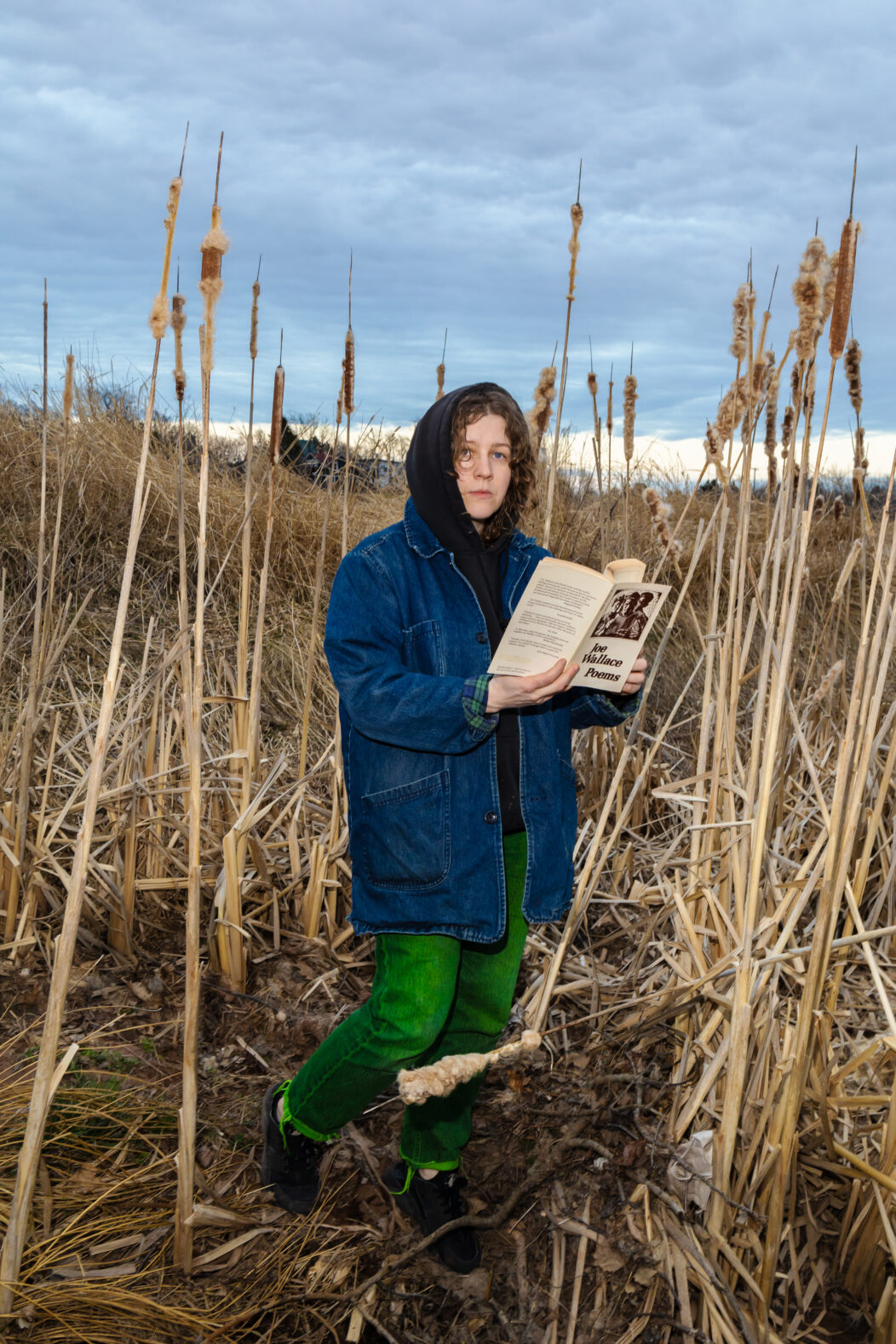
Schmidt caught the country-music bug as a teenager at Crazy Strings, the legendary weekly bluegrass series hosted at Toronto’s Silver Dollar Room. Schmidt became particularly enchanted with the music created by Chris Coole, John Showman, and Max Heineman, who were playing in various combinations, including The Foggy Hogtown Boys, and ended up providing much of the string-band texture that suffuses Audible Songs from Rockwood. (They are currently in Lonesome Ace Stringband.) “I would go with my fake ID to the Silver Dollar and watch Chris and John play,” Schmidt recalls. “I grew up idolizing them, in the sense that I knew I’d never be able to pick as fast as they could. But then Chris ended up taking me under his wing.”
Soon after they met, around 2010, Coole would invite Schmidt over every Tuesday, make a pot of soup, and break down country and bluegrass guitar styles as they played and sang traditional songs together. “I’d show her a lick or two on the guitar, [and] I remember teaching her a few finger-picking patterns,” Coole recently told me. “One thing that has struck me about Simone from the beginning is that she pays more attention to music than most musicians and songwriters I meet. She pays more attention to tone, to phrasing, to the sound of words, to the meaning of words, to arrangements. I may have helped turn her on to paying attention to timing and using a metronome. I know we talked about this some, and I also know from hearing her practise with a metronome quite a bit when we lived in the same house. In my experience, that level of attention is rare, and I think it’s what makes everything Simone does stand out.”
Gathering inspiration from Crazy Strings and a steady diet of classic country, Schmidt and One Hundred Dollars emerged at a relatively active moment for the Toronto indie-rock underground. Bands were making decent money touring, record labels were willing to risk money putting out vinyl by new bands, and festivals like Sackville, New Brunswick’s Sappyfest were helping to re-establish links between Canadian bands in disparate parts of the country. Toronto was on its way toward, but had yet to fully arrive at, its current incarnation as renoviction capital and playground of the wealthy. Neighbourhoods like Kensington Market, Parkdale, the Junction, and Roncesvalles still offered apartments with relatively affordable rents. With One Hundred Dollars, and later The Highest Order, Schmidt created a life around regular touring and making records, while working as a personal support worker and devoting energy to political organizing. By 2012, feeling the need for a musical vehicle they could direct, Schmidt created the moniker Fiver to accommodate a variety of projects that exceeded the parameters of One Hundred Dollars and The Highest Order.
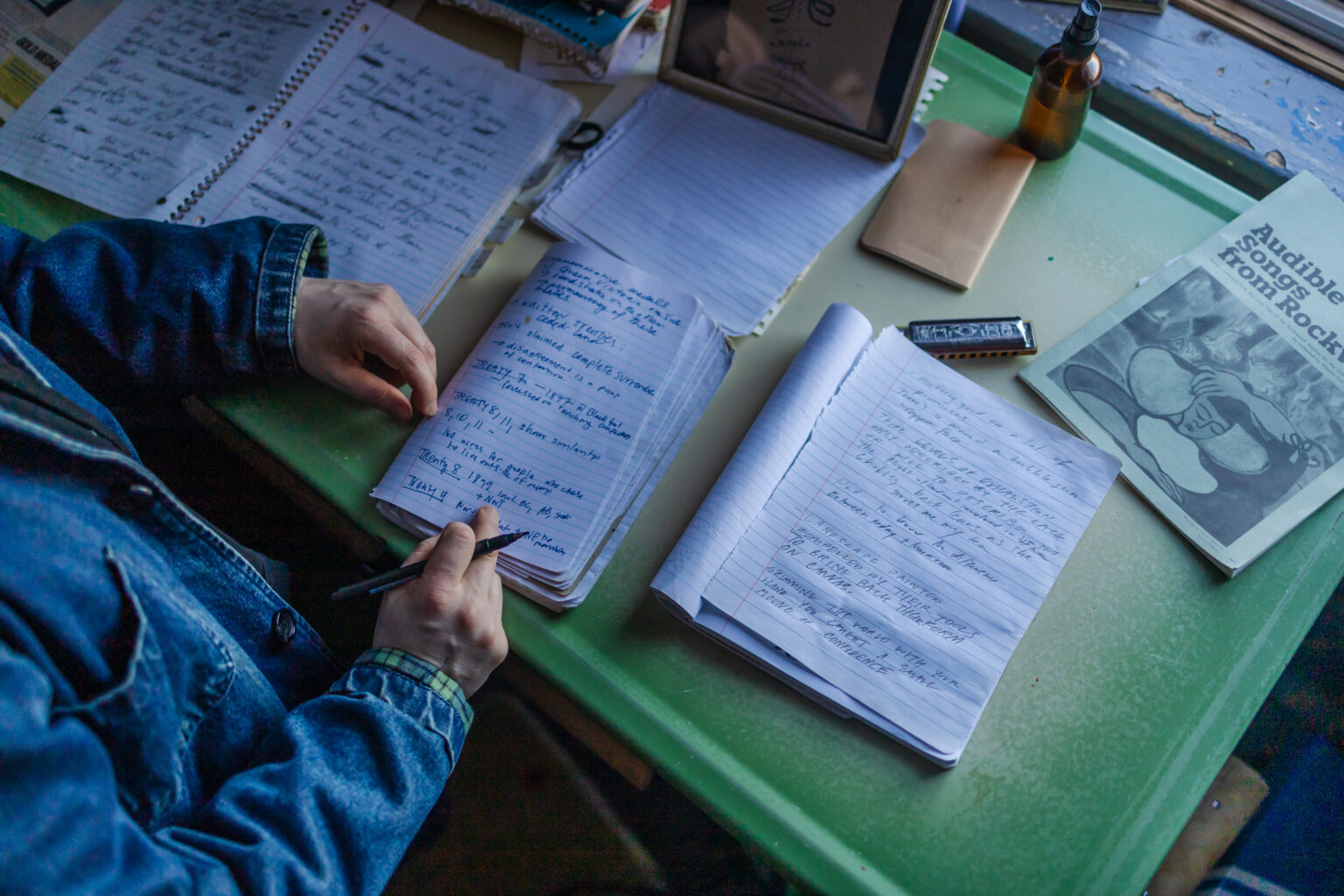
“It took me, I think, three years because it kept getting harder and harder… the undertaking got more and more complicated, and I got really worried about messing with someone, so I just, I don’t know, I’ll never really know, but I think it went over OK with whomever.” Schmidt is talking about Audible Songs from Rockwood, which originated from a chance encounter with a short historical article about the Rockwood Asylum for the Criminally Insane, which was established in Kingston, Ontario, in the mid-nineteenth century. It was a short trip from that article’s bibliography to the Ontario Archives. For many months, Schmidt sifted through Rockwood patient files and government reports documenting the experiences of those who were incarcerated there in its first three decades, looking for clues to gain access to the interior lives of women deemed mad by the newly muscular medical–carceral establishment.
It’s an extraordinarily heavy task to create a work of art that, by its very existence, will become the primary point of contact between most of its consumers and a maligned population of tortured souls who have been pushed to the margins of Canadian history. When Schmidt talks about Audible Songs from Rockwood, one senses the extreme care that has been taken to avoid doing harm to the people whose lives are indexed in the brittle, yellowing papers of Rockwood’s archives.
“There’s a ledger that lists every person who was ever at Rockwood, along with all the statistical information about them,” Schmidt explains. “What they were presenting with—maybe they were melancholic—or if there had been an acute event would have been described, and then their date of admission, the date of their release, if that ever happened, or the date of their death, if that happened.”
Schmidt unpacks the writing process by offering a compelling example of an archive file about a woman who was admitted at age twenty-eight, and who had a husband and children. “There’s a letter from her husband asking, ‘How’s my wife doing?’ The superintendent wrote back, ‘Your wife is totally fine, you should pick her up.’
“‘I can’t come, I’m in Texas. It will be a while. Here’s twenty bucks for anything she needs.’”
More than thirty years went by before a letter arrived from one of the woman’s children asking if she was still alive; the superintendent sent back a similar reply, Schmidt says. “It’s clear that nobody ever came to pick her up, because her date of death is recorded at Rockwood. Over that time, I knew certain things had happened at Rockwood. I knew they had moved from a smaller building to a large limestone edifice that housed up to six hundred people. So I tried to imagine what this person was experiencing. Her narrative perspective would have told the story of being abandoned, but also described the changes that she experienced at Rockwood.”
These material traces consolidate themselves in one of the album’s most striking songs, “House of Lost Words.” Schmidt’s voice follows a winding melody, twinned in old-time style by an acoustic guitar played in the instrument’s lowest register. Syllables swell here and there, straining at the overall sense of reserve, while other words disappear in the throat, carriers of meanings too devastating, perhaps, to be fully articulated. The refrain delivers its message with striking economy: “No hope in leaving the House of Lost Words.”
Every detail, Schmidt stresses, comes from something found in the Rockwood archives. I mention a reference to a yellow bird in one song. “It could be a decoration at Easter time, who knows?” they say. “I am describing the isolation, trying to imagine the smells, and sounds, and thinking about how those would integrate into a metaphor or a turn of phrase.”
Schmidt notes that most of the materials in the archive were written by people in power: a superintendent, a cop, or a doctor. “There are no first-person accounts. You have to try to understand what the place was actually like and the competing narratives or understandings about why anyone was there. I guess this where you can only imagine.”
Creating a vehicle through which an audience can experience historical processes in motion allows the listener or viewer to ponder more critically the operations of power and social forces, and to study the ways in which ordinary people pushed back in small and large ways. Audible Songs spans four decades. “That time represents the beginning of certain kinds of carceral institutions,” Schmidt says. “Rockwood Asylum for the Criminally Insane was a response to the abuse of prisoners at Kingston Penitentiary [to the point they] could no longer conform to the social order required of them. So they had to [build] this new place to contain them.”
To capture the stark reality of Rockwood, Schmidt called on Showman’s virtuosic old-time fiddle, its rosin-caked bow strokes summoning sheets of ghost notes and wispy overtones, and Coole’s steadily clacking clawhammer banjo, as well as the bass playing and singing of Max Heineman, and the startlingly accurate vocal conjurings of Kristine Schmidt, who sounds like a lost Carter Family sister. Additionally, Alia O’Brien, of the heavy metal band Blood Ceremony, plays haunting flute on “Worship the Sun (Not the Golden Boy),” and Cris Derksen provides cello counterpoint on “Hair of the Dead.” In making these choices, Schmidt was obeying a deeper logic than that which would have prescribed strict historical fidelity, using old-time timbres and tuning variations to summon the liminality and spookiness characteristic of institutions like Rockwood.
Schmidt’s playful negotiation of the vexed question of historical authenticity––its multiple levels and the many barriers to its realization––also extends to the liner notes of Audible Songs from Rockwood, which invent a fictitious ethnomusicologist, “Simone Carver,” who claims to have invented a new scholarly method for retrieving songs from the past. This ruse was carried even further by Schmidt in a recent appearance at an online symposium on madness in character. “So I pretended that I was Simone Carver,” Schmidt says with a twinkle in their eyes, “and gave a regular Power Point presentation, and nobody knew that I was a fake person. I was talking about the audible songs versus the inaudible songs, and thinking the message was clear. They knew, obviously, that I couldn’t have heard an inaudible song.
“But they all [were asking], ‘So, how did you hear?’”

Part of Schmidt’s extraordinary sensitivity to the concepts of audibility and inaudibility derives from their struggles with misophonia, a neurobehavioural syndrome characterized by heightened autonomic nervous system arousal and fight-or-flight reaction to specific sounds (often, as in Schmidt’s case, the sound of chewing). “I have to mask social events by listening to music or standing right next to a speaker so I can’t hear people chewing,” Schmidt explains. “I learned how to pay attention to certain sounds as a defence mechanism, a means of protection.”
Audibility has almost always been understood as secondary to visibility in Western schemes of knowing, given the relentless privileging of sight in philosophy, politics, and aesthetics. But, as philosopher Jacques Rancière has noted, audibility was, in fact, the central term in the first major philosophical mapping of humans into ranked categories. For Aristotle, the ear was privileged over the eye, as far as it allowed for the distinction between the human who could speak and the animal that could only bark, whinny, or whimper. To be capable of citizenship, in this highly inegalitarian way of thinking, one needed to pass a virtual audition, conducted within a framework of power that could hear nothing spoken in any tongue other than that of the freeborn Greek male but the base babbling of the non-human. To be audibly different, in other words, was to be rendered inaudible. That division between those deemed worthy and those deemed ineligible has continued to be articulated and re-articulated within settler colonialism via the doctrines of discovery and terra nullius in the African slave trade, and in the carceral regimes of modern capitalism. Against this backdrop, we can better appreciate the care that Schmidt has expended in rethinking the meanings of audibility and inaudibility, and in foregrounding the pain and violence in the process of rendering the inaudible.
As our conversation draws to an end, we talk about the necessity of patience and persistence in the process of allowing songs to make themselves known to the songwriter. “I feel grateful for how defiant meaning can be,” Schmidt offers.
“It does feel to me that there’s not much scaffolding in my life. I don’t have a home. I don’t have a clear future. I don’t have that much aspiration. But I know that I do have a song that is coming forth. “The most terrifying moments in my life were the year when I had no access to metaphor. I felt fully lost. But now, the scariest part is avoidance, where I think, ‘Oh, I can’t write that song again,’ and recognizing that if I want to come upon a new way of being, I have to wait for a different song. And this is how it is.”
Kurt Newman is a guitarist and improvisor.