
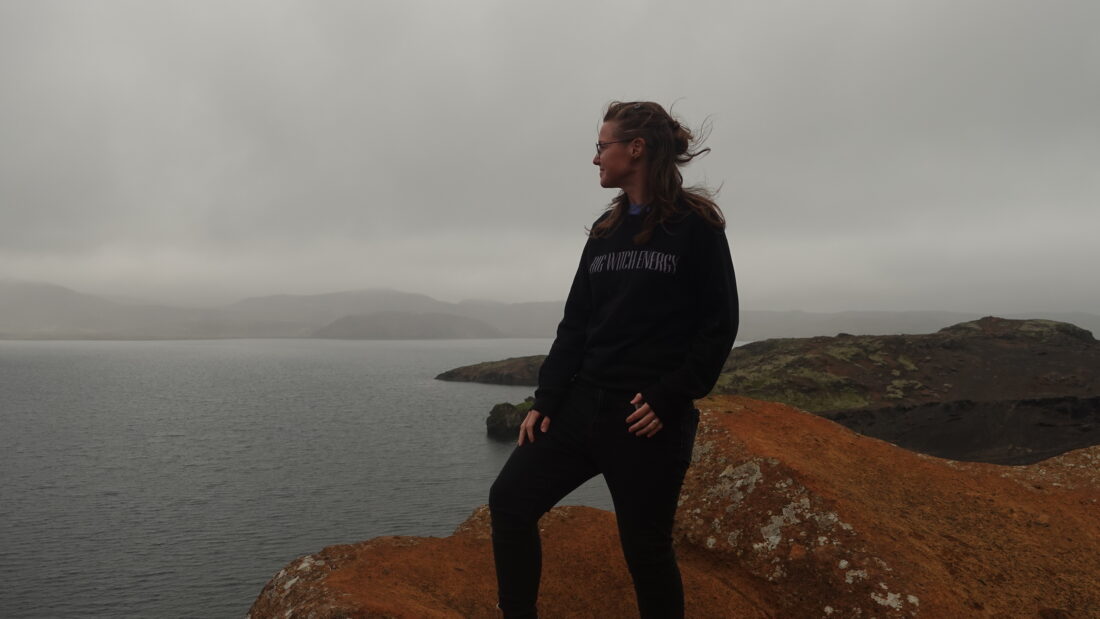
On their new album, Realm, Montreal-based composer and improviser Allison Burik uses guitar, bass clarinet, alto saxophone, and voice to create an imaginary ecosphere inspired by Nordic mythology—otherworldly soundscapes that would not feel out of place in a Game of Thrones episode. From the squalling ostinato and spine-chilling throat-singing that give wings to “Be the Dragon” to the serenading soothsayer sculpting fate in “As the Norns Weave,” the album’s nine compositions offer escapism while revealing the musician’s exploration of their Norwegian roots, spiritualism, and identity.
“What drew me to Nordic myths was a desire to understand my ancestry through a non-Christian lens,” they explain. “My grandma is full Norwegian. I had the chance to speak Norwegian with her recently, and I’ve been diving into ancestry and related stuff. I wanted to go back and source out what humans were like back then . . . especially before Christian contact. The more I studied, the more diversity [I found] in terms of gender representation, but also in the roles that people played in society, which were more diverse.
“For example, the Norns were super-respected figures: three women who determined the fates of everyone. They held so much power in society, and people [thought] of them as objective souls in control of everything, like the [Greek mythological] Sisters of Fate. If you look to ancient history, you learn about the Völvas—women who were considered seers. Folks would have their runes thrown by them and go to them for ideas of what their futures looked like. They held a powerful role in Viking society.”
Burik shaped Realm with producer and engineer Sylvaine Arnaud, who’s worked with artists such as Patrick Watson and Gilles Vigneault, and played all the instruments save for cameos on “Solstice III (The Promise)” and “Fragment 94” by guitarist Magdalena Abrego (Deerlady is her duo with bassist Mali Obomsawin).
Burik says their interest in mythology and stories about women, shapeshifters, and gender-queer creatures connects them to nature. “I believe in a different plane of existence—a different realm—than what modern society focuses on much of the time. I take solace in learning about other ways of being and in other ways of believing.” This also enables Burik to personify these characters by way of a structural component. They cite the concept of “the hero’s journey,” a narrative archetype with a clear beginning, middle, and end.
“You can really skew that in music, as well—it’s all art,” they continue. “There’s something visceral about imagining these creatures or figures and their stories and personalities. I feel, in a way, that I become them. One song I wrote on a [previous] record, ‘House of the North Wind,’ was inspired by an old Norwegian folk tale about a woman who goes on a journey to find her love. She visits each of the four winds. The Southern, Eastern, and Western winds all tell her that she needs to go to the house of the North wind, to be taken to lands east of the sun and west of the moon.
“That blew me away, to think of the winds having personalities. When I was writing that song, I could feel a storm inside me that was guiding me but also something to be feared. I think it’s a chance for me to embody the characters and the stories a bit more, you know?”
The germination of Realm began when Burik assumed an NES Artist Residency in Skagaströnd, a former fish processing plant located in northwest Iceland, in 2022. “I started writing ‘As the Norns Weave’ after meeting the brilliant artists at the residency, some of whom had staged showings of their work. I was just feeling connected and grateful. As I started playing this riff on guitar, I thought about fate, chance, and luck, and was thinking, ‘Wow, it feels like the loom of the Norns and the weaving of time.’”
After adding guitar, voice, and woodwind, however, Burik got stuck in composition limbo until, by chance, they discovered a new and unusual technique to break out of it. “I took a nap,” they say with a laugh. “I entered an almost dreamlike state where I had the piece in my head. When I was on the verge of sleep, I heard the next stages of that piece.
“I remember clearly being in this half-asleep, half-awake state, playing the music in my head, and then suddenly, a pool opened up and cascades of arpeggiated saxophone and multi-layered, reverberating cavernous sounds ensued in the background. I had a sense of the harmony I wanted to include, and how I wanted it to end. I woke up and, within ten minutes, I headed back to the studio to record what I hadn’t finished.”
Burik often comes up with ideas for the ending or the middle of a piece first. Figuring out the transitions is the hardest part, they explain. “But the end has to be viewed with some type of finality. There has to be an arc—all the pieces in Realm have it. If the arc is satisfied, the shape is there. That’s how I know a piece is done.”
Burik often thinks of their music as a landscape or a soundscape. Their experiences during the Iceland residency affected “the pacing and the wild ruggedness of the actual music.” Travelling and being in unfamiliar, non-urban environments provided strong creative inspiration. The sense of freedom conveyed in Burik’s music is expressed via improvisation. “When you get to a sense of release, I feel that something is freed within me. That’s how I know when something is aligning.
“All of my pieces are templates or sketches. Some of those I can stretch to be what they need to be in the moment, to better serve an artistic direction, an audience, or a necessary vibe. I love having that sort of freedom as a foundational tangent to what I do.”
Like Montreal-based avant-garde bass saxophonist Colin Stetson, Burik experiments with extended techniques. Realm pieces “Be a Dragon,” “Seal Folk,” “Heiemo og Nykkjen,” and “Birka 581” (the only track not written by Burik) feature simultaneous vocalizing and sax playing. Burik utilizes Piezo-style contact microphones and a Zeppelin Design Labs DIY kit that allowed them to solder and customize equipment in order to record some of those unearthly sonics. Throughout the process, Burik threw sounds together using Ableton software, layering them in demos, recording the alto sax independently, and then phasing in all the vocals.
“On a couple of tracks, there are moments when I am playing the alto sax or bass clarinet and vocalizing simultaneously, singing through my horn,” Burik explains. “I captured that by rigging a DIY contact mike throat collar, then attached that to a little optic collar and ran that through the mixer. We picked up all the sounds that were happening from my neck. Sylvaine EQed those moments so we weren’t picking up all the scratchy contact mike sounds, but [only] what was as pure as possible from my throat.
“Because I’m mostly playing long notes on bass clarinet, it sounds like a ghost in the background, [but] that’s me singing into the bass clarinet. The song’s growly texture [comes from] the interference of my voice with the reeds.”
Listening to Realm, one might be surprised to learn how far Burik has come in developing these sounds. Originally from Kansas City, Burik barely knew the sax existed when they began playing music. “My first instrument was the violin. I picked it up at six or seven. I was forced to study classical violin, and then I switched to Celtic fiddle and bluegrass. That was a little more satisfying.” Five years later, Burik switched to saxophone. It wasn’t until high school that they first encountered jazz improvisation. “The director of the jazz band played the trumpet and took a solo over a blues. It blew me away, because he was making it up as he was going along, and I didn’t know that was an option. That’s what got me going in that direction.”
Later, Burik took private lessons with local saxophonist Dan Thomas, who encouraged them to compose. “I wrote this song that ended up being a bit of a folk melody, in three-four time, and it was a jazz-head chart, a melody with chord changes,” they recall.
In Boston, Burik earned a bachelor of music in performance from the Berklee College of Music in 2016, and a master of music in contemporary improvisation from the New England Conservatory, where they also took private lessons in film scoring, in 2020. After moving to Montreal, they married alto saxophonist Claire Devlin, a member of Bellbird, a quartet featuring Burik, bassist Eli Davidovici, and drummer Mili Hong. Burik’s other musical collaborations include experimental duo Umbrella Pine (an experimental duo with Abrego), and the sextet led by bassist, songwriter, and composer Mali Obomsawin, from Odanak First Nation.
Earlier this summer, a trio of Obomsawin, Burik, and Abrego released Live Sketches, an EP of two improvised pieces, recorded in concert at the Music Hall at CSU Monterey Bay. The trio created the music for Julian Brave NoiseCat and Emily Kassie’s 2024 Sundance Film Festival prize-winning documentary Sugarcane, which premiered in theatres in August.
“I feel like a musical omnivore,” Burik admits. “I definitely have a free jazz side that’s bubbling at most times. [Playing in] Bellbird or with Mali Obomsawin, I can be more textural, or approach it in a different way. With Bellbird, I’m trying more of the modern jazz approach, as I came into improvisation by learning old-school jazz like Kansas City big bands, Charlie Parker, Sonny Rollins, and Sonny Stitt. It feels really nice to be able to satisfy all those cravings.”
They’ve also tipped their toes into experimental saxophone communities, reaching out to Chicago’s Nick Zoulek, for example, to further explore the art of the contact mike. “He does this really cool close-miking stuff,” they enthuse. “He puts cellophane on his fingers and gets his mikes really close, so when he lifts up his fingers, all the keys with the cellophane crinkle.
“More recently, I’ve been hanging out with [Canadian reed player] Naomi McCarroll-Butler, who makes her own kind of overtones. There’s a good crew of weirdo saxophonists in Montreal, for sure. I’m tapping into the jazz community and just getting my footing in the experimental scene.”
Burik, who takes Realm on tour this fall and will begin working on new solo music this winter, hopes listeners find respite from a troubled world in their recent music. “I wrote Realm to create a safe space for myself and my heart. It’s a place to come, be, and exist outside of the chaos that we all face every day. I hope it can bring magic [into] people’s lives and something outside of the literal every day, as well as a little bit of the cosmos, I guess.“Realm opened up a lot of potential pathways for me to explore, and I’m anxious to travel deeper down those roads.”
NICK KREWEN is a Toronto writer and editor whose byline has appeared in The Toronto Star, The Globe and Mail, The Hamilton Spectator, SOCAN Words & Music, and Grammy.com. He recently contributed to the Chicago Review Press book Prince on Prince, Interviews and Encounters. He also plays a mean tuba.