
In the late summer, pulling into Joshua Van Tassel’s home, which is situated just off a scenic stretch of the highway along Nova Scotia’s South Shore, feels more than a little dreamy. When it’s sunny, the yard is lit up green; white sheets might be hanging off a laundry line blowing in the wind, while off in the distance a trampoline sits coiled tight and ready for a couple of kids to put it to the test. The whole vista is wrapped in woods, and nestled in the trees at their edge is something that looks like a spaceship—or at least a large, strangely shaped shed. This pop of silver is the aptly named Dream Date Studio, which is where the majority of Van Tassel’s creative work gets done.
Originally from West LaHave, Nova Scotia, Van Tassel headed to Antigonish after high school to pursue a two-year diploma in jazz studies at St. Francis Xavier University. There he was exposed to different types of music and different ways of making it; the infamous and now defunct Evolve Festival, notorious for its wild party culture, held its inaugural event there just before Van Tassel’s sophomore year. David Myles, who became a longtime collaborator, was dating someone at St. FX and came through often with his band KungFunkShun, which is how Van Tassel and Myles met. Eventually, Van Tassel left to make a go of it in Toronto, where he studied for two years in Humber Polytechnic’s Bachelor of Music program, became a regular hired gun for local artists like Great Lake Swimmers, Sarah Slean, and Donovan Woods, and established Dream Date Studio.
But in late 2021, Van Tassel and his growing family moved back to Nova Scotia. Their days were numbered at the house they’d been living in, a condo was slated to be built behind the studio space he’d been working in, and his wife had just given birth to their second child. This was all happening in the unpredictable middle of the COVID-19 pandemic. They wanted to be closer to Van Tassel’s family and buy a house.
A few years later, with his studio active in Upper LaHave, Van Tassel has established relationships with a substantial chunk of the East Coast music community and a reputation that extends beyond the region for his work as a producer and player. The move also made him neighbours with the Halifax-based Forward Music Group, the label through which he’s released a number of records, including his 2023 album The Recently Beautiful. One of the conversations for this article took place while he was tracking FMG label head Kyle Cunjak’s stand-up bass parts for an upcoming album by St. John’s, Newfoundland-based folk-pop singer-songwriter Nico Paulo, whose 2023 Polaris long-listed, self-titled album Van Tassel recorded, produced, and played percussion on.
The physical building that the studio is currently located in may be expanded soon, Van Tassel tells me during one of my visits last summer; for now, he’s maximizing its compact space. Drums that are not being used are stuffed into a tiny attic above his main workspace, which features a desk, a modestly sized monitor, and multiple keyboards, pedals, and samplers. Off to the side are two shelves of popular and less well-known music books that investigate questions about sound and creativity from both technical and philosophical perspectives. A 2022 Juno Award for Best Instrumental Album—Myles’ That Tall Distance, which Van Tassel played on, cowrote and coproduced with Myles, and mixed at Dream Date—is displayed on a corner shelf with the same pageantry as the houseplant beneath it. Against one wall is an upright piano. Each time I visit his studio, a drum kit is sitting in the middle of the floor, with a collection of goat hooves (or chajchas) on top of the hi-hat. And among all this is Van Tassel in all his capacities—drummer, composer, producer, instrument builder—searching for the right sound.
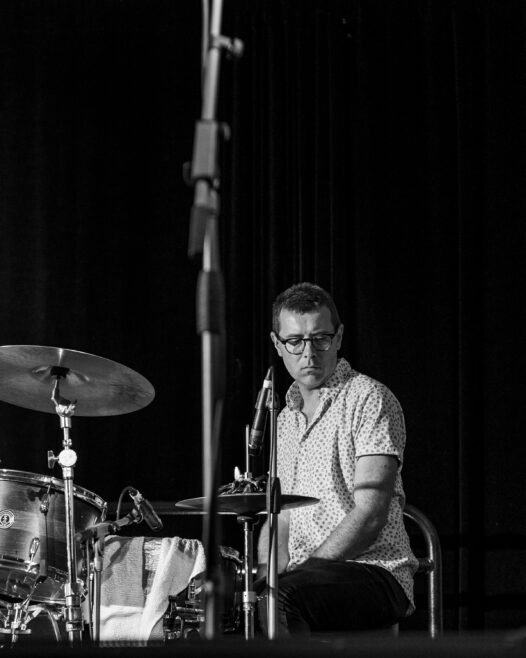
For a drummer, pinpointing the perfect sound has to be about the song, Van Tassel says. “It has to be supportive. As I get older, gain experience, and play with more people, I realize that I’m happiest when [my playing is] almost transparent—when the artist is able to perform to the best of their ability and feels completely grounded without thinking about the drums.” Aside from Myles, Van Tassel has played drums for artists such as folk singer-songwriters Donovan Woods and Rose Cousins, and with Great Lake Swimmers, to name just a few, and through these experiences he has grown accustomed to artists referencing sounds from other people’s songs or recordings to explain what they want to hear.
“They don’t want me to [copy] a beat from a War On Drugs song, it’s that they like the drive and the intensity, the spirit of it,” Van Tassel says. “People can’t always verbalize it—it’s like describing a smell. How do you find words to describe the feeling that you get from music? The closest a lot of people can get is saying, ‘Play that.’ ‘Well, it works in that song, that specific musical beat. But how can it translate into your song?’” Other times, musicians have no idea what they want, which might necessitate play or exploration. That spirit of investigative problem-solving makes its way into his production work. Having those experiences as a drummer—learning to synthesize influences and sounds, staying curious about what direction to go in—has helped Van Tassel develop an effective vocabulary for his work as a producer.
“Being a producer is about relationships,” he says. “It’s about asking someone: ‘What are we actually talking about here? What are we trying to do? Are you happy? What do you want?’”
His recent productions are full, but never sound busy. Listening to the intimate, lush music of Paulo’s self-titled record, or the neo-traditional North Atlantic folk of Villages’ Dark Island—both released in 2023—one clocks a playful, exploratory spirit. “I am scared of having a sonic signature,” Van Tassel says. “I don’t want all the records I produce to sound the same. I don’t want to be heavy-handed, I just want the artist to sound more like themselves than they ever have.
“A producer’s role is to help an artist get as close as they possibly can to the sound that’s in their mind—and then take it further.”
Van Tassel notes that working with Cousins is always a co-production, and that his role, as he sees it, is part translator, part psychologist. As such, it’s easier to get where they’re going if the artist has a clear vision of what they want instead of relying on him to make all the decisions. “‘Let’s figure it out—what if we don’t use any keyboards or synths, just your voice, and we process it through things to create this feeling you’re looking for?’ In Rose’s case, that’s what it was,” he says. “If she had sung just her lead vocal, [I’d say] let’s run it through one of these pedals that reverses it and pitches it down an octave and lowers the sample rate so it’s kind of fuzzed. Now I’m going to do it again, and it’s something completely different, but there’s still a human element in it that I think subconsciously we can connect to. That was the translation.”
Van Tassel’s own catalogue is filled with instrumental records that run the musical gamut. There’s the airy, fantastical psychedelia of Dance Music: Songs for Slow Motion (2014); the cinematic, multimedia collaborations of Crossworlds (2018); and the arrangements on Dance Music Vol. II: More Songs for Slow Motion (2020), which were inspired by the Ondes Martenot, a monophonic electronic instrument introduced in 1928. Van Tassel’s 2023 album The Recently Beautiful conveys a sense of yearning and loss that is further emphasized by its musical sparseness. The album features shorter, more precise pieces than were found in his previous work. “When I listened to [my previous] albums, I could hear myself leaning into effects or colours and [using] density almost as a crutch. With The Recently Beautiful, I was trying to avoid that. It was about precision, and taking everything away until the only things left have to be there.”
To get to that point, he focused on clarity and melody, always asking himself whether an element he wanted to use would serve the composition. “Why a guitar part? Is it there because you have a guitar in your hands? That doesn’t mean you have to play it,” Van Tassel says. “If you’re just playing the same thing this other person’s playing, don’t play it.” When he was mixing New Brunswick-based roots artist Matt Andersen’s upcoming record, The Hammer & the Rose, which he also produced, he noticed that Afie Jurvanen (aka Bahamas) and Christine Bougie—both guitarists, based in Halifax and Toronto, respectively—didn’t start playing until the second verse. “They’re incredible technicians and musicians who can do anything, but they have the maturity and the experience to understand that it’s about Matt’s voice and the song, and to just wait.”
In early 2024, Van Tassel formed Dream Date Designs with Matthew Fudge—a product designer of software instruments, music technology, and media creation applications—to design and build products and interactive experiences for audio creatives. Their first release, Dreamer, a loop-based sample player, was released in May 2024 and marks Van Tassel’s first foray into digital instrument building.
Van Tassel creates and curates Dreamer’s loop libraries, which are easily added to the program and available at the Dream Date Designs website. Their next project, Glasis, is an app that makes available the sounds of a 1950s glass xylophone they found in an antique shop. This searching and scouring and desire to have digital control over analogue sounds are yet another way that Van Tassel is broadening his sonic vocabulary in order to find the right sound for the right moment.
Van Tassel describes a four-channel drum machine they’re working on. “You’ve got four different voices, and each voice has its own sixteen-step sequencer,” he says. “You are able to make each of those voices self-generate a random sequence every time a bar goes by. And you can input the sequence manually, as well. So for each voice, you can change the number of steps. You can easily set these circumstances up to have four different sounds, all triggering in a way that seems random but is actually completely connected to your master clock.
“It’s so much fun to be able to have four different notes of a scale and to let this instrument create melodies that are randomly panning and all happening at slightly different cycles,” he adds. “And when they line up, it’s this beautiful cohesion moment. It’s a little complicated to explain, but it’s the most fun I’ve had with a drum machine.”
His excitement in talking about Dream Date’s forthcoming “drum machine” reveals what’s currently occupying Van Tassel’s mind. He’s returning to rhythm—the musical element he has the most experience with—and seeking new textures to express. He wants to home in on rhythm in a heavy way, to pay as much attention to the feel and the sounds of the percussion in his compositions as the melodies. “I want to push myself to make it sonically adventurous,” he says, “but focus on being melodic and beautiful as well.
“At this point, it’s not enough for me to just have a cool beat,” he continues. “It needs to be more than that, to serve some emotional purpose. How can I make a rhythm feel as important and justified as a melody? I’m excited now to figure that out, so it’s not just there to move something along, it’s got an emotional quality to it, too. Rhythm is emotion.”
MATT HORSEMAN was born in Winnipeg, Treaty One Territory, and is based in Mi’kma’ki (Nova Scotia). His photography and writing have been published in National Geographic, the Globe and Mail, Canadian Geographic, VICE, No Depression, the A.V. Club, FADER, and other publications. His article “Jeremy Dutcher’s Gift for His People” (EDIT magazine) won the silver medal in the Short Feature Writing category of the 2019 National Magazine Awards. In 2020, he published his first book, Two Rivers (Axis Mundi Press). In 2022, he was nominated for the National Gallery of Canada’s New Generation Photography Award.