
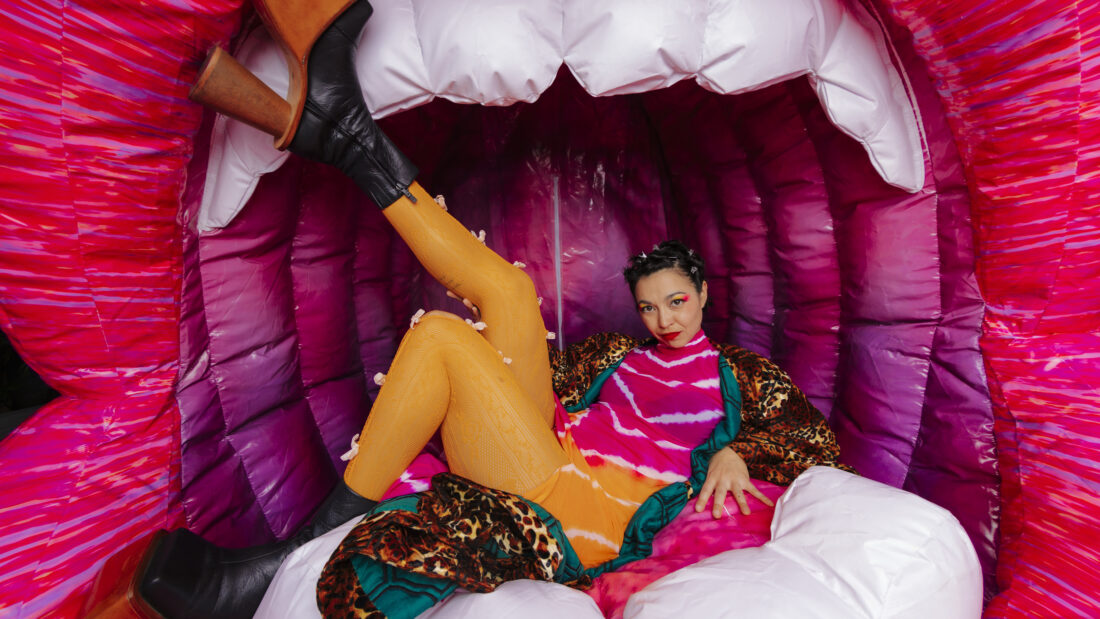
Maylee Todd does not shy away from spectacle. During a video conversation last September, the singer-songwriter, producer, and multimedia artist tells me about the setup for an upcoming show in Los Angeles, where she is currently based. “I have this big inflatable mouth,” she says, laughing. “It’s seven feet by seven feet and, as it turns out, quite heavy—I think it’s going to have to go into its own luggage.”
Todd has long gravitated toward playful, large-scale world-building in her music. For a string of Toronto shows, she hung up a giant fabric vulva installation that audiences walked through to enter a projection-filled concert space she dubbed a “virtual womb.” Later, during the COVID-19 lockdowns, she taught herself 3-D modelling and body tracking to create Maloo, a virtual avatar of herself that she performed alongside via projections and in virtual reality. Todd’s recorded output has also moved in wide-ranging directions: Her earliest releases drew heavily from soul and funk and featured harp and warm vocals, while her more recent work experiments with a softer, synth-forward sound and delves deeper into new technologies. She has taken her all-embracing creative work on tour across North America, parlayed it into interdisciplinary performing and curating opportunities at NPR and Lincoln Center for the Performing Arts, and garnered accolades from entities like Women in Music Canada, SOCAN, the Canadian Screen Awards, and the U.K.’s AIM Awards.
But for all the unapologetic genre-jumping in her music, Todd maintains a singular presence. Hers is not so much a signature sound as it is a signature spirit: a throughline of playfulness and an experimental ethos that delights in the possibilities of the strange.
“Basically, the approach is: How much frickin’ fun can I have, moving forward?” she says. “Also, what are some of the weirdest sounds that I could use—the oddest sounds I can make musical?”
Todd grew up in the small community of Oak Ridges, north of Toronto, with two older sisters who played in bands and dabbled in fashion. Her mother was an avid quilter, and her father—a locksmith by trade—moonlighted as an Elvis impersonator. Her grandfather, also a locksmith, was known for his zealous interest in UFOs, and for his performances as an escape artist under the alias The Great Toddini.
“At a young age, I had this video camera I would not part with,” she says. “I was really into comedy, so I would remake films like Scrooged, the Bill Murray movie, with Barbies. All my school projects were in video form, but it wasn’t ever about the project, it was about the commercials I injected into the project that no one asked for. That’s really where it started: rascalling around with video.”
Todd moved to Toronto in her early twenties and dove into as much music and performance as she could. She studied comedy at Humber College, and picked up the Paraguayan harp, an instrument that would eventually become a characteristic part of her sound world. She joined Henri Fabergé and the Adorables, a self-described satirical “sprawling indie rock collective” that formed in the mid-2000s, a time when the city was flush with a flurry of DIY music-making. “That was such a freeing time for me,” Todd says. “It was the indie-rock days—bands that [had] like a hundred people, everyone also doing their own projects, and everyone supporting each other.”
Her first three albums—Choose Your Own Adventure (2010), Escapology (2013), and Acts of Love (2017), all released on Toronto’s Do Right! Music—along with the solo musical and multimedia projects that followed, serve as a statement of her refusal to be locked into a particular genre or style. Riffing on her day job as a personal trainer, Todd developed “Sweatshop Hop,” an interactive aerobics series that was equal parts comedy and performance; it gained a cult following and eventually aired as segments on the cable channel MuchMoreMusic. The idea informed her elaborate, comic-book-inspired video for “Aerobics in Space” (a playful single from Choose Your Own Adventure), which featured Todd in the role of cosmic superhero. Other tracks from the same album further broadened the scope of Todd’s songwriting: “Summer Sounds” opens with soft, breezy vocals over what feels like a standard bossa nova groove, but by the two-minute mark it reveals itself to be a distinct diptych, with the initial beat unravelling into a more densely orchestrated, funk-influenced second half.
Casting a similarly wide net, Todd’s self-produced Acts of Love, the final release of her Toronto years, coalesces around an intimate, soulful sound; she describes it as a “bedroom record,” both in terms of production and aesthetic. Across seventeen tracks, it treads a meandering line between stripped-down R&B and dancier, upbeat synthpop. Earlier versions of some of the songs first appeared on Virtual Womb, a multimedia concert-installation she toured for a few years in the mid-2010s. Audiences arrived at the performance space by walking through a large-scale, hanging textile sculpture of a vulva, created by Toronto artist Roxanne Ignatius. Upon entering a darkened space filled by live visuals projected on the ceiling, they were encouraged to lie down and observe as Todd performed live arrangements of her music—a psychedelic, ego-less space that Todd describes as “just gestation.”
Film producer and fashion designer Caroline Mangosing met Todd in 2007, while running the Kapisanan Philippine Centre for Arts & Culture out of a basement space in Toronto’s Kensington Market. “We had a sandwich board outside, and Maylee just walked in and was like, ‘Hi! I’m Filipino,’” Mangosing says. “She ended up performing at [our] first Filipino arts festival, when we started as a little barbecue in [a] little park in Kensington. She just came out of nowhere with this one-person band setup. She had a little drum kit at her foot, and she had a harmonica, and she had all of these things attached to her, and then she was singing…I was like, ‘What an alien,’” she laughs.
“She was just so truly Maylee—like nobody else,” she adds. “I thought, ‘I want to be around people like that.’”
Mangosing reconnected with Todd in 2022, when she was in L.A. establishing a showroom for her Filipiniana and Filipino-inspired fashion line VINTA Gallery, and they quickly became friends and like-minded collaborators. Last spring, for the closing show of “Women and Nonbinary Artists in Tech”—a five-part monthly series that Todd curated at New York’s Lincoln Center from January to May 2024, featuring women and non-binary artists working at the intersection of music and experimental technologies—Todd performed in a custom outfit designed by Mangosing: thick quilted orange pants and an iridescent magenta shirt with voluminous structured shoulders, a contemporary take on the iconic butterfly-sleeved terno dress of twentieth-century Filipiniana fashion. Todd wore another Mangosing design in L.A. last September, when she performed alongside her big inflatable mouth installation at the launch of Mangosing’s latest brand.
“There’s a lot of storytelling in Maylee’s music, and it’s never what you expect,” Mangosing says. “She does dance music, she does experimental performance, and she screams, and it’s never just about the music, it’s about the entire world.
“She was always the alien. My partner and I would always say that what she does is not of this world, and we just want to be on her spaceship for the ride.”
Shortly after signing to L.A.’s Stones Throw Records in 2020, Todd settled in L.A. herself. She recalls feeling that the city immediately welcomed her and embraced all of the weirdest parts of her music—including a new, more introspective sound inspired by her fascination with science fiction and imagined utopias. During the COVID-19 pandemic, she found a creative home in virtual reality, drawn to VR spaces like the early versions of the online platform Decentraland and Meta’s beta project Horizon Venues, which offered spatialized audio experiences that allowed users to speak with each other in a way that paralleled real-life socializing while they isolated at home. “You can take on new identities in those spaces,” Todd explains. “Depending on what your avatar looks like and what your voice sounds like, you get different reactions from folks, but you can switch your identity and have different experiences. It was a fascinating time that inspired work that was very solo and tech-forward—a lot of ‘into your head, out of your body’ kind of stuff.”
Those ideas eventually worked their way into Maloo, which was released in 2022 on Stones Throw. The album follows the perspective of Todd’s digital avatar Maloo—a Maylee lookalike, but with opaline skin and webbed ears—through an imagined virtual world that Todd dubbed “The Age of Energy.” For many of the concerts featuring music from the album, Todd performed alongside a live projection of Maloo—a kind of uncanny, singing mirror-self. In 2022, at one of the closing parties for the Decentraland Music Festival, Todd embraced the music’s VR roots and Maloo performed her set to an entirely virtual audience.
Compared to Todd’s previous work, Maloo is sparse, honing in on layered synth loops and airier, gossamer vocals. The album is a collection of “science fiction lullabies,” she says, and it’s audible in the music, with songs that drift along pensively, more silky treble than bass. On Maloo, Todd eschews harp in favour of giving centre stage to her Yamaha Tenori-on, a now-discontinued electronic instrument designed by Japanese media artist Toshio Iwai and released in 2007. A flat, square-shaped synthesizer with a sixteen-by-sixteen grid of LED switches used to activate and deactivate sounds, the Tenori-on was originally developed as a step sequencer software for a short-lived Japanese handheld game console called the WonderSwan. Though it offers MIDI and external sample capabilities, that video-game lineage is still distinctly audible in the Tenori-on’s design and library of internal sounds—a retrofuturistic vocabulary used by Todd throughout the album, and mirrored in the mother-of-pearl-toned renderings featured in the album art and videos. But despite their futuristic underpinnings, the songs on Maloo feel surprisingly vulnerable and personal. Todd tells me that while the technologies she worked with function as sites of joy and whimsy, the songs themselves are about identity and grief.
The album’s vulnerability is what first attracted fellow Los Angeles-based Canadian musician Mocky to Todd’s musical world. “Maylee and I had played gigs together,” Mocky tells me over a phone call. “And then I finally checked out Maloo, and that was it.
“Sometimes with music that starts out as an electronic project, the song feels like an afterthought,” he continues. “But oftentimes, the best songs are the ones that can live on their own—away from the audio, away from a computer, away from even a piano. Maloo really nailed that. It connects right on a human level. It touches on some kind of truth.” He and Todd now collaborate regularly, at times meeting weekly to write music together and serve as one another’s sounding boards. Their current individual work-in-progress recording projects are influenced by those sessions: Todd’s vocals are sometimes featured on Mocky’s music, and co-written song segments appear in both of their projects.
Mocky says that kind of collaboration reflects the broader creative spirit of Highland Park, the neighbourhood where they both live. It’s full of small venues where rotating casts of musicians support each other’s music, and is the permanent base of the Stones Throw and its vinyl listening bar, Gold Line, which opened in 2018 and where Todd now DJs monthly. She is one of the community’s true supports, Mocky says. “She puts out loads of energy in all directions. You want to have a collaborator like that—someone who will just jump right in and catch you if you’re falling, or take a risk with you.
“She’s her own producer. She’s a great songwriter. And she’s fearless,” Mocky adds after a pause. “She’ll just jump in the deep end on anything, but create a really safe place to share your emotions. I think the more that she continues to put that in her music, the more people will start to get to know the Maylee that I know.”
After the release of Maloo, Todd bounced between the early stages of a number of projects. Between her move to the U.S. and a multi-year writer’s block, Todd became involved in curating, coding, comedy, and performance work. She nurtured an ongoing collaboration with L.A. comedian Eric André, and—with Maloo—hosted “The Virtual Womb Network,” a monthly show on the web radio platform NTS. She also began experimenting with an EEG (electroencephalogram) headband, which monitors electrical activity produced in the brain, mapping her brainwaves to audio to create ambient music.
This past year has been a turning point for that work. After an October 2022 performance of Maloo at Lincoln Center, Todd was invited to curate the series “Women and Nonbinary Artists in Tech” from January to May 2024, for which she hosted artists like femme dancehall musician Alanna Stuart, interdisciplinary artist and filmmaker A.S.M. Kobayashi, and California multi-instrumentalist and producer Salami Rose Joe Louis. In June 2024, she opened for Canadian avant-pop artist Allie X on her North American tour. When we spoke last fall, she had begun work on a new album, through which she intends to dig into new parts of her inner psyche and practice.
While most of her previous music has been concept-driven, now Todd is focusing on doing as much intuitive, freeform writing as possible, without trying to use any conceptual theme to justify it. “With this process, I’m the most sober I’ve ever been,” she says. “I’m sitting with a lot of stuff, a lot of solitude, and a lot of processing. There’s a lot of discomfort there.”
For her upcoming record, she’s working with harder sounds—industrial drum samples and heavier bass lines—and producing songs that feature doubled-up vocals, a carryover from her performances with Maloo. Yet at the same time she describes her newest music as almost a full-circle return to where she first started as an artist: shedding some of the focus on technology in order to recover the cathartic feeling of her earliest days as a vocalist.
“Maloo was very introspective,” Todd says. “The whole Virtual Womb show was about lying down and doing psychedelics and getting into ten years of trauma in one night. But now I just really want to be present. Not everything has to be worked through. Sometimes, it’s just about screaming and dancing and letting out energy. That’s sort of where I am at this stage in my life.”
She reassures me that Maylee the technologist isn’t going anywhere. There’s her continuing work with the hacked EEG headset and upcoming mentorship initiatives, such as teaching Ableton Live software to beginners. Her focus now, though, is to define a creative practice not by the issues it confronts, but rather by the feeling it gives her.
“Looking back at these shows, there was a lot of me just kind of sitting and singing behind a wall of tech, making sure that everything was running smoothly,” she reflects. “But before I was doing any of this stuff, I was a performer. I was running around with a mic like a chicken with her head cut off. And that was really, really fun to do.”
The projections, the outfits, and the technological freewheeling will continue, she says—but never at the expense of joy. “Making art is already difficult: difficult financially, and difficult to sustain. So if this is going to be a challenge, you have to enjoy it.
“Right now, I’m asking myself, ‘What does enjoyment look like to you this time?’ And for me, I think it’s going to be running around and screaming into a microphone, and having a celebration of some kind. Having a lot of fun.”
SARA CONSTANT is a flutist and writer specializing in new music. She holds degrees from the University of Toronto and University of Amsterdam, and currently works as the digital media editor at The WholeNote magazine and as an organizer of the Toronto Creative Music Lab. She is based in Toronto.