
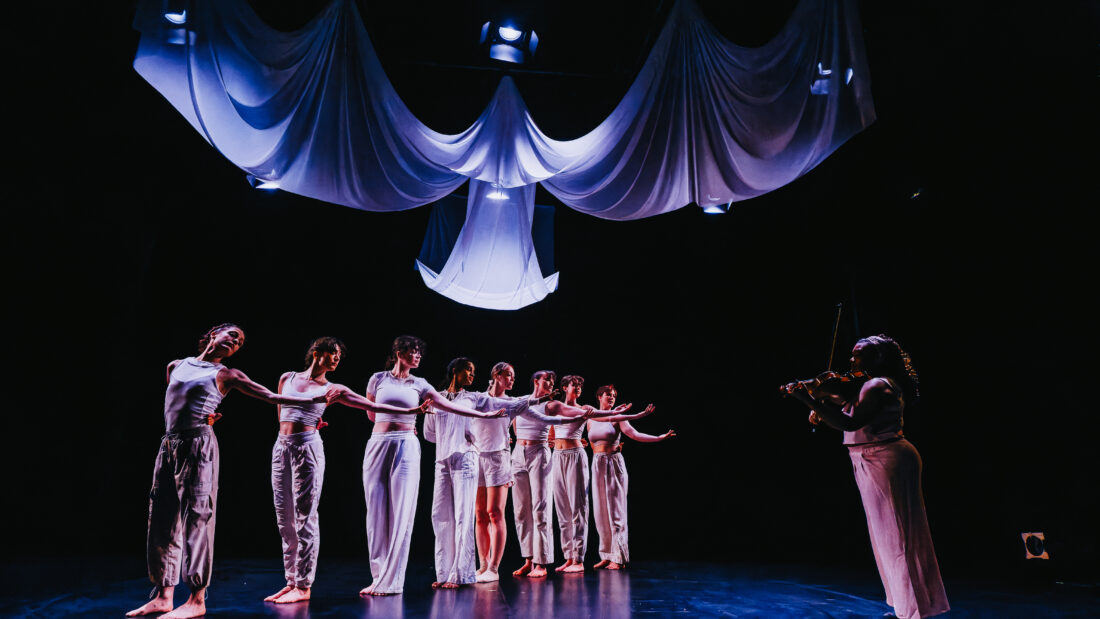
For violist and composer Kathryn Patricia Cobbler, making music is about being in conversation with herself, her collaborators, her instrument, and the classical and new works she performs. While mindful of the modern viola’s historical origins and its role as an instrument in Baroque music, she uses electronic technologies and extended techniques to explore and expand the viola’s role as a solo instrument in twenty-first-century contexts, and seeks out untraditional performance venues in order to close the chasm between the stage and the audience.
A second-generation Canadian whose parents are from the Caribbean, Cobbler, who grew up in Windsor, Ontario, was encouraged to play music from a young age. Early in her music education she realized the piano wasn’t speaking to her. She felt drawn to the violin’s sound, and through the vibrant local musical community she became enamoured with chamber music. While working toward her bachelor of music honours degree at Western University in London, Ontario, Cobbler attended a concert by the renowned Takács Quartet and was captivated by a solo performed by American violist Geraldine Walther (a member of the quartet from 2005 to 2020). During a conversation after the show, Walther encouraged her to pursue the viola. A year later, she decided to follow that path and studied with Toronto-born violist Virginia Barron, a noted chamber and orchestra musician and educator (now retired).
After Cobbler received her master of music degree from the University of Ottawa, the loop pedal—an electronic device that allows a performer to create and play back recordings of a musical performance in real time—became an important element of her creative practice. She had been introduced to the technology by Ottawa violinist Mika Posen, who uses it in her experimental solo music project Merganzer. “I just remember my hand shaking, which sounds a bit funny,” Cobbler says of her first loop pedal encounter. “It was one of those things where I just didn’t know how much it would change my life and my journey.” New York violist and composer Jessica Meyer, who uses a loop pedal, was another key influence who coached Cobbler in her early days of experimenting with looping. Cobbler gradually began treating the loop pedal as a separate instrument that interacts with her viola.
“The loop pedal [gave me] permission to call myself a composer,” Cobbler says. “Growing up, I used to hear music in my head all the time, and I just thought that was normal. By allowing me to hear the music in real time, the looper gave voice to the layers I was already hearing and let them come out.”
In March 2020, Cobbler released her four-part suite Selah on Bandcamp—her first released recording. Another pivotal moment in her composer journey came when she entered her piece A Home Called Wander in Castle of Our Skins’ Black Composer Miniature Challenge. Founded by violist Ashleigh Gordon and pianist and composer Anthony R. Green, Castle of Our Skins is a Boston-based arts institute that produces concert and educational series dedicated to celebrating Black artistry through music. In May 2020, Gordon performed the world premiere of Cobbler’s piece on the organization’s YouTube channel, and the score was published in Black Composer Miniature Challenge Anthology Vol. 1 – Viola and Piano, making it the composer’s first published sheet music.
Cobbler’s compositional style is influenced by both her improvisation and her visual artist practices; these two pursuits unite in her workshop concert Sound and Living Colour, one of several educational activities she’s involved in. “I explore how the paintbrush is similar to my viola bow,” she explains. “I start teaching different painting techniques and different brushstrokes, but then [I show how I] translate that to my instrument—this idea of painting with sound.” The concept of sound as a palette informs her compositional style, particularly when it comes to creating graphic scores. When she starts working on a new piece, a sketchbook sits beside her viola, loop pedal, recorder, and video equipment.
This integration of the visual and sound practices has added an extra dimension to her academic studies. Cobbler is in the second year of her PhD in Critical Studies in Improvisation at the University of Guelph. One of her favourite aspects of the program is how both faculty and students pursue their artistic practice alongside their academic study. Being a reflective researcher who also holds space for her roles as composer, musician, and improviser is not something she takes lightly.
“What does it look like for these [roles] to meet on an equal level?” Cobbler asks. “What role does improvisation play in that?”
One of the ways she has been exploring the intimate conversation between composer and performer is through various collaborative projects with dancers. The interactions between her playing and the dancer’s movements give her a three-dimensional perception of sound. “One practice I like in improvisation and composing is this idea of mirroring,” she says. “[It’s] what [happens when I] take that movement, join that feedback loop, and alter my sound to say, ‘They heard me, and they’re responding.’”
During the pandemic, Cobbler began working with her now-frequent collaborative partner Elizabeth Emond-Stevenson, a Franco-Ontarian dance artist who works under the moniker Take Up Space. In Modes of Togetherness, a piece conceived by Emond-Stevenson in 2023, Cobbler served as both composer and performer, conversing with dancer Rosalie Paquette through physical movement, and allowing her to become part of the piece. “This idea of connection had become more loaded than it was before the pandemic,” Cobbler muses. “Exploring connection was different because of our past experiences, and in some ways it felt like there was agitation. Ultimately, the culmination of that piece is a relearning of how to connect, this idea of rediscovering and reworking connection through music and movement.”
She and Emond-Stevenson formed the duo Re:Imagine, a live dance-music collaboration that reimagines the solo works of Johann Sebastian Bach in performances that are intended to “reanimate still and silent public spaces” while exploring both classical and improvised forms. In short, they’re intended to spark conversation and connection, bridging the past with the present.
“We are responding to each other in real time,” Cobbler explains. “The thing I love about those concerts is that we’re able to have multiple levels of interpretation. It’s not just sound, it’s also movement, and the intersection of those together.”
This year, she and Emond-Stevenson plan to bring audiences the second part of Modes of Togetherness. “We need connection more than ever,” she says. “I’m interested to see how that word—how we interpret it and how we experience it—evolves through both movement and music.”
Cobbler also plans to return to the studio with her viola and loop pedal. And she will perform her solo work Unyielding Roots, in which she uses djembe rhythms (patterns heard in West African hand-drum playing) to explore her lineage and the role of Afro hair and skin as memory-keepers that hold the memories of ancestors while also being connected to the identity of beauty.
In June 2025, Re:Imagine will perform a new piece at the Diefenbunker: Canada’s Cold War Museum in Ottawa. Cobbler is looking forward to accessing the museum’s archives to see the notes that were left by the architects and engineers at different stages of the museum’s development. She hopes that their research will allow Re:Imagine to explore the concept of protection from several perspectives in order to translate it into a musical piece. “From a wider lens, what does that look like for the people they weren’t [considering], who weren’t in the room? And what does it mean today [when we talk] about safety, protection, and people feeling like they’re being taken care of?” Cobbler says. “We will be designing a performance piece using the Critical Path Method as inspiration for our creative process. The work will be presented with a video display of the concert, along with content from the making of the piece and examples of my graphic scores, at the museum for a few weeks after the concert.”
It is clear, as we wrap up our conversation, that Cobbler is just getting started and will continue through her viola practice, her compositional work, her improvisation, her collaborations, and her desire to provide connection.
“We as composers can put something out in the world, let it live, and say, ‘Yes, this is what I’m saying right now, and I invite people into this conversation,’” she says. “I hope that [my] conversation will continue to have meaning and relevance long after I’m gone.”
ABIOLA REGAN is a freelance writer and poet. Her articles have appeared in publications such as rabble.ca, Herizons, CBC Life, Salon Magazine, and The Capilano Review. Follow her on Instagram @arwriting.