
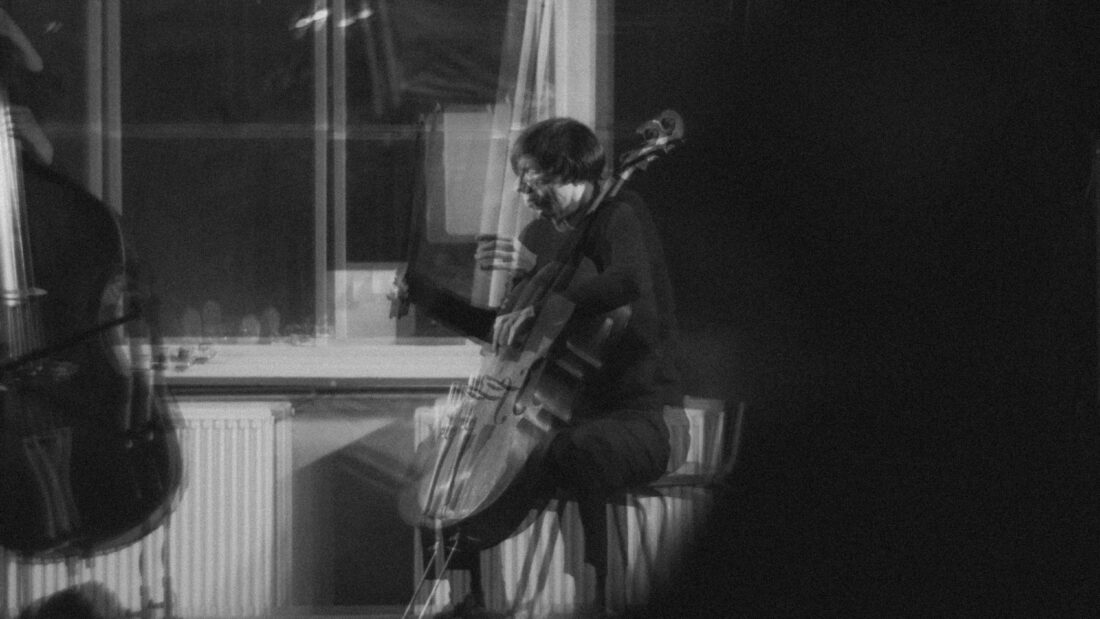
Artist and cellist Rémy Bélanger de Beauport’s roots run deep in Quebec City, where he grew up and now stands tall as a lightning rod and activator for the improvised music scene. His influence and contributions permeate the music scene through the multiple projects he wrangles. He is one of the commissioners of the Musique pas d’air (tuneless music) series, a founder and organizer of EMIQ (Ensemble de musique improvisée de Québec/Improvised Music Ensemble of Quebec) and GICLE (Groupe d’improvisation et de création lunaire et expérimentale/the lunar and experimental improvisation and creation group). He regularly plays in Montreal, Rimouski, and other improvisation spots in the province. Our paths crossed in Montreal in 2019 when he played in an Ensemble SuperMusique (ESM) concert that included my composition Manhattan Bridge. In November 2024, I had the good fortune of catching his duo with double bassist Joëlle Léandre in a concert presented by Montreal collective No Hay Banda. More recently, I’ve been enjoying his #everydayfrenchtoast project (viewable in his Instagram account’s highlights), a long-running “performance,” as he calls it, where he documents making French toast for breakfast and includes visitor contributions. During his swing through Montreal in December 2024 to play with ESM, he sat down to discuss his music and his ideas about art and community.
In 2003, Bélanger de Beauport moved from Quebec City to Montreal, where he studied music composition and theory at McGill University, as well as mathematics at Université du Québec à Montréal. In 2006, he attended a workshop and concert by American guitarist Fred Frith that changed his life. He was fascinated by the mystic quality and hyperactivity of ideas in free improvisation, and he dove into it. He had recently started playing the cello, and was encouraged by mentors such as clarinetist, improviser, and composer Lori Freedman. The cello became the vehicle with which he would explore experimental soundworlds, and the first album in this journey was Plat. Released in 2007 on Ambiances Magnetiques, Plat features music from the ensemble Fenaison—Bélanger de Beauport (cello), Charity Chan (piano), and Kris Covlin (sax)—with Pablo LeCavalier-Ruiz (bass recorder). He had added “de Beauport” to Bélanger, a common surname in Quebec, having just read Marcel Proust’s seven-volume novel À la recherche du temps perdu (In Search of Lost Time). The book has remained a touchstone for him, due to the author’s rapturous descriptions of the quotidian side of French high society. On the label’s website, Frith describes the music on Plat as “passionate, mysterious, and full of contradictions—careful and abandoned, melodic and noisy, peaceful and edgy, logical and surprising—music that doesn’t make sense.”
From 2011 to 2015, Bélanger de Beauport lived in Rimouski, where he was a catalyst of the city’s experimental music scene. He first met Joëlle Léandre (Musicworks 105) in 2013, during a five-day workshop she gave to members of the GGRIL (Grand Groupe Régional d’Improvisation Libérée), the city’s well-known large improvisation ensemble. Léandre—a veritable icon of double bass, free improvisation, and contemporary composition—clicked with the cellist, who was fascinated by her straightforward, critical style of feedback. He followed her to Montreal to take the same workshop again.
In 2016, an extended “immersion” in Berlin’s experimental and improvised music scene offered Bélanger de Beauport opportunities to attend daily performances and make numerous artistic connections. These experiences led to his second Ambiances Magnétiques release, the solo recording D’éclisses. He returned to Quebec City like a warm breeze, and the improvised music scene flourished. Since his arrival, Musique pas d’air has grown from two to three concerts a year to ten or more. This year, the grassroots organization is applying for funding for the first time, despite the fact that the existing funding models don’t align with projects and initiatives that need to stay flexible. He laments that improvised music, paradoxically, requires the performers to plan everything out when seeking support from formal sources. This doesn’t hold him back, however, because he believes that music is an art of coming together. “There wasn’t an improvised music curator in Quebec City before, but now people are getting to know each other, discovering each other—it’s raised a community,” he says.
Likewise, the EMIQ sprang from the community Bélanger de Beauport brought together when he offered an improvised music class at L’Ampli de Québec, a centre for training, support, creation, and dissemination that’s dedicated to the city’s up-and-coming songwriters, composers, and performers. He began assembling a large ensemble similar to the improvising orchestras he knew from other cities—Berlin BERIO, GGRIL, Ratchet Orchestra, ESM, Vancouver’s NOW Orchestra, et al. Since its creation in 2018, EMIQ has grown to a roster of 125 musicians interested in playing improvised music and, at present, the ensemble plays roughly one concert a month, often with a special guest from another discipline. There are no rehearsals. Interested players come to the show, where Bélanger de Beauport explains the mostly simple concepts and pieces just before performing in front of an audience. Many of the ideas for improvisations come from Bélanger de Beauport, and the ensemble also plays pieces by others. A 2018 concert for International Women’s Day featured pieces by Joane Hétu, Danielle Palardy-Roger, and Allison Cameron, as well as a collaboration with performance artist Mai Bach-Ngoc Nguyen. This year, EMIQ presents monthly concerts in collaboration with the Jacques-Cartier Residential and Community Centre, which works with young people aged sixteen to thirty-five. Bélanger de Beauport hopes the workshops and events will involve these young people and, in some way, help them cope with mental health challenges, precarity, and homelessness. Other EMIQ collaborators include the Baroque orchestra Les Violons du Roy and the Centre for Deep Listening. The Quebec launch of the Centre for Deep Listening’s new publication, 365 Scores for Deep Listening, was hosted by the ensemble, which played pieces by Bélanger de Beauport and Musique pas d’air organizer Leo Azaria included in the book.
The members of GICLE first connected in an improvisation workshop Bélanger de Beauport conducted at the Quebec City Conservatory. To encourage non-hierarchical and horizontal relationships, he suggested they form an independent research group and invite others to join. Meetups are held every full and new moon and do not include an audience. They are mostly attended by emerging musicians, as well as musicians passing through town, and local poetry, spoken word, object theatre, and queer artists. This kind of artistic happening was not available in Quebec City when he was coming up as a queer man interested in creating experimental music.
The prodigious number of projects Bélanger de Beauport has initiated may be viewed as all the more remarkable because he has continued to be actively involved in the scene despite experiencing a harrowing attack that made international headlines and necessitated over two years of rehabilitation. He is one of the surviving victims of a sword-wielding assailant who stabbed seven people, killing two of them, in Quebec City on October 31, 2020. He received several blows, suffered fractures on his head and shoulder blades, and had to have an inch of his thumb and the index finger of his right hand severed.
Bélanger de Beauport refuses to be defined by what happened that day. When I asked to interview him, he requested that our conversation and the article not focus on the attack or the ensuing trial; abundant information is available online. He has expressed his sentiments about the incident in music and words. Less than three weeks after the attack, he released a video on YouTube in which he shared his memories. He described and showed his injuries and said he had forgiven the attacker, whom he considered someone with mental health issues left untreated by an overwhelmed healthcare system. He spent three weeks in the ICU and four months in a rehabilitation centre. For more than a year, he was unable to play cello and instead improvised on the theremin.
Léandre is also familiar with the aftereffects of a traumatic injury. In 1975, she was in a car accident that left her in a coma with severe burns. She offered support to Bélanger de Beauport, and during that conversation he decided that, should he regain the ability to use a bow, they would make music and perform together. The goal motived his recovery. In 2021, he was able to play again, and he started working on lining up concerts and putting together the resources for a tour which took place three years later.
On November 11, 2024, I attended the last concert of their tour at the Sala Rossa in Montreal. I sat in the front row, with nothing in the space between me and the duo. As they began to play, I was overcome with the feeling that the large instruments seemed small in the hands of these players, who moved their hands, arms, and whole bodies nimbly. The second improvisation made me think of massive deciduous trees: incredibly solid, yet with delicate leaves quivering in the breeze. Later in the concert, Léandre used her voice, mumbling, muttering slowly over the course of an improvisation, becoming more coherent and intelligible as she landed on the words “la paix,” and suddenly bringing the listeners and the musicmaking into a political statement, a prayer, a reality. This was followed by an improvisation where I noticed Bélanger de Beauport’s black thumb (a prosthesis) and the particularities of both instruments when played using mainly thumbs. It looked and sounded playful, an ecstatic reclamation of loss and a celebration of what is still possible. Bélanger de Beauport played a solo composed almost exclusively of airy sounds, an exploration of liminal spaces and textures. The two ended the set in a rollicking, light-hearted chase and tumble toward some soft horizon. I was left feeling touched by the depth and specificity of their explorations and connections, underpinned by pathos and yet never indulgent. I was impressed by their range of movement as they danced with their instruments and each other. Later I read that Léandre believes duets are art. “You can hear and listen very well to your conversation,” she told Cadence magazine. “When you improvise, there is no hierarchy. You just listen deeply, in a way you become the other one. The duo is fantastic for this.”
Léandre describes her recovery from the 1975 accident as “a wake-up call about the urgency and need to be deeply conscious” to be herself. She left France—where she had built a reputation as a performer of complex contemporary music with groups such as l’Itinéraire, 2E2M, and Ensemble Intercontemporain—to spend a year at the Center for Creative and Performing Arts in Buffalo. John Cage, Morton Feldman, and Earle Brown, who were based there, became profound influences, and the New York Downtown scene, with its free jazz and wealth of dance and performance arts, changed her artistic focus. Similarly, after his recovery, Bélanger de Beauport applied for and received the Quebec Council for Arts and Letters’ Studio in New York City residency, which covers a six-month stay and offers a stipend. He had intensely studied and admired the work of the Fluxus artists, especially that of Charlotte Moorman, the New York-based American cellist and performance artist, but he had never visited the city. The residency was a rare opportunity to focus solely on creative activity, which for him meant going to see a show every day. It wasn’t long before he became part of the intentional improvised music community, collaborating with artists such as trumpet and electronics performer Kwami Winfield and trombonist and DIY concert organizer Selendis Sebastian Alexander Johnson.
“In Quebec City, there’s very little improvised music, and I’m often involved in one way or another in the organization of events,” Bélanger de Beauport says. “[In New York] there can be as many as ten or twelve improvised music concerts a day. In fact, there are more interesting concerts in a single day that I’d like to attend in New York than there are in a year in Quebec City.” He kept a daily blog where he detailed the shows, meetings, and sessions, interspersed with his musings. This blog allows him to retrace certain collaborations to the moments of connection and acts as a repertory of people he’s heard and interacted with.
As we chat, I notice Proust’s novel on the table. The repetition of everyday life rituals have led Bélanger de Beauport to a number of performance projects where the mundane becomes transcendental. During the forty-five days of his attacker’s trial, he produced D’eclipse, a performance project wherein he kept a blog of the everyday things he was doing without mentioning anything about what was going on in the courtroom. The description by Folie / Culture, the Quebec City cultural centre that presented the work in April 2022, did not mention it, although the title referenced it for those who might have known: “Eclipse like a blackout, an embargo. And from eclipse to eclipse, we taste absence without the startling bitterness of real disappearances.” Bélanger de Beauport didn’t want to have anything to do with the trial or engage with its sensationalism, so he “performed” and catalogued in minute detail the everydayness and the continuation of his life, in a statement against any meaning or closure that the police or judicial systems could pretend to provide.
“I was eclipsing myself from the media spectacle of the trial,” he says. He muses about how art so often resides in doing the same thing repeatedly and noticing that the results always seem different. He is likewise delighted in the community that has sprung up as people send their French toast photos to add to the collection, making it a kind of relational art. Making French toast, dancing to music with his cello, or organizing improvisatory lunar experimentations, Bélanger de Beauport is both distinctive and distinguished. He encourages us through his artistry, his community commitments, his sincerity, and his activism.
TERRI HRON is a musician, performer, and multimedia artist. Her work explores historical performance practices, field recording, invented ceramic instruments, and videoscores. Hron studied musicology and art history at the University of Alberta, historical and contemporary performance at the Conservatorium van Amsterdam, and electroacoustic composition at the Université de Montréal. She is the executive director of the Canadian New Music Network, where she has developed programs that focus on pluralism and sustainability.