
Yoo Doo Right’s Justin Cober is drawn to nature’s violent tendencies. The grainy black-and-white photo on the cover of the Montreal experimental rock group’s third and most recent album, From the Heights of Our Pastureland, shows a monstrous, perfectly formed tornado funnel bearing down on a streetscape of cowering power lines and low-rise buildings. Taken on July 8, 1927, in Vulcan, Alberta, the historical image is a chilling and extraordinary visual that captures a disaster-in-progress as an absolute, albeit temporary, power enveloping the horizon.
“To be honest, I really, really love bad weather,” says Cober. The 1996 movie Twister changed his life, he tells me during my visit to his apartment in Montreal’s Hochelaga quartier. Before deciding to make sounds for a living, he studied to become a meteorologist. From the Heights channels this interest and energy. The album opener, “Spirit’s Heavy, But Not Overthrown, Part 1,” stirs and rises up like a hot, ominous wind; Cober is only half-joking when he says that he visualizes Philip Seymour Hoffman (who played Dusty Davies in the original Twister) calling out the tornado’s severity and the storm-chase team jumping in the truck. But the music is just as interested in what comes when the funnel dissipates and the chaos has ended.
“Sonically, [the album] feels stormy,” he says. “We don’t want to talk too much about climate, but as our world becomes stormier and more things are destroyed, we’re questioning what all this means. It seems a perfect opportunity to consider how we can rebuild after the impending collapse of the frameworks we benefit from. It’s all coming to a head, and how we [respond] is going to be important. But I feel like we’re probably going to fuck it up.
“It ties into this idea of air being sucked out of a room before it’s destroyed, and then picking up the pieces and figuring out how to rebuild without rebuilding the same horrible thing.”
Since founding Yoo Doo Right in 2016, guitarist and vocalist Cober, bassist Charles Masson, and drummer John Talbot have grown it into one of the most formidable and exciting post-rock bands in a city bursting with them. Their debut LP, Don’t Think You Can Escape Your Purpose (2021), and A Murmur, Boundless to the East (2022) swim in galaxies of sound, presenting a kaleidoscopic vision where the vaguely unsettling, avant-garde spirit of krautrock unwinds beside more celestial forms of art-rock, post-rock, noise, and postpunk. It feels European, in the same way that many things feel European to North Americans, because they evince life beyond the tired dominant North American culture. From the Heights takes these explorations even further.
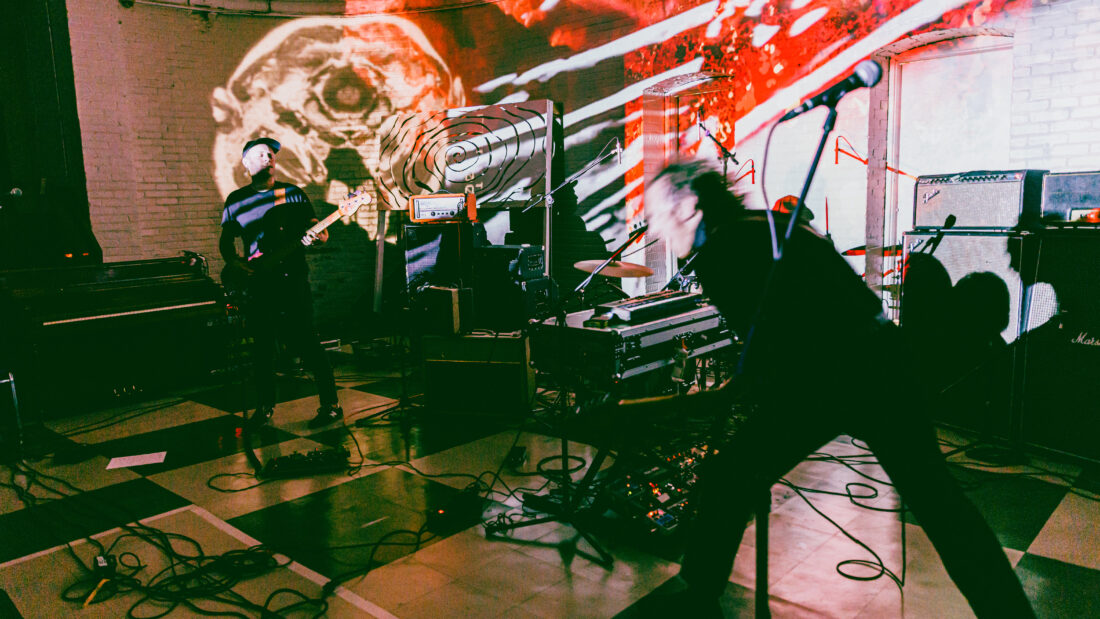
In early 2023, in the dead of winter, the band drove five hours from Montreal to the Saguenay region (200 kilometres north of Quebec City), where they set up their gear in the garage of a rented ski-town chalet. Cober had an unpleasant head cold. Plenty of tea and whiskey were on hand. They made sure their songwriting space was far away from other people. They didn’t want any noise complaints. “We’re fucking loud,” says Cober. Yoo Doo Right believes in the importance of being as loud as possible.
While their previous albums conveyed volume and space with reverb and other effects, From the Heights, which was recorded by producer Seth Manchester (Big Brave, Metz) at his Machines with Magnets studio in Rhode Island, sounds more three-dimensional and present. Manchester zeroed in on distortion as the tool for conjuring those sensations. The pound of Talbot’s drums, the drone of Masson’s bass, and the crush of Cober’s guitar are captured at their most visceral and overwhelming.
The Yoo Doo Right sound is strongly connected to Cober’s other musical vocation: building effects pedals. (The band has a song named after a distortion-creating diode.) Cober’s grandfather was a tinkerer who read Popular Mechanics and built its little DIY projects. When Cober was young, he’d take trips with his grandfather to the junkyard to pick up old stereo equipment and try to repair it. He showed Cober how to solder and passed on his love of the finer workings of electronics. When Cober started playing in bands, he realized that guitar pedals and amps were similar to the systems he and his grandfather had dissected.
During his downtime from his job making vegan sausages, Cober started making fuzz pedals for himself and his friends. He gave one of his Preamp 150 pedals to John Dwyer, the mastermind of California rock band Osees, who loved it and spread the word. When orders kept coming in, Cober made Mile End Effects, his pedal business, his full-time job alongside music-making. A few years ago, the landlord of his workshop priced him out of the space with a massive rent increase, so now Cober builds pedals in the basement of his apartment.
More than any kind of shared musical taste, Cober, Masson, and Talbot have a common interest in trying to be “the loudest band in the universe,” says Cober, who grew up in Kitchener, Ontario. He moved to Montreal for post-secondary school, but soon dropped out to jump in a van, tour for months in punk bands, and play basements across North America. Masson and Talbot had similar intentions. Talbot, who grew up in Edmonton, drummed in metal bands, and Masson, the group’s only Montrealer, was in screamo outfits.
Cober was drawn to Constellation Records’ experimental-rock roster: Godspeed You! Black Emperor, Do Make Say Think, and Fly Pan Am imparted how texture and sound can convey meaning without the manipulation of words. He was also deeply inspired by German psychedelia, and the broader German countercultural movement of the late ’60s and early ’70s.
The German youth of this period, whose parents lived under fascist rule, bore the responsibility of rebuilding postwar Germany. There were militant leftist, anti-fascist movements and protests, and influential music sprang up from these tensions—the hypnotic grooves of Can and Tangerine Dream. “I’ve always found it interesting how the political climate of the time shaped that music,” Cober says. “It’s psychedelia, but not in the same way that the West Coast American psychedelia happened. It was angrier, it was darker.”
Cober is interested in the ethnographic and sociological aspects of music, tracking movements and scenes alongside their political and social contexts to glean deeper meanings. “Some of the most ferociously political music has no words ever spoken,” says Cober, invoking classical works like Sergei Rachmaninoff’s 1892 composition Prelude in C-Sharp Minor. “It’s just this angry, churning piece of music. He was a Russian composer at the turn of the century, and that was a pretty intense time in Russia. That’s what I’m taking from it. Maybe that’s not what was intended at all. I never studied music in that way.” No surprise, then, that most of the music on Yoo Doo Right’s new record is instrumental.
Cober tells me about a podcast he heard that explored an experiment conducted in the 1960s to train dolphins to speak English. Years later, researchers concluded that rather than teaching animals our language, we need to learn theirs: a communication regime of noises. People were trying to pinpoint certain words or phrases dolphins might be saying, thinking of sound in terms of linguistics instead of emotion—sound as a form of communication itself, beyond language.
“I think there’s something special about trying to convey meaning through timbre and composition and music, and I mean non-lyrical music,” says Cober. The ambiguity allows for a range of interpretations, even for those opposed to the philosophy behind the music. But sound, rather than rhetoric, is what Yoo Doo Right wants to use. “We’re not at the forefront of battling these fucking evil forces in the world, but we’re trying to be an inspiring force.”
There is a thematic link between the original krautrock era and Yoo Doo Right’s latest record. The project for young people of conscience in Germany was to resist a horrific manifestation of fascism and envision a future in the ruins. The struggle of From the Heights of Our Pastureland is against the carnage of colonialism and imperialism. Cober mentions the rebuilding process that will be required in Palestine after Israel’s genocide, or in Canada after the genocide against Indigenous people. The record calls into question what it means to rebuild after such destruction. “From our perspective, we’re talking about this collapse as if it’s coming—but that apocalypse is happening right now and has been happening for hundreds of years for so many people,” he notes.
The band’s esthetic focus on loudness, though, isn’t expressly political. “Honestly, it feels good,” Cober says with a grin. “It’s fun. I could say it’s to be powerful, to be a force. But honestly, when you’re pushing 125 decibels . . . [My Bloody Valentine guitarist] Kevin Shields put it really well. They played so loud and it was such a transcendental experience that they’d finish a song and they’d all be giggling and laughing because it’s just really, really fun to feel something like that.
“It’s also pretty dangerous,” he adds, as a caveat. Yoo Doo Right provide earplugs for everyone at their shows, and, begrudgingly, they abide by local decibel regulations. These sounds need to be felt in a room together; they were not meant to be heard in a vacuum. Standing in front of two mammoth speaker cabinets at his rehearsal space after our interview, Cober hooks up his Kollaps, a Mile End Effects pedal of foundation-shaking sonic proportions. Physical waves of sound blare out and rattle our chests. We smile and giggle.
Yoo Doo Right knows that sound can communicate a feeling just as powerfully as language can—and that’s useful knowledge if you want to galvanize people. “That sort of emotion can be an incredible motivator,” says Cober.
LUKE OTTENHOF is a freelance writer based in Montreal and an assistant editor at Premier Guitar.