
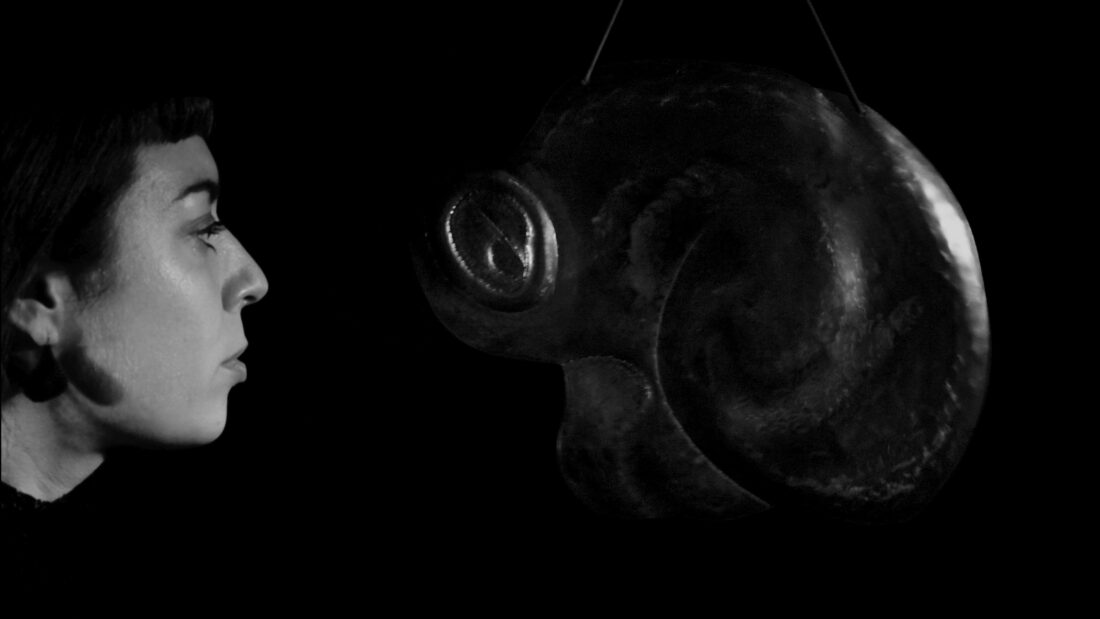
One evening in 2019, U.K.-based conceptual sound artist Lola de la Mata was out for dinner in London, sipping sake as chatter filled the low-lit room. Without warning, feedback from a nearby speaker blasted her left ear. Someone had plugged an electric keyboard into the restaurant’s soundboard without checking that its master fader was at zero. The blast caused a sensation she describes as “warm, hot pain” that felt like it was pushing inward. It also gave her chronic tinnitus.
De la Mata, who played violin as a youth, had trained as a textile designer, moved her creative practice into the dance world, and recently returned to music as an improviser. In the past, she had experienced tinnitus—the sound of ringing in her ears—from attending loud concerts, but this time it was different. At first, her tinnitus was just pain, and for a while her left ear could barely hear anything. One night, she thought she heard the distinctive low rumbling of thunder and woke her husband so they could get up and watch the lightning together. But there wasn’t any thunder. The sound was in her ear.
A month after the restaurant blast, she got her hearing checked out at an audiology clinic in London. She was told that her ear had experienced a trauma and had been in a sort of coma; the rumbling was a sign that her ear was “waking up” by trying to reconnect to auditory pathways in her brain. She was also told that she should give up performing music. Although her hearing eventually tested well, medicine could not stop the tinnitus, which evolved from a rumble to a giant chord before settling into a sort of triad. Loud environments must be avoided, she was told.
De la Mata, who was twenty-eight at the time, wondered if she would have to live the rest of her professional life outside the soundworld she had just started to explore.
I wanted to learn more about de la Mata’s experience with tinnitus because I once faced a similar question. When I was sixteen, I was invited to study with acclaimed Canadian clarinetist James Campbell and was on a path to a professional concert performance career. I also played saxophone and drums. I was around music all the time. It proved too much for my ears, and I developed chronic tinnitus.
Just as writing became a way for me to understand the loss of a music performance career and the presence of tinnitus, de la Mata turned to her creative side to cope with the new sounds in her head. After pursuing teaching and curatorial work, she decided to make music differently. She pitched the London-based label SA Recordings on a project based on the sounds of tinnitus and the mechanics of the ear, which resulted in her composition “KOH-Klee-uh,” named after the cochlea, the tiny, snail-shaped organ in the inner ear that converts physical sound waves into the brain activity we call hearing. “KOH-Klee-uh” features U.K. percussion virtuoso Joby Burgess on the Canna Sonora, a harp-like instrument made of tuned metal rods that vibrate to produce tones when the player rubs them up and down with resin-coated fingers or gloves. “It emits incredibly piercing tones,” de la Mata says. The instrument not only sounds like tinnitus, it also produces non-harmful overtones in the listener’s ear that approximate the experience of tinnitus. The composition was released as a single in 2022 and was included on the label’s compilation The Hearing Experience, which also features works by Astrid Sonne, Damsel Elysium, and the Tara Clerkin Trio that explore concepts of hearing.
In October 2022, de la Mata received a grant from the Arts Council of England’s Developing Your Creative Practice (DYCP) fund, and used it to design new instruments. Although her early efforts didn’t produce anything she considered playable, a piece shaped like a giant ear canal was later used in live performances. “[My] concern there was about trying to touch the ear,” she says. “Trying to touch the different parts of the ear. Trying to access the mechanism to understand what was moving.”
She was often homebound during this period. The tinnitus, along with accompanying vertigo, was debilitating. She and her husband had moved near a park in hopes that a more peaceful environment would help. After creating ceramic prototypes of instruments, de la Mata experimented with glass. One day she took home a fused glass piece she’d worked on at a blower’s studio. When she tapped it, sound rang out with musicality and intention. It was the first object she’d made that deserved to be called an instrument. She also wanted some of her new creations to be clearly recognizable as instruments: The sounds coming out of them might be challenging, so she wanted their shapes to signal music to audiences.
The material that interested her the most was metal. In early 2023, in a studio above a wood shop, she put on ear protection, picked up a big hammer, and loudly smashed a metal plate to shape a cymbal. The vibrations travelled up her arm and through her jaw, aggravating her tinnitus. She kept at it, and went to another studio the next day to make a triangle and a gong.
During her ongoing research, de la Mata grew interested in the work of neuroscientist A. James Hudspeth, founder and head of the Laboratory of Sensory Neuroscience at The Rockefeller University in New York, which studies the neural mechanisms of hearing and pursues treatments for hearing loss, focusing primarily on cochlear hair cells in the inner ear—the thousands of sensory cells that send sound information to the brain. The research group, which includes resident musicologist Lana Norris, conducts research primarily on animals, not humans, but their interest in hearing is wide-ranging. “[Hudspeth’s] way of discussing the ear is very musical,” says de la Mata, who was invited to give a talk and, during her visit, was shown an area of the lab that is deep underground. She recalls Hudspeth stomping his foot on the floor and explaining that the lab was constructed on bedrock in order to create the ultra-quiet conditions required for experiments. Old linoleum squeaked beneath her feet as she walked down a corridor past several soundproofed rooms containing slightly different sets of equipment accumulated by scientists over the years. One room had a small-scale set-up (the lab at one point investigated hair-cell regeneration in the inner ears of mice). De la Mata borrowed a tiny microphone and recorded the sound of her tinnitus.
“Our ears are not passive receivers,” says biophysicist Francesco Gianoli, a member of the research group. “They don’t just passively capture the sounds that they receive. They actively amplify them, just like a microphone.” The energy that powers this amplification can be powerful enough to be detected outside of the ear. This phenomenon, which science still cannot fully explain, is referred to as spontaneous otoacoustic emissions, or SOAEs (sound generated from within the inner ear without external stimulation). It is commonly used by physicians to assess hearing in newborns. “If you are a newborn and your ears do not emit sounds, there’s a good chance that you may have a form of hearing loss,” says Gianoli.
SOAEs usually fade or disappear as people age, and in the majority of cases they are not the cause of tinnitus, even when they are still present. In subjective tinnitus, the most common form, only the person experiencing the sounds (ringing etc. can hear them. In objective tinnitus, which is less common, sounds are audible to both the person and others (via a doctor’s stethoscope or microphone); the source is usually not the person’s ears but, rather, a secondary physical source, such as their heartbeat echoing into their ears. De la Mata has an even rarer form of objective tinnitus: Not only are her SOAEs still present, but the recordings of them made at the lab are what she hears as her tinnitus.
Returning home after her visit to Hudspeth’s lab, de la Mata learned that SA Recordings, which had been set to fund and release her solo album, was closing. This caused her significant stress. She’d cleared her schedule and turned down commissions in order to make the record. Many of her friends in the artistic community were in doctorate programs, which provided them with support and funding to conduct their creative practice as research. She decided to reframe her artistic exploration of sound as an academic investigation, and in the fall of 2023, she became a PhD candidate at the University of Liverpool, in the city where she is now based. Her focus is on tinnitus, SOAEs, and the work of the late American composer Maryanne Amacher, known for her compositional interest in otoacoustic emissions.
In 2023, de la Mata also received funding from Help Musicians UK and decided to record and self-produce her album. Oceans on Azimuth, released in May 2024, includes “KOH-Klee-uh.” She uses the first glass instrument she made on a composition called “Whorling.” The cymbal she hammered herself is part of “Timbral Mirrors,” and she uses her custom triangle and gong on the album. Members of the sensory neuroscience group can also be heard: A clip of Gianoli appears on “Calibration God,” and the voice and lyrics of Norris on “Pink Noise.”
The compositions featuring the recordings of de la Mata’s tinnitus, “Left Ear” and “Right Ear,” might be difficult for some people to listen to: high-pitched tones, the pulsing of de la Mata’s heartbeat, even her breathing, all recorded in an ultra-quiet room resting on bedrock. The tracks have been cleaned up, but the raw and potentially maddening experience of tinnitus remains palpable.
While Nova Scotia musician Seth A. Smith, featured in Musicworks 144, shifted his practice to create instruments and compositions to mask the sounds of his tinnitus, de la Mata has created her instruments and compositions to bring the sounds and experience of tinnitus out of her body and into the concert hall and recording studio so listeners can engage with them.
Although de la Mata has received some feedback from people saying that she shouldn’t foreground tinnitus in her music because it could be harmful or triggering to listen to, she feels it’s important that the subject be made visible—and audible. Experimental music “seems to suit the subject, because we’re not told how to listen to it,” she says. “I’m kind of playing with this idea that there is no guidance to how one listens to experimental noise or music. Obviously, mine is very conceptual. So there’s a narrative, there’s a story. But I also feel there’s a lot of room for people not to like it, but still to find it interesting.”
ANGUS MACCAULL is a Canadian journalist and poet with work published in Newsweek, Maclean’s, The Toronto Star, The WholeNote, and The Walrus. He is currently working on a memoir about losing a music career to tinnitus.