
Writer and musician Julia Eckhardt has noted that we tend to use the word “quality” as a way of making vague value judgments about music, without ever having to justify them. “Speaking about quality in music seems to be simply a way to divide music into the categories of ‘good’ and ‘bad,’ without ever asking for whom, in what situation, and in what function or at what purpose,” she wrote in her contribution to the 2024 anthology Bodies of Sound: Becoming a Feminist Ear. Instead, she offers a list that suggests a truer definition of what quality originally used to, and could still, mean when we talk about sound: “character, disposition, particular property or feature, kind, relation.”
When Lisa Conway and I meet in summer 2025 at a coffee shop near her home in Montreal, we discover that we’ve both been reading Eckhardt’s writing—and so Eckhardt’s list ends up becoming an entry point for me in thinking through Conway’s wide-ranging sonic output. Conway’s explorations in music stretch over genre and disciplinary lines across the Canadian experimental music scene. She has composed music for film and theatre; developed multichannel loudspeaker setups and site-specific sound installations; mixed and mastered a swathe of albums by other local experimentalists; and created music through her solo project L CON that has ranged from washes of electroacoustic sound to playful experiments with reel-to-reel tape to acutely intimate singing and songwriting.
Throughout, Conway has cultivated a deep love for musical technologies that misbehave and fail and break, and for reconsidering what sonic quality might mean in those contexts: acoustic feedback, old tape decks, faulty vintage electronics, and samples of objects and instruments brought into new light when recorded or processed in a particular way. Her practice is rooted in listening for the specific histories, characteristics, and relationality of sounds—whether those sounds are read as good, bad, or both—and pulling inspiration from the messy “what if” feeling that emerges.
“I think exploring different things is just a need—and I don’t know where that need comes from—to do the things that I’m not sure about,” she says, “and to stay curious as an artist about sound.”
Conway grew up in a rural farming community a fourteen-hour drive north of Vancouver. She studied classical violin as a child and later joined the Valley Youth Fiddlers, a group based in the nearby town of Smithers, British Columbia. She eventually started studying with one of the group’s mentors, Oliver Schroer, a prolific avant-garde fiddler and composer who suggested a path for Conway. “When I was twelve, I saw Ani DiFranco perform at the Vancouver Folk Festival, and I was just like, ‘Wow, this person has her own label, and records and produces and mixes her own stuff.’ I got really excited about writing songs after that, and Oliver said, ‘You should learn, you should record yourself, you should learn how to make demos.’ And he had gone to York [University], so that’s why I went to York.”
Conway moved to Toronto in 2006 to start a BFA in music at York, where improvising and installation art became new avenues for her to think about sound and music. She began improvising with dancers and playing in bands with fellow music students like cellist-composer Cory Harper-Latkovich and saxophonist Karen Ng, who are now both active artists in the local improvised music scene.
“I was in a Twin Peaks-inspired band of Lisa’s called Chrome and the Ice Queen,” Ng recalls. “Saxophone and voice have always been such related things, especially with tone. In that band, I would play unison melodies with her voice. They would move together and then briefly land on a little harmony and come back together in unison again. I just loved playing her melodies, playing melodies with her.” At that age, they were both trying to find themselves as musicians and improvisers, but even at that time, something about the spaciousness of Conway’s early songwriting made it feel unique. “Lisa was one of only a few people I knew who was really dedicated to ballads—slow, patient music,” Ng explains. “A lot of people would associate that kind of a sound with sadness, but I actually don’t find it sad at all. Her songwriting is beautiful and kind of bare in a really gorgeous way.”
In the twenty years since they first met, Ng and Conway have remained friends, collaborating on musical projects and supporting each other’s work. In an industry that can often feel ungenerous, they have encouraged each other to find their musical footing, and to take up space to advocate for themselves and their ideas. “I love how she sees and interprets the world,” Ng says. “The world of sound, and the world in general.”
In her last year at York, Conway took a class offered by the visual art department called Sound for Artists. “I’d been thinking about sound and textures and was writing songs and making albums, but I never really knew where I fit, and never felt fixed in a genre or discipline,” she says. “Violin was my first instrument. Classical violin always felt challenging to me, in terms of where I fit into that world. As a fiddler, I didn’t know where I fit in terms of my songs and the types of sounds I was interested in bringing into records. But [in the Sound for Artists class], I felt seen, in a wild way. It gave me permission to keep following this path and [my] curiosity around sound, without so many boundaries.”
In 2013, she started a master’s in sonic arts at Queen’s University Belfast, a small, interdisciplinary program where students came from visual art, audio engineering, and music backgrounds. There, she developed multichannel electroacoustic compositions and sound installations, experimented with motion-triggered granular synthesis and spatialization, and tested out new text-based scores and other interdisciplinary work. After graduating, she returned to Ontario—with stints in Toronto, in Grey County (where Conway and her partner at the time built and ran a recording studio they called Wildlife Sanctuary Sound), and in Guelph—then moved to Montreal in 2023 to begin a doctorate in the individualized PhD program at Concordia University.
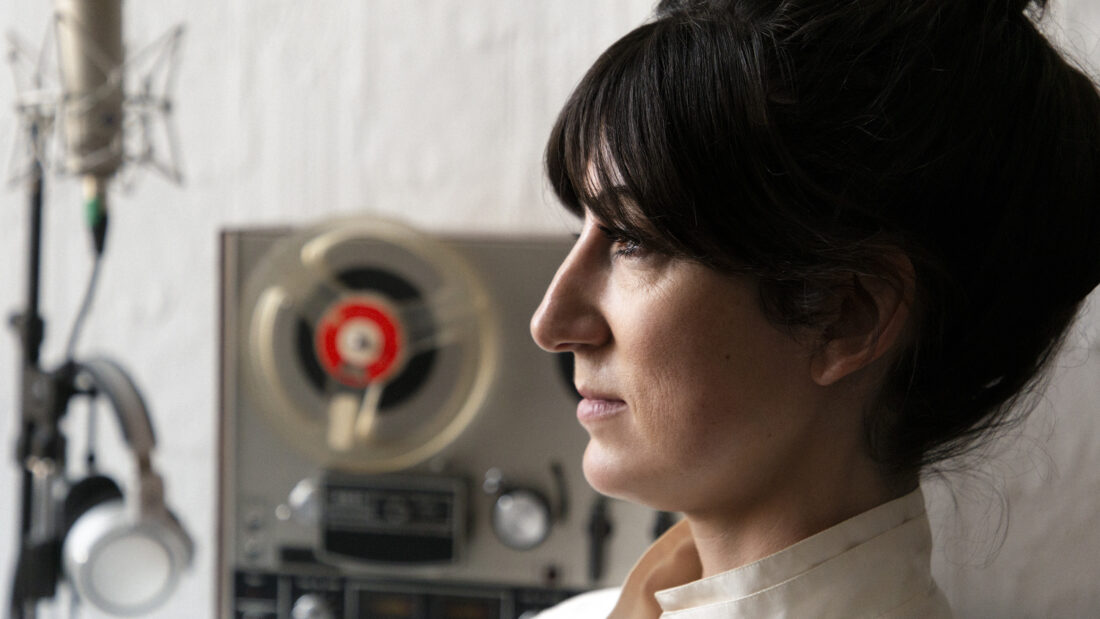
The idea of failure—and what failure means in music—has since become a defining theme of her work. “I’m reflecting now on my relationship with gear and what that means,” Conway says. “I keep choosing to engage with gear that is older and kind of temperamental. I’m doing live sets with a reel-to-reel tape machine, and part of my excitement is that it might not work. There’s something thrilling and vulnerable and intimate about it.
“That’s also where the improvisation part comes in. I wonder what that vulnerability is: not only of using these technologies, but also of being present and live [with them as an improviser]. It feels very fragile. I’m always curious [about] which element of that people are drawn to as listeners.”
She cites French composer Éliane Radigue’s work in the 1960s and ’70s with reel-to-reel feedback—slow-moving, dense textures that, upon listening, slowly reveal worlds of inner detail. In Radigue’s pieces from this era (available in a five-part series on Alga Marghen, an Italian label specializing in archiving experimental twentieth-century composition), the feedback loop between a microphone and a loudspeaker that are picking up each other’s signals (or from a tape machine where the inputs and outputs have been connected), often considered an accidental or unwanted sonic artifact, instead becomes the sonic material for long-form minimalist compositions.
“Feedback is technically a failure,” Conway says, making air quotes around the word failure. “It’s a kind of error, but it’s also a beautiful result that can become wonderful sonic material. I do feel like that’s where a lot of learning has happened, in the moments where things are not working.” The turn toward glitch and error merges her creative process working with gear as a performing artist with her parallel practice as a technician and recordist, where solving technological issues is part of the job. “At the beginning of my degree, I was joking that I was getting a PhD in troubleshooting,” Conway laughs, “but now it’s become a foundational part of what I’m looking into and how I think about making things with music technology.”
Troubleshooting gear issues while building a sound installation, preparing for a concert, or recording a session is a deeply entangled part of the process, and yet it’s often seen as preparation for artmaking, rather than as a significant aspect of the creative practice itself. “Working in male-dominated spaces, I’ve felt like I have to be perfect all the time—so bringing up things not working has felt really vulnerable. It’s something I have felt nervous about. But it’s a big part of what working in music technology is. It’s ‘things not working’ all the time. It’s what leads you to other really interesting results.”
In a video recording of a performance of Tape Loop Explorations at Moncton’s RE:FLUX festival in June 2025, co-creators Conway and visual artist Emma Ongman sit face-to-face at separate desks: Ongman with a video camera, Conway with a keyboard, microphone, and reel-to-reel tape machine. Conway runs a three-second loop of tape through the reel-to-reel. The gentle, repeating sonic fragment then slowly forms the basis of a rich, shimmering soundworld, while live video footage of the tape loop, overlaid with translucent images of water and waves, plays on the projector screen behind them. Throughout the video, Conway switches out the tape loops, stretching each one out and around a microphone stand onstage so that it’s taut enough to feed through the mechanism without catching. In the final minutes, Conway brings out a tape loop that is over two metres in length. She feeds it through the machine three times, starting and stopping the playback, then leaves it playing a soft pattern of four repeating chords. Singing overtop of the chords, she holds the tape loop in her left hand, gently keeping it aloft and pulling it through the machine so that the chords become distorted by glitch and sudden fluctuations of tempo.
“Improvising and troubleshooting and listening are all interlinked,” she says. “Entering into something, the feeling of not knowing and exploration—it’s being in the moment and being present and trying to find it.”
The desire to write and sing her own songs is partly what led Conway to experiment with recording and composition in the first place, and recently it has become increasingly vital to her process. A song can be a container, she explains, to test her weirdest and riskiest ideas. “I realized that if I sang over something really strange, people wouldn’t notice as much,” she says. “I could experiment more than I could otherwise if I put a melody overtop.”
The eight songs on The Isolator, her 2023 L CON album released on Idée Fixe Records, are intimate and warm, with various configurations of bouncy synths, piano, and strings forming a backdrop for her soft vocals. Present within the songs’ orchestral pop world are glimpses of that experimentation. Conway tells me she ran the piano sounds on the record through a granular convolver (a device that allows for two different sound sources to be combined using granular synthesis and convolution) to create a subtle burbling effect. Elsewhere, on a passage in “Ordinary Girl,” Ng’s saxophone doubles Conway’s voice, crafting a suddenly more rounded, multilayered sound. Halfway through “What if Heidi Likes the City?,” an unexpected crisp percussive layer (a sample of a ticking Swiss watch, it turns out) emerges from the texture.
The album as a whole touches on themes of homeland and belonging. Conway’s mother immigrated to Canada from Switzerland, a place that Conway has visited but never lived in. The Isolator is her attempt to uncover and untangle some of the complexities of her Swiss-Canadian identity—having a homeland that isn’t fully knowable, that instead exists in more of a speculative sense, through the transmission of intergenerational stories and memories. Bookending the eight songs are two slow, expansive tape loop pieces crafted from samples of the alphorn—a three-to-four-metre-long wooden Swiss wind instrument, traditionally played on the mountainside. “The alphorn is such a stereotypical Swiss instrument,” she says. “Making tape loops with it was kind of a way to come to the alphorn on my own terms, and to think about that landscape and that spaciousness.”
Conway first started writing for alphorn during the height of the COVID-19 pandemic, corresponding via email with players in Switzerland and Vancouver. (Editor’s note: Readers can hear B.C. alphornist Jim Hopson on the Musicworks 152 CD.) In the summer of 2024, she travelled to Switzerland to continue that work with the Zurich-based alphorn ensemble The Alpine Sisters, as well as Swiss alphorn player Mike Mauer. “The alphorn started as an improvisatory instrument,” Conway explains. “It was used to call livestock and communicate between villages. Some of the [better-known] melodies are written and notated, but they all started just as shepherd improv. It’s been cool to return to the alphorn as being something that lives more in that realm.”
In recording and processing the sound of the alphorn, Conway played with different forms of amplification, echo, and reverb, in ways that allude obliquely to the specificity of the natural reverb alphorn players consider optimal and try to achieve when playing in the mountains.
“It’s exciting to think about the alphorn as an improvisatory instrument and a land-based environmental practice,” Conway says. “I’m trying to marry the worlds of the alphorn and [my work with recording and electronics] in my head, and I think my research may be around bringing technical, computer kind of practices into more of a nature-based feelings world. They’re not so disparate, and whether sound is in space on a mountain or in space in a dome of loudspeakers, those two things feel related to me.”
In an interview conducted by Eckhardt, Éliane Radigue describes listening as a kind of mirror that can draw meaning out of any sound: “It’s the quality of the listening one brings to sound that makes it perceptible. It’s the listening that makes it our own, according to the quality of our attention. If you open your body and your mind to listening with an active attitude, you will draw out very specific things […] it’s a reflection of one’s state of mind at that moment.”
This is the type of attention that Conway brings to her music—from her pieces and sound installations blending analog and digital technologies to her improvisations and songs. Stripped of their connotations with being good or bad, sounds and their various qualities become a personal experience specific to time and place—an open space where new forms of meaning can emerge.
“I’ve been recorded by many people, but Lisa remains the only person—and I really do mean only—who’s recorded my sound and makes me think ‘I sound like me,’” Ng says. “She has this gift of knowing just the right amount of air to include in the sound, just the right amount of each thing so that it teases out an authenticity of your being.”
In a way, it’s as though Conway is capable of witnessing each sound in all of its complicated detail: turning it around and around, and listening until a new side of it catches the light. “Lisa has the kind of ear where she can hear you in a really generous way,” Ng says. “And it resonates.”
SARA CONSTANT is a flutist and writer specializing in new music. She holds degrees from the University of Toronto and University of Amsterdam, and currently works as the digital media editor at The WholeNote magazine and as an organizer of the Toronto Creative Music Lab. She is based in Toronto.