
Natural environments mold ecosystems and identities. Myths, histories, and the knowledge of local populations move to their natural rhythms. Today’s exploitation of resources poses dangers to life as we know it. Mining, quarrying, deforestation, and fossil fuel extraction threaten vulnerable environments and Indigenous communities living in their ancestral lands. Rising global temperatures accelerate glacier melting. Droughts are commonplace. In 2025, the British government urged citizens to delete old emails and save water meant for cooling data systems. Territorial disputes in the South China Sea and China’s land reclamation projects destroy coral reefs. In 2026, the island nation of Tuvalu will enact the first wave of a planned relocation of its citizens to Australia in a climate-change visa offering that is part of a larger pact between the two countries. Scientists continue to debate whether or not to officially recognize the Anthropocene Epoch—in which human supremacy effects planetary change—in Earth’s geological history. Where does sound-making fit in amid climate injustice and shifting world orders?
The drum set is centre stage. A study on forest rhythms commences. Cymbals respond to mallet action, creating gradual crescendos out of nothing. The crashing resonance is deafening and repeats in a slow, unfolding cycle. A drone emerges not with sustained tones but with repetitive kinetic energies of the forest under gusty winds.
The afternoon sun was raging during my two-hour bus ride from Toronto to Hamilton, Ontario. When I arrived in the Westdale neighbourhood, I saw people lining up in front of St. Cuthbert’s Presbyterian Church. A sign outside proclaimed “Zula Presents Something Else! Festival”—a witty moniker for a music festival that is now in its eleventh year. Backstage, a Pulitzer Prize-winning musician greeted me while sipping tea before her solo performance on drum set, which is part of an ongoing exploration of forest rhythms.
Susan-Marie Chan Ibarra is an interdisciplinary artist—percussionist, composer, sound artist, and researcher—of mixed cultures and interests. Familiarly known as Susie Ibarra, she was born in Anaheim, California, the child of Filipino immigrants in the United States. “My mother is Filipino Chinese,” she said. “My families are from the Philippine provinces of Bulacan and Tarlac, but my parents met in Manila.” After moving to Houston, Texas, as a child, Ibarra gained exposure to various creative pursuits: music, visual art, languages. “I started learning piano when I was three. I played guitar and sang in choirs, but I wanted to be a visual artist. My siblings played the piano too, but I ended up being the family’s professional musician.”
When she was young, Ibarra thought about becoming a visual artist, but in high school she dropped art and shifted into percussion. Hearing jazz artist Sun Ra was a turning point. She first heard him on the Hal Willner-produced 1988 album Stay Awake: Various Interpretations of Music from Vintage Disney Films. “Sun Ra’s group The Arkestra recorded “Pink Elephants on Parade” from Dumbo,” she said. “I loved it!” Later, while studying at Sarah Lawrence College in New York, she had a chance to see Sun Ra perform at Sweet Basil, a now-defunct jazz club. “I brought a few friends,” Ibarra recalled. “I ended up standing in with one of the drummers, the late Earl ‘Buster’ Smith.”
The Filipino diasporic communities of the U.S. were also always accessible. “We have family in the Gulf Coast area—in New Orleans, Louisiana, and Fort Worth, Texas. Filipino communities are strong there. We hosted visiting choirs from the Philippines. As physicians, my parents would usher other communities into the mix,” Ibarra said. Not every diasporan has this privilege. For Ibarra, these transnational family and cultural ties helped her overcome the awkwardness she felt growing up in places where locals looked different from her.
Forest sounds unfurl. Hands are sound-makers. Fingers tap drum surfaces. Ibarra flaps and claps her hands and rubs them together. The sound of friction shifts to brush sticks that flap in the air and brush on surfaces like whispering voices. Drum frames clack and cymbals crash. The sarunay [a miniature kulintang gong] mimics chimes in a gentle breeze.
The kulintang caught Ibarra’s attention early in life. Eight small, knobbed gongs in a row from the Southern Philippines are played alongside a palabunibuniyan (an ensemble of louder gongs) and a drum. “My tito’s [uncle’s] house had a kulintang,” she told me. “The music sounded sonically wonderful. I eventually found my way into gong ensembles [when I was] a teenager in New York.” Her affinity with the instrument was strengthened by studies with Danongan Kalanduyan, a notable musician and teacher, in California and Cotabato City, Mindanao. Beyond its sonic curiosities, the palabunibuniyan dynamic informs her own mentoring practice. “Looking at different cultures, the nature of percussion lies in ensemble playing,” she said. “In mentorship sessions with the drum set, I now make people play with other percussionists.”
In addition to her own mentorship under drummers Vernel Fournier and Milford Graves, Ibarra’s studies at Mannes School of Music in New York and the now-shuttered Goddard College connected her to important music scenes. She collaborated on albums with free jazz artists such as William Parker (Compassion Seizes Bed-Stuy, 1996), her mentor and fellow drummer Denis Charles (Drum Talk, 1998), and guitarist Derek Bailey (Daedal, 1999). Ibarra revealed the multivalent, non-Western orientation of her sound on the 1999 album Radiance (with multi-instrumentalist Cooper-Moore and violinist Charles Burnham) and its 2000 followup Flower after Flower (where she added several notable artists to the mix, such as trumpeter Wadada Leo Smith and accordionist Pauline Oliveros). Two 2024 releases on Tzadik Records went deeper into contemporary spins on tradition (Folkloriko, which includes the forty-minute suite “Lakbay,” which honours the life of Filipino immigrant workers) and electronic improvisatory possibilities (Entomological Reflections with the trio Mephista, featuring Ibarra with pianist Sylvie Courvoisier and Ikue Mori on electronics).
My earbuds tune in to the title track of Ibarra’s 2021 album Talking Gong. Claire Chase’s belligerent flute, Alex Peh’s rhythmic piano, and Ibarra’s textured percussion orbit each other in conversation. Even with recurring refrains, the track at times sounds jarring as they stray from one topic to the next. Is the gandingan (four suspended gongs)—the Maguindanaon talking gongs—more metaphorical than functional in this music? Nonetheless, the virtuosic power and chewy textures are fodder for metaphorical “tsismis” (gossip) and “chikahan” (chatter).
Southeast Asian gong cultures can seem interchangeable even to learned musicians. I’ve seen people mistake the kulintang for the bonang in Javanese gamelan. “We get bunched [together] so much that sometimes I want to wear a T-shirt saying, ‘Southeast Asia is not a country!’” said Ibarra with humour and quiet indignation. “I had discussions with Balinese artist Putu Tangkas Hiranmayena [now teaching at Iowa’s Grinnell College] about the similar sonorities between Balinese gamelan and kulintang.” And yet the tunings, musical structures, and myths are different. Each rainforest’s footprint is unique.
“Orientation and pedagogy depend on where we’re listening,” she continued. “Vocabularies and ways of centring are fluid for me.” After more than three decades of navigating pedagogies, she now upholds a so-called “hybrid practice” that honours the essences of things and their resonances from different contexts.
Using bamboo poles, Ibarra and percussionist Levy Lorenzo (Musicworks #145) evoke the rice-pounding rhythms made by the people of the Cordilleras, the central mountain range of Luzon. Energies intensify as mallets and sticks find their way without hesitation. Drum rims clank as if to excavate the drum’s inner crevices. The kulintang a kayu (a wooden version of the instrument) rings like wood blocks. Polyrhythms and time shifts arise from each drum. Confrontation demands physicality and presence as the forest rages. The drum set inhabits its own space.
Ibarra’s 2024 composition Sky Islands, which won the 2025 Pulitzer Prize for Music, celebrates the highland forest habitats of Luzon, the largest island in the Philippines. Some ecologists believe the mountain ranges of Luzon and the cloud forests along their slopes may be home to the world’s largest and most diverse concentration of mammals. Recent field surveys have documented various endemic species. In 2002, botanists found a rare flower species thought to be extinct for over 200 years. Sky islands are not fully isolated, however, as they are part of complex systems that reveal the Earth’s interconnectedness. We are learning that the encroachment of human settlements and the destruction of highland habitats mean infectious parasites and diseases are more easily transmitted from one to the other. Indigenous communities recognize this interconnectedness.
T’boli folk complained that Lake Sebu was contaminated with tilapia fish farming and fertilizer run-offs from plantations, endangering endemic fish species. Other groups refused to migrate from coastal areas in spite of tsunami dangers. “They started to ask me hard questions about their environmental concerns,” Ibarra recalled. “I was a young artist. I’d never worked in those areas before. I couldn’t give them straight answers.” Sacred ties to ancestral lands are at stake with climate injustice. “It doesn’t matter if international organizations like Habitat for Humanity rebuild houses on higher ground. It’s difficult to convince communities to leave.”
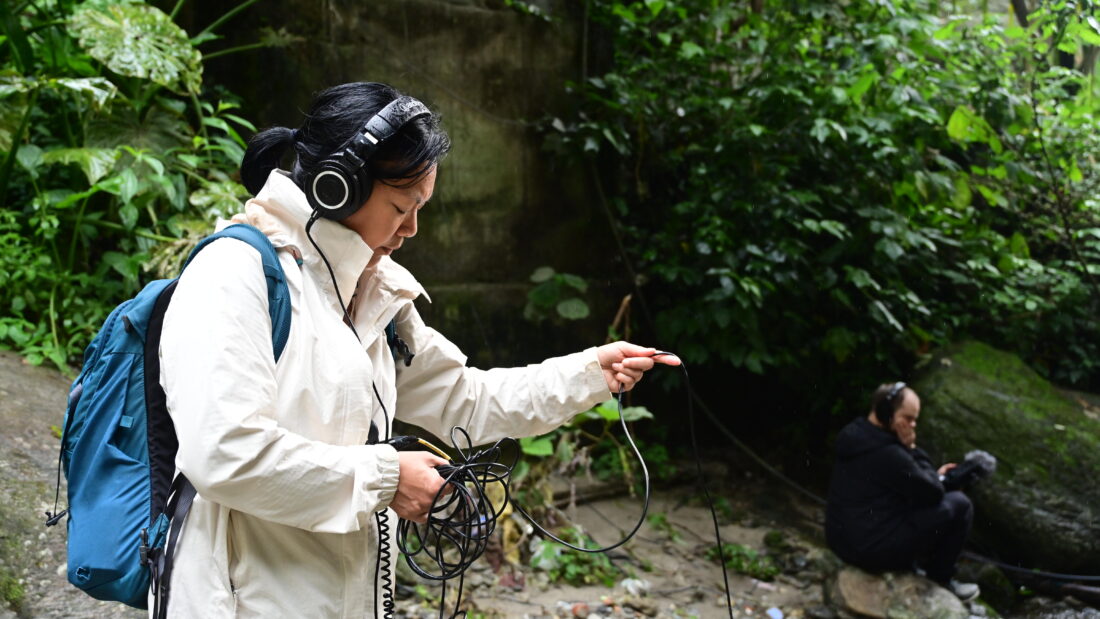
Consequently, Ibarra delved more deeply into ecological issues. She took part in conservation efforts around the endangered Philippine eagle. She started meeting and talking with scientists and making field recordings of non-human sounds. Vibrant inner worlds of flora, fauna, and geological landscapes intrigued her. The canyons of Utah created fifty million years ago were resonant stone instruments, reminding her of ritual and ancestral connections to land. Water—whether from rivers, oceans, or glaciers—was a sound-maker and culture mover. The re-centring of natural environments reveals the fragility of anthropocentrism. We see deterioration and wonder why we can’t stop causing it.
Ibarra collaborated with glaciologist Dr. Michele Koppes—a geology professor at the University of British Columbia whose research explores how glaciers, mountains, and the people who dwell near them are responding to climate change—on Water Rhythms: Listening to Climate Change, which consists of sound installations and a subsequent podcast that trace the paths of water from mountain and glacier run-offs in the Himalayas, Greenland, and the Pacific Northwest.
For one of her recent compositions, Parallels and Confluence for piano quintet and quadraphonic fixed media (2024), Ibarra conjured up a love story between two Philippine rivers: the Pasig River in Luzon and the Bugang River in Panay Island. Field recordings of India’s Ganges River by Ibarra and multi-instrumentalist Jake Landau metaphorically channel both rivers amid the quintet’s currents. Her affinity for field recordings is undeniable: “It’s a practice that found itself,” she said. “I loved placing field recordings in my earlier work.” This process feeds her sound research, sometimes aided by transcriptions that invoke different ways of listening.
The rhythms of the natural world catch her interest nowadays, she said. “Cycles, from tree fractals to ocean waves in motion, which came from listening a lot in the environment.” The complexities of tree branches stand both as a source of creativity and as a connection to the inner worlds of trees. “That tree branch has a self-symmetry that multiplies,” she continued. “Emulating that, I would record a tree, get its base frequency, and do calculations to arrive at a number that forms the basis of a rhythmic cycle.”
So where do Ibarra’s sky islands, glaciers, and canyons meet? They converge in an emerging ecology of rhythm—the ebb and flow of activity where humanity’s understanding of time’s passage unfolds. Back in Hamilton, on a late-afternoon sound walk through Princess Point Trail with Ibarra focused on birdsongs, thirty participants heard gray catbirds, rose-breasted grosbeaks, and red-winged blackbirds join along at different times. Human footsteps sounded out a silent ritual through the trail. Natural rhythms enacted a musical passage of time.
JURO KIM FELIZ is a Toronto-based composer, pianist, and writer. Collaborating with Thin Edge New Music Collective, Ensemble x.y, Liminar, and others, his music has been performed at major events such as New York’s MATA Festival, Nief-Norf Summer Festival, Mexico City’s MUSLAB, the Asian Composers League Festival, and the Yogyakarta Contemporary Music Festival. He is the recipient of the Goethe Southeast Asian Young Composer Award (2009) in Kuala Lumpur and has commercially released music with Ablaze Records. During a Canadian Music Centre Library Residency, he created Nomadic Sound Worlds, a miniseries of podcasts and essays that frames Canadian contemporary music through the lens of global migration.