
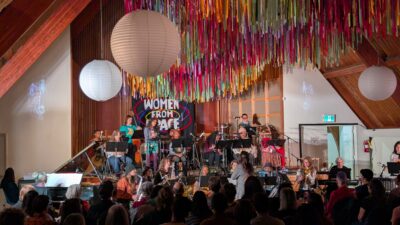
There have been mutterings lately about audience etiquette—namely, that it’s all gone to the dogs. I’ll say! Last year I watched Yorgos Lanthimos’ Poor Things next to a teenager who consumed a container of cold spaghetti and absconded from the theatre with twenty-five minutes remaining. You can imagine my horror, then, when, midway through the opening set of this year’s Women From Space festival, the man sitting in the chair next to me placed a keyboard on his lap and began to play.
Lo, it was all part of the plan! Allison Cameron’s Small Scale Experimental Machine had begun with the Toronto-based composer and improviser producing sounds alternating between jolting and antagonistic to pliable and sweet. There had been wah-wah-wah-ing reminiscent of the adults in a Peanuts cartoon, and now, a set of sleeper agents activated in the audience. One less anecdote for the etiquette killjoys.
The audiences of the festival’s seventh iteration were beyond enthusiastic and attentive for the annual celebration of women and gender-diverse musicians in creative music, improvisation, and jazz. Cameron, and the rest of the performers on the chilly Friday opening night, played to a packed house. Plastic Babies—the group project of improvisers Christine Duncan, Laura Swankey, and Patrick O’Reilly—followed Cameron with a set of vocal-forward experimentation that marked the release of their eponymous debut album. Homing in on the potential of their voices, Duncan and Swankey have perfected the balance between language qua language, with whispered, sung, and shouted phrases reminiscent of Jenny Holzer’s Truisms, and language broken back down into pure sound. In what has become an opening-night tradition, the twenty-person in-house ensemble Big Bang! took the stage, this year celebrating the work of Nina Simone, as arranged by Pursuit Grooves, Olivia Shortt, Alexa Belgrave, Minjia Chen, tUkU, Tania Gill, and Madeleine Ertel. Chen’s arrangement of “Alone Again (Naturally),” a Gilbert O’Sullivan tune rewritten by Simone to reflect her troubled relationship with her father in the wake of his death, was a shining moment for the ensemble, which managed to build on the tender monstrosity of Simone’s work with their own despairing comedic timing.
The festival shifted focus on its second night to a series of movement-based works, beginning with two collaborative pieces pairing musicians with dancers from Toronto Dance Theatre, the evening’s co-presenter. With the audience surrounding them, Erin Poole and Rosina Kazi moved like prize-fighters, exchanging embraces and breathy vocalizations, slowly reaching outward to the audience, and inviting them to participate. Reluctant at first, the audience opened up after a few jokes and a little cajoling. On the stage, musician shn shn and dance artist Chantelle Mostacho combined voice, electronics, and waacking. I am sometimes unconvinced by the forced friendship between dance and improvised music. Does the music serve to scaffold the dance? Does the dance serve to embellish the music? Thankfully, Women from Space and Toronto Dance Theatre seemed to have cracked the code with these pairings, producing level blends of both forms.
Up next, New York-based yuniya edi kwan seamlessly wove folk traditionality and ritualism using voice, violin, and clear-toned whistling in a solo performance that was poetic, smart without being overly cerebral, and beautifully heady. Closing the night, the performance by butoh (avant-garde Japanese dance theatre) dancer azumi O E and composer Eucademix featured the most involved visual effects of the festival. Lighting artist Waldo Walle surrounded the performers with a ring of blasting strobes that helped contemporize an already modern form of dance theatre, though at times it may have served to obscure the harrowing expressiveness of O E’s performance in favour of a larger gesture toward a certain clubbing esthetic.
Minjia Chen and Linnea Sablosky joined Sunday’s lineup with a performance of Meara O’Reilly’s Hockets for Two Voices, the composer’s exploration of the ping-ponging, melody-sharing technique known as hocket. The evening also included sets from pianist Myra Melford’s Fire and Water Trio (with saxophonist Ingrid Laubrock and drummer Lesley Mok) and modular-synth player Arushi Jain.
The trios and duos represented longer term projects, unlike the ad hoc nature of much of the festival’s groupings, though it is never suggested that one or the other is a more fruitful approach. This could easily ring as the central ethos to the festival: Coming together is worth it in as many ways as one can find to do it.