
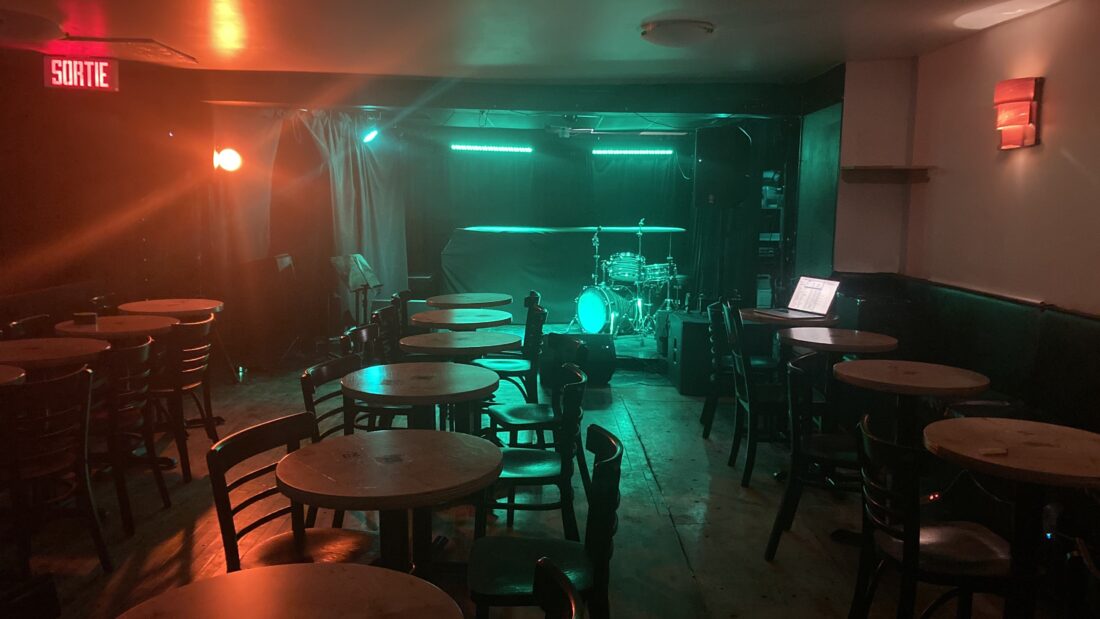
Down here in the basement the air is sticky and humid, and the music is loud. I can feel the bass moving through my body. It’s in the floor, beneath me. Up on the top floors you can listen to music, too, but in the basement you can play it loud. The room is nestled in rock and soil. The heavy, hot earth makes the music sound different—more alive. Here in the basement, the music is given back to the ground on which it is briefly allowed to be played.
Some music is meant to be subterranean. There are things that flow and converge underground; things that can’t survive in the light. To enter the Village Vanguard, the famous New York jazz club, you must descend the crowded stairs. Ralph Ellison’s Invisible Man lived in a basement where he wanted to play Louis Armstrong’s “(What Did I Do to Be So) Black and Blue” on five turntables simultaneously. In basements from Bushwick to Bahia I’ve seen people making music that can only be made in the bowels of the Earth, where the floor won’t give, where the bass can resonate, where the neighbours won’t knock.
When I first entered Café Resonance—a venue on Park Avenue in Montreal—I thought the fact that it was in a basement was a good sign. They were sanding the floors, and they told me the light wasn’t so good but the sound was.
“The room sounds good.”
When a musician says that, they mean that the room makes music possible. Musicians depend on rooms. A good-sounding room gives back to the player in a generous loop. It’s not just about the shape and material, but also about the room’s history—how and why people gather there. Sound is an embodied encounter with the empty fullness of space. Sound reminds us that space is filled with what cannot be contained within it. When a room sounds good, it’s the confirmation of a blessing.
In mid-February of 2022, after nearly ten years of tirelessly hosting jazz, poetry, and experimental music, the owners of Café Resonance invited a couple dozen of us to meet at the venue to drink its remaining bottles of alcohol. They had closed the business. The piano was being moved, the plants given new homes, the food donated. Like many there that evening, I had played at Resonance regularly over the years. The evening turned into an impromptu memorial for a space that had represented the possibility of music—hearing it and being heard—for many artists and audiences.
What made the café unique, beyond the love and inventiveness that were poured into it by its large community, was that it was unwaveringly anti-commercial. When they opened the café in 2012, musicians Martin Heslop and Caoilainn Power decided their ethos would be to choose music over profit, which resulted in a venue that radiated a rare beauty. Martin worked constantly: I remember him putting down his bass during a set so he could pull banana bread out of the oven. But despite the challenges they encountered in the first years, there was always music. Every musician who played there was treated well: given food and a generous fee, and thanked for their music. They were allowed to experiment. Music was celebrated at Café Resonance for its capacity to be experimental. The music was fundamentally an experiment about how to make a space feel alive.
My strongest memories are interwoven with a sense of the place as a living, breathing entity. Devin Brahja Waldman stepping out from behind the espresso machine and hypnotizing the room with his effortless grooves—deliciously atonal, playful, seemingly sourced from a dream of jazz. Philippe Melanson, Gab Drolet, and Simon Labbé improvising music in the candlelit bathroom. The early, world-opening sets of Chiquita Magic, Lune très belle, Bernice, and Thanya Iyer, to name just a few. Hot, crowded nights when music seemed like the glue holding our precarious lives together in friendship, in life improvisation. The place oozed music; it was in the glimmer in the eye of the server, in the hum of the fridges. We seemed to be waiting for the walls to sing. How is one to leave a place like this, a place from which we received the gift of music so humbly and so regularly? On the walk home, warmed from dance and drink, I wondered how one should grieve the loss of a space, and the loss of the history of performance that it holds.
The trouble is that performances are notably hard to hold on to. As performance scholar Peggy Phelan writes in Unmarked: The Politics of Performance, “Performance’s only life is in the present.” As it applies to a musical performance, this sometimes gets lost. The rise of recording as repeated on turntables, CD drives, mobiles phones, etc., has had an undeniable impact on how we understand music’s relation to performance as a form. When we hear music, we might already assume that it has been recorded, that we could listen again. But, as Phelan argues, performance isn’t something you can repeat: “Performance becomes itself through disappearance.” When it is recorded or documented, it becomes something else. It is precisely performance’s inability to be transformed into a repeatable object, Phelan argues, that defines it as a form.
We need breath, not just recordings of breath. Just like we need basements where musicians gather, and rooms that sound good. Phelan reminds us of those qualities of performance that begin and end in the room with us, that can’t be recorded, circulated, and repeated. She attunes us to the stakes of performance: There is something in the music—in the moment of its making—that cannot leave the room.
That was what made the cultural moment of Café Resonance. As the hub of an active, expanding Montreal scene, the space meant a lot to many musicians, poets, and artists. Individuals rarely make musical or artistic breakthroughs alone; these things happen within groups of loosely connected artists who admire and subtly compete with each other. A place to perform, to experiment, is where we realize the extent to which we are connected. I asked Isis Giraldo, the venue’s final manager and booker, if she knew how many shows took place there over the years. She sighed. So many. One or two a day, seven days a week, for almost ten years. There is a lot that has emerged from Resonance. Recordings made at the venue capture something of its spirit. The artists who played there are making beautiful, radiant music elsewhere. The staff who made the place fun and strange and flirty and full of joy will find other venues for their talents. But this is a eulogy for what couldn’t get out—the musical performances that were not translated into recordings, that became themselves because they disappeared. There’s a feeling you got when you walked out of the hot venue and entered the cool night, and realized that you saw something that you will never see again. An incandescent spirit, revealed. The performances that are given back to the earth in the basement where they are allowed, briefly, to be, to dance, and to disappear.