
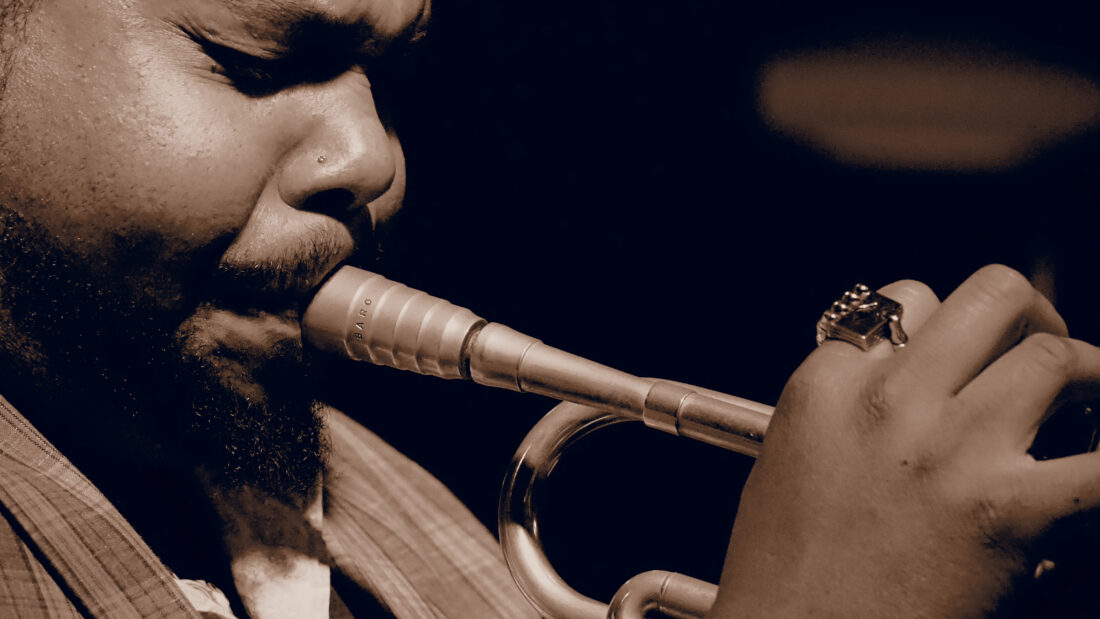
“You wanna play jazz?” asked Miguel Patterson, the director of Cuba’s National Radio and Television Orchestra (Orquesta de la Radio y Television de Cuba), who had overheard lead trumpeter Alexis Baro’s improvised flourishes during rehearsal—an environment where solos must be played as written. “Get four guys,” Patterson said to Baro. “You have a gig on Thursday.” The young trumpeter requested the use of the big band’s rhythm section, and so it began. At age twenty, Baro was leading his first jazz group at Jazz Café in Havana.
A few years later, in 2001, Baro moved to Toronto and was quickly picked up by noted jazz drummer Archie Alleyne, whose Kollage was one of the highest-profile jazz ensembles on the scene at the time. “There are no jazz schools in Cuba,” Baro tells me during a lengthy conversation last fall. “You’ve got to listen, you’ve got to ask your friends, maybe a piano player. You literally find your way. I got hold of some sheet music, cassettes, and play-alongs, and it became part of my routine of practising.
“When I started playing with Archie, it was like, ‘Oh my God, this is heaven!’”
Baro played with and composed for Kollage for several years, during which time he received three nominations for best jazz trumpeter from the (now defunct) Canadian National Jazz Awards, and went on to compose and record many acclaimed albums, both as bandleader and band member, across a variety of genres.
I’m always floored by the high level of musicianship among Cuban players and singers. I once interviewed Samuel Formell, leader of Los Van Van, the famous ensemble formed and initially led by his father, Juan Formell. He told me that in Cuba, eight-year-old children are tested for musicality, assigned an instrument, and sent to music school. “Not everybody is good,” Baro says with a laugh when I mention this, adding, “In Cuba, there are auditions for everything.” When he was young, students were taught European classical music from fat books of technical exercises; Cuban music was barely covered. “It’s classical, period,” he says. “But the thing is, Cuban music is on the radio. It is on the streets. It’s everywhere. You cannot escape it. There are all kinds of ensembles and things that happen musically. If you are in a music scene, you are going to be involved in Cuban music.”
Baro’s mother was a cellist in the National Opera and Ballet Orchestra and would take Alexis to work with her when she couldn’t find a babysitter. Although her little boy would sometimes wander off, she knew he could be found in the trumpet room. “You have to listen, or you have to ask somebody, or you have to lift somebody’s solo or try to emulate or imitate somebody,” he says. “Rarely will somebody say, ‘Come for a lesson to learn how to improvise in Cuban music.’ And it’s the same for jazz. You learn by doing your own work.”
In an interview with Fikisha Cumbo of Pure Jazz Magazine, Mario Bauzá, founder of Machito and His Afro Cubans, said, “It is Afro-Cuban jazz. What is Latin? We are not Latin.” This is a common phenomenon in modern culture—the softening or even scrubbing away of the African roots of modern artistic disciplines. When we do that, we ignore a sordid history, and forget who is implicated in the facts around the descendants of Africa living in the Caribbean and the Americas. Language choices can obliterate histories.
Baro tells me that the sound we recognize as the Cuban trumpet emerged from the enslaved people who became freedom fighters and took cornets from the Europeans—the Spanish—when they won a battle. “They developed their own cornet calls,” he explains. “One meant salute the flag, another meant retreat. One of the most popular ones, alehuejo, a phrase that has lasted for two hundred years or so—literally meant to cut heads! Musically, it means just go! (Alehuejo is referenced in the opening song of Baro’s 2022 album, Mi Raiz.)
The history of Cuban music has many gaps. Musicians who left the country were rarely referenced in the musical education Baro received. For example, the name of pianist, composer, and big-band leader Bebo Valdés—who was a star on the scene in the 1950s and defected in 1960 following the Cuban revolution—was not as well-known in Cuba as his son, pianist and bandleader Chucho Valdés, who remained in the country. In addition, during the 1980s and ’90s there was a “deficit” of tape; Baro tells me that players often recorded new music over the master tapes of older recordings. “If you did not have access to the vinyl, you would not get to hear this music,” he says. “If you did not have a teacher who mentioned them, you would never hear about them. Eventually, new stuff would replace them on the radio—and that’s it. Gone.” Although the names of some famous musicians—like Paquito D’Rivera or superstars like Vera Cruz or Arturo Sandoval—never disappeared, an entire aural landscape of recordings is missing. “As a musician, you imbibe this musical lineage, even if you don’t realize it,” Baro says.
Mi Raiz (My Roots) features a series of original Baro tunes and strategically chosen covers that follow the evolution of the Cuban trumpet. It is rich, complex, and more varied than is generally explored outside of Cuba. “[In Canada] the Cuban trumpet sound is available in an extremely limited way—usually a line of players doing cool, clever shots, and amazing horn lines,” says Baro. He co-produced the recording with Ahmed Mitchell and Greg Gooding, creating a brilliant documentary in sound. “No Puedo Ser Feliz” is a lush big-band piece written by noted Cuban composer Adolfo Guzmán (1920–1976) and made popular by the legendary Cuban pianist–singer known as Bola de Nieve (1911–1971). Baro’s version is arranged by Toronto-based (since 1998) Cuban pianist, composer, and bandleader Hilario Duran. Baro’s original song “En Son De Descarga” features the Cuban cuatro; the piece was written in the style of traditional son and was also influenced by descarga (improvisation using multiple Cuban music genres), which became popular in the late 1940s and ’50s, Baro notes. “Campo De Batalla (Battle Ground)” holds a deep tension from its onset, and in its distressed melody, it expresses the trauma and history of freedom fighters, enslaved peoples in Cuba who were part of the African diaspora in the Americas, and who fought for their own liberation from the Spanish. “El Clarin De Pueblo Novo,” which Baro wrote with Toronto-based Cuban musician Pablosky Rosales, is an ode to the Cuban trumpet in which singer Alberto Alberto calls out the names of some of its greatest players, including Jorge Varona, El Guajiro Mirabal (Buena Vista Social Club), Arturo Sandoval, and Félix Chapopttín, whose composition “Yo Si Como Candela” is included on Mi Raiz.
The album also links the Cuban musical communities of Canada and Cuba. Cubanismo, a group founded in the 1990s around the same time as Buena Vista Social Club, was led by trumpeter Jesús Alemañy. After members Roberto Riveron and Jorge Luis “Papiosco” Torres left Cuba for Canada, it was disbanded. Alemañy eventually re-established the group in Cuba, and brought a young Baro on board. The version of “100 Años De Juventud”—a song by the legendary Afro-Cuban jazz band Irakere and its founder, Chucho Valdés—on Mi Raiz features Riveron on bass and Papiosco on percussion, while Alemañy and Baro render their own take on the iconic trumpet duet of the original version.
“The audience will eat what you give them. If it’s good, it’s good,” Baro says. “They don’t need a history lesson. They need the opportunity to hear the trumpet as a melody line, to see the trumpet player up front as bandleader, or to hear a trumpet and percussion band, as it’s heard on the streets of Cuba. If you put on a good show, they will ask for it again. But if you don’t get the chance to showcase this music, how are they going to know?” Race can be an issue, something seen across artistic genres, he says. “I grew up in the ballet, where one out of twenty-five dancers in the school was Black. It’s about opportunity. Not everyone needs [to be] the same as Arturo to be great, to be acknowledged, to have the opportunity for grand careers. He’s seventy-five now. There’s no one else?”
Audiences may not need to know the history, but hearing about it can enrich their listening experience. It’s also important for players to know where the music comes from. “In a direct or indirect way, you can sense that legacy in the playing, even if you might not know the roots of it,” Baro says. “You hear it, you emulate, and you imitate something that was done nearly a hundred years ago. The trumpet is not just a tool to be used as a horn section. Younger players should know where they come from.
“As a soloist, that’s what I’ve been doing for years, out front as a bandleader and a composer. It’s the whole mission and purpose of [Mi Raiz]. And you don’t need to emulate an American jazz player to do it. You can do it the Cuban way.” As we finish up our interview, Baro is lending his skills to the Soulpepper Theatre production of Billie, Sarah and Ella: Revolutionary Women in Jazz, and I sense I’ve only just touched the tip of Afro-Cuban music, Afro-Cuban jazz, and Baro’s knowledge, research, and artistic contributions. Fortunately, there’s another album in the planning stages, and more collaborations to come.