
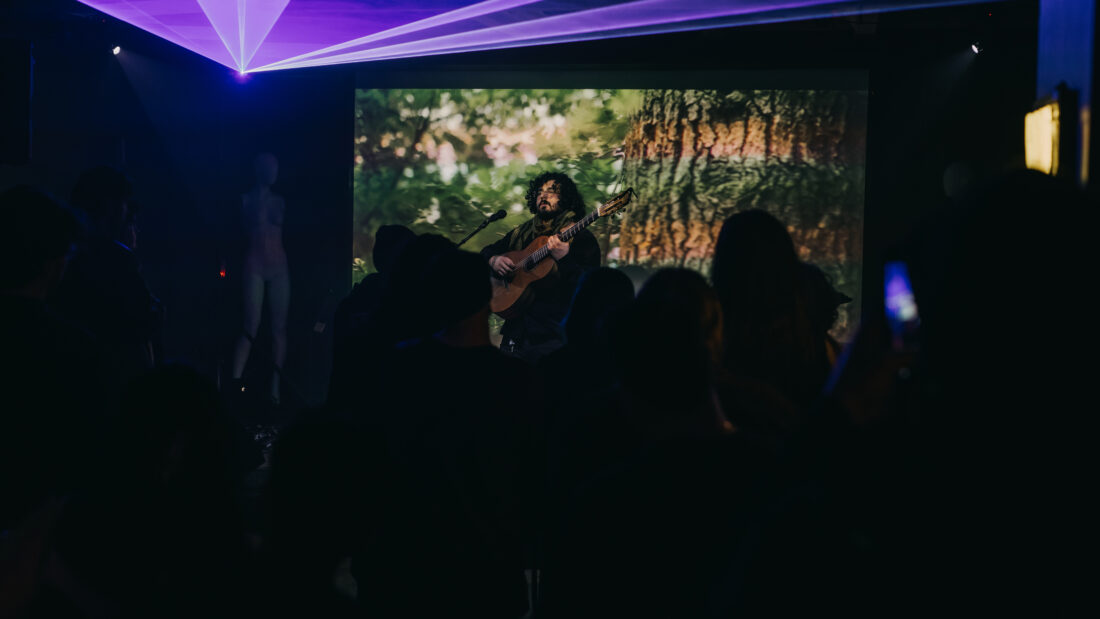
“I haven’t learned a notated piece of music by a composer in five years. I don’t want to be a cover artist!” Palestinian-Canadian guitarist Bilal Nasser says with a laugh, speaking via Zoom from the University of Windsor’s Liberation Zone (a space organized by the school’s Palestinian Solidarity Group) in May. Nasser, who began studying classical guitar at age ten and completed a bachelor of fine arts in music and history at Toronto’s York University in 2020, has always sought out ways to defy institutional conventions. “I went straight into classical music when I was younger, but I was always listening to ’90s screamo, metalcore, and emo,” he says. “[After] my guitar lessons, [I’d] go straight home and say, ‘Wait, I can teach myself [hardcore music] too!”
Nasser’s mother was a classically trained pianist who suffered immense stage fright—so much that Nasser has never seen her actually perform, although he’d sometimes hear her playing through open windows when he was returning from school. She was responsible for Nasser taking up guitar. At the same time, he found himself drawn to ’90s bands like Cap’n Jazz and Slowdive, and later discovered the Arabic audiovisual project Jerusalem In My Heart. “Their aesthetic values really align with what I try to do now,” he says of the Montreal duo and their label, Constellation Records.
Nasser felt that his creativity was being stifled at university, until a professor encouraged him to write his own music. “Honestly, I seriously struggled to be a composer for most of my life. I failed at it—I could not get a musical idea out of me,” he says. But that all changed when he decided to expand the classical guitar repertoire to include music he actually wanted to play.
His self-released debut recording, Where the Orange Groves Grow (2021), encapsulates his break from a traditional path in Western European canonized performance and shift toward self-discovery and a DIY sensibility. While the guitar music of Japanese composer Tōru Takemitsu (1930–1996) and Cuban composer Leo Brouwer (b. 1939) are discernible influences in his work, Nasser situates himself in the post-classical realm, which prioritizes the music’s aesthetic value above its sonic qualities, he says. “It’s not about reforming classical music or having different voices in institutions. We need entirely different spaces for music to occur in. It’s a conscious effort against the colonial signifiers in classical music that cannot be reconciled.”
In early 2024 Nasser began a career in the field of harm reduction. Through this work he builds relationships with and supports people who are unhoused or experiencing extreme addiction, or both. “It’s [not] something I thought I would get into as a professional musician,” he says. “Down the street there’s an abandoned waterpark we all used to go to as kids, but it’s a homeless shelter now, which is kind of a dystopian image.
“Some of my clients are musicians or creative people, but they literally do not have the means to make music,” he continues, adding that his home has been broken into several times. “A man I work with once stole a shitty twenty-dollar guitar—not my laptop, or any expensive gear, or food, or anything else. It made me recontextualize my entire life and my career.”
Perhaps not surprisingly, Nasser’s music and human rights work coalesce in his creative practice. He performs his compositions in local joints. When on tour, he opts for dive bars and experimental music venues over traditional recital halls. He hosts a podcast about political organizing. “It’s performative to make political art and not actually be centred in a movement,” he tells me, as his eyes scan the student encampment where he’s been living for nearly two weeks.
Nasser did not set out to make his sophomore record, How Can We Say Nothing, which was self-released in February, an explicitly political work. Instead, he turned inward to reflect on his personal experiences and existential burden: “I moved away from my comfort zone as a solo classical guitarist and wrote actual songs.” He relies less on music theory and more on intuition, blending contemporary alternative tunings, neo-romantic string-quartet writing, ambient field recordings, and emo and hardcore vocal styles into a dazzlingly mature artistic statement. The record’s vulnerability is most evident in Nasser’s voice—from the soft delivery of “There is no essence to anything, there is no ‘deep down,’” contoured by a poignant violin and guitar melody in “…So that Flies Drop Dead Mid-Air,” to the raw, guttural screaming on “Barely Here.”
It was impossible for Nasser, who lives in one of the poorest neighbourhoods in Windsor, to make home studio recordings without shouting, sirens, and other noise bleeding into the takes. His building is uninsulated, so his hands were often too cold to play. And to top it off, he and his colleagues were in the middle of an action to protest the city’s delays in opening a safe consumption site, which is located nearby. “The politics literally seeped into the record,” he says.
The cover artwork of How Can We Say Nothing is a screenshot of a scan of an original photograph of Nasser’s Palestinian grandparents, survivors of the Nakba (which means “catastrophe” in Arabic), a word used to refer to the violent displacement and dispossession of Palestinians in 1948 when three-quarters of the population was forcibly expelled from their land as decided by the UN and carried out by Israeli Zionist militias; it’s also used by many now to describe the ongoing present-day plight of Palestinians in Gaza.
Members of Nasser’s family also surface on the record in the form of their sampled voices. “[The album] comes from a place of stagnation—feeling stuck in life and not being able to imagine a future,” he says. “I went through home videos to examine my past and my family, and I wanted that to be a throughline.”
Dry Goods, an art gallery in Windsor, invited Nasser to curate an exhibition about his latest album; he was interested, but felt he couldn’t make it about himself. The photo of his grandparents led him to consider that many other people must have similar stories and photos. For his The Land with a People project, Nasser called on people from the Palestinian diaspora to submit their own images, which were then layered onto a map of pre-colonial (1948) Palestine. This first iteration of the project showcased many folks ethnically cleansed from their land, which continues to be pillaged by settler violence.
“It feels weird to make art right now,” Nasser says. “I’m not trying to centre myself or my own experiences, it’s about Palestine and centring the people there.” During his last tour, he played rooms jammed with people in keffiyehs every night. And by riding this wave, he hopes to bring more people into his sphere of communal care, uplifting the disenfranchised and the collective as his artistic practice expands.
YAZ LANCASTER is a transdisciplinary artist residing in Lenapehoking (New York City). Their work as a performer, composer, poet/writer, and collaborator is grounded in queer, DIY, and liberatory frameworks.