
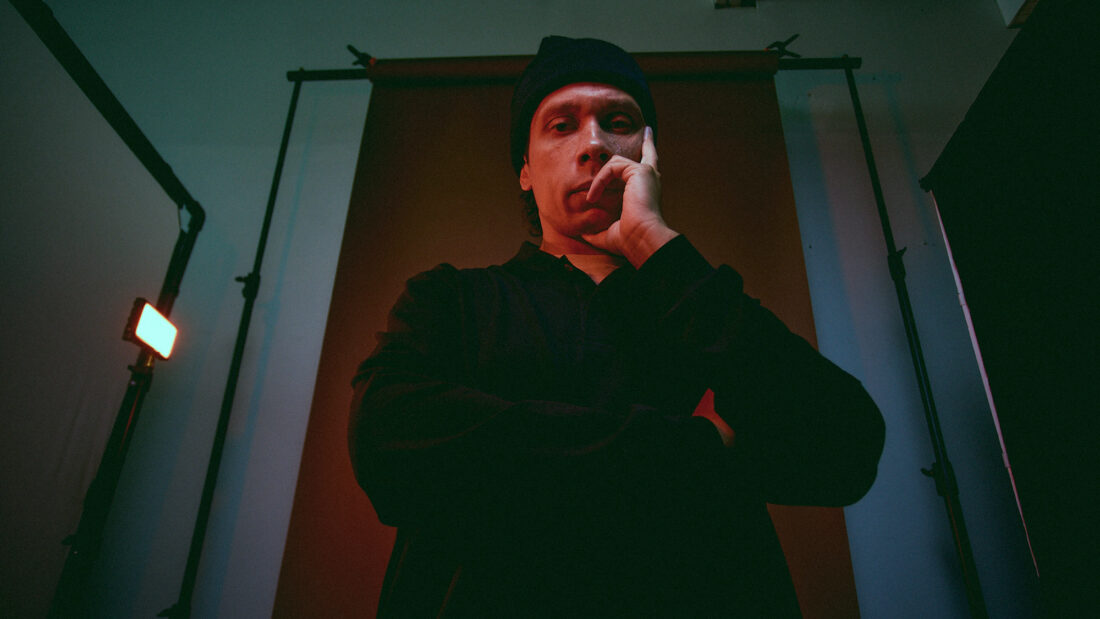
Being a rapper in Winnipeg is kind of like being anything else in Winnipeg—except a hockey player. You are underestimated, overlooked, and fighting to be seen by the outside world. Winnipeg has been discredited, made fun of, and skipped over in the conversations around the history of Canadian hip-hop, but its contributions can’t be discounted. “You can draw inspiration from anywhere, and history happens everywhere, including here,” says Brendan Kinley, who is best known as Brendan Grey, founder and frontperson of Winnipeg hip-hop ensemble Super Duty Tough Work (SDTW). In early June, SDTW released an extended version of their 2023 album Paradigm Shift—the group’s second recording to make the Polaris Music Prize long list—and spent most of the summer performing shows in the U.K., Europe, and Canada. This November, they hit the road for a Canadian tour with Edmonton-born-and-raised hip-hop artist Cadence Weapon. SDTW is essentially MC Grey’s project. Although personnel has fluctuated, the last few years have seen the SDTW lineup solidify around Ashley Au (bass), Marisolle Negash (keys), Gabriela Ocejo (guitar), Olivier Macharia (saxophone), and Kevin Waters (drums), with Grey often hiring session players for overseas shows.
Nigel Webber’s self-published 2024 book Gritty City: An Oral History of Winnipeg Hip-Hop Music: 1980-2005, which draws on 120 interviews, traces the evolution of Winnipeg’s hip-hop scene. In all that time, some things haven’t changed. Grey thinks the city’s scene deserves wider recognition. “My style is my own, but [Winnipeg] is the place where I’ve lived the longest, so I do feel a pretty strong connection,” he tells me during an April interview in Winnipeg. “Winnipeg doesn’t necessarily get the love that it deserves.” Grey wants to bring Winnipeg into the global music conversation.
“What I see in Winnipeg is a resilient city that has roots in the labour movement and significant anti-colonial history and movements,” he says. “Those are two areas that I am interested in within the city—and outside of the city—and that I draw inspiration from.”
Grey was born in Ottawa and raised in Switzerland and Germany. As a child, he listened to everything from Maestro Fresh Wes and Gloria Estefan to Nirvana, Bruce Cockburn, and Kid n Play. While he was growing up, his mom and auntie introduced him to all kinds of music, fostering an appreciation of music across all genres. His uncle was the late Juno Award-winning musician Gerry Atwell, who was also a stage and screen writer and a cultural icon in Winnipeg’s Black community. His grandmother Frances (Brown) Atwell was a singer and pianist. Her influence and voice can be heard on “Grey’s Lament (Grandmotherland)”—one of Grey’s favourite SDTW songs—and “Guillotine Dreams.”
Grey moved from Germany to Winnipeg to attend university and earned a BA in sociology and international development studies before entering the jazz studies program at the University of Manitoba, where he earned a B.Mus. in jazz performance (drum set). He developed an appreciation for Miles Davis, Yusef Lateef, Cannonball Adderley, Joshua Redman, Brian Blade, and Esperanza Spalding. This period of his life opened his mind and ears to new sounds that have influenced his music.
The name Super Duty Tough Work was inspired by one of the subjects in Tony Silver’s Sundance Grand Jury Prize-winning 1983 documentary Style Wars, which explores early hip-hop culture, with a focus on graffiti art. In the film, Kase 2—whom Grey describes as “a foundational graffiti writer, a style writer”—refers to one of his styles as “super duty tough work.” As Grey tells me the origin story of the band name, it occurs to me that he collects details like this to use in his work, waiting for just the right moment to harness them for maximum impact. Grey recalls the band’s first show, held at 72 Princess on December 21, 2013: “It was me, Marisolle Negash, Sandy Fernandez, Sean Burke, and Clash Sounds. We were opening for a group called Jupiter Storm. The party was thrown by the frontperson of that group.”
For four years in a row, SDTW participated in Dilla Day—an annual global event honouring the late J Dilla, the visionary Detroit producer and rapper—to bring Winnipeg to the global stage. Back then, Grey was mindful that audiences like familiar music. “It [was] good and bad,” he explains. “In our shows, when we played something that people recognized, they could latch onto it, sing the words, and feel more involved. But people didn’t always realize when it was my lyrics versus someone else’s lyrics, where I finished and someone else started.” In the early days, the ensemble, which has always featured creative working musicians from Winnipeg and beyond, would experiment with instrumental arrangements of music by hip-hop artists they admired. But Grey realized they weren’t showing everything they could do musically. “It got to the point where we had to release something that was clearly all original material, so people could see that we could hang on that level on our own.”
While the band’s live shows still have the feel of a mixtape, the focus is on creating original music. The shift was precipitated in part by the decision to enter the 2018 edition of Searchlight, CBC Music’s long-running music competition to find Canada’s next breakthrough act. “That was the force behind recording and releasing a song at that time,” Grey says. “There was a deadline. We had to do it.” While they did not win, they did produce their first single, “Hypnotic.” Creating their first original song marked a paradigm shift for the group. “In the last five years or so, we’ve been moving with more focus, more of a purpose,” Grey says. “It’s great that we’ve been able to carve our place, but it’s tough. I respect [hip-hop artists in Winnipeg] doing their thing and forging ahead.”
With recording original music now a primary goal, SDTW set about channelling a unique blend of jazz-influenced instrumentation, social commentary, and performance art on their debut EP, Studies in Grey (2019), which made the 2020 Polaris Music Prize long list. A couple of producers Grey had worked with in Sleeping Giants, his previous group, created beats that SDTW members then played live; two of the songs were written by Grey.
For Paradigm Shift, released on Next Door Records, Toronto-based producer and fellow 2020 Polaris Music Prize long-lister Junia-T travelled to Winnipeg to work with the group. Grey and then-bandmate Marisolle Negash (keyboards) worked with Junia-T in a home studio, making beats and creating skeleton ideas before the entire band went into the studio for about ten days to compose the rest of the album. Lyrics and arrangements were completed later.
“I’m a very minimalist person,” Grey says. “Just give me drums, bass, keys, and then the proper filter, the proper mix. That might be enough, but so many things are left out in that approach. That [was why] it was great to have Junia and Marisolle, who is a strong songwriter and has lots of ideas about layering textures and harmony. It’s about having people that you can bounce ideas off, who are thinking in a way that you’re not thinking.”
For Grey, like many wordsmiths, inspiration comes from many sources. Whether his lyrics are based on words he wants to use or ideas and events he wants to talk about, specificity is a constant. “In my high school English class, the teacher was talking about critical analysis, and how you have to look at every word, [and] assume that every word and every inflection is done on purpose,” Grey says. “That’s how I operate in life, and that’s how I operate in music. Everything is there, ninety-nine per cent of the time, for a reason.”
Whether namechecking Winnipeg, dropping in lines about the genocide of Indigenous people from coast to coast to coast, or making pop culture references, Grey’s lyrics highlight inequity and systemic oppression, celebrate his musical influences, and name people whose stories we may not have previously been familiar with. His work also contains deeply personal elements.
“‘Grey’s Lament (Grandmotherland)’ was probably the last song written for Paradigm Shift, lyrically,” he says. “We pulled from some records that had been in my family for several years. My grandmother was a singer in her younger days and played piano. Her mother was a career pianist and organist, and they made recordings together that were in the basement of my grandparents’ house. We used samples from [those recordings] on our record. ‘Grey’s Lament’ features my grandmother’s voice, and you can hear some of her mother’s keys playing in the background too. ‘Grandmotherland’ was the title of a play that my late uncle, Gerry Atwell, wrote about his grandmother and her life.”
Grey plays with pop culture influences, a staple of hip-hop, collecting ideas over time based on things he’s read, heard, or seen. He holds onto them for as long as it takes, until the right moment presents itself to include them in a song. He does the same with vocal samples, making mental notes of quotations that register in his consciousness and discovering places to use them. Over time, Grey has been able to lean into the uncertainties of his nuanced music practice. “Generally, it’s a natural progression of sitting with the music and writing, recording, layering, listening, and then knowing, ‘OK, it needs something else, let’s do it. That one’s good, move to the next one.’”
With Paradigm Shift landing the music of Super Duty Tough Work on the Polaris Music Prize long list for the second time, Grey is leaving an indelible stamp on Canada’s hip-hop scene. “I enjoy making music. I love rapping, I love all this stuff, but it’s nice to be recognized for the work that you put in,” he says. “My mission is not to win the Polaris Music Prize or a Juno or Grammy or anything like that, although those things would be nice. For me, this is a life’s worth of dedication to this culture.
“[Super Duty Tough Work] has just outlasted and worked harder. It’s about staying in the game. There are so many super-talented people that don’t get support, don’t get love, and don’t get money, so they have to go do something else.”
Grey places a higher value on cultural cachet and the respect of his peers. “That doesn’t necessarily mean just industry peers. That means people that are in this movement and this culture like I am.
“With each release and each experience, each work partnership, you learn new things, right? You can be told something, but until you experience it, you might not understand it. You might not be able to put it into play properly until after the fact. That’s something that has happened with me. Following the release of our last two records, [I’ve become] aware of the things that industry people react to.”
SDTW released an extended version of Paradigm Shift in June, featuring instrumentals and one unreleased track. “The way the business is, it’s about consistently releasing music,” he says. In an email in late summer, Grey confirmed that SDTW was in the early stages of making their next recording, which is shaping up to be a heavily collaborative work—a change from how they’ve made records in the past.
Grey’s vision for the music has remained the same. “There are new elements and it’s tighter and more refined, but it’s still similar to what we were doing at our first show.”
ABIOLA REGAN is a freelance writer and poet. Her articles have appeared in publications such as rabble.ca, Herizons, CBC Life, Salon Magazine, and The Capilano Review. Follow her on Instagram @arwriting.