
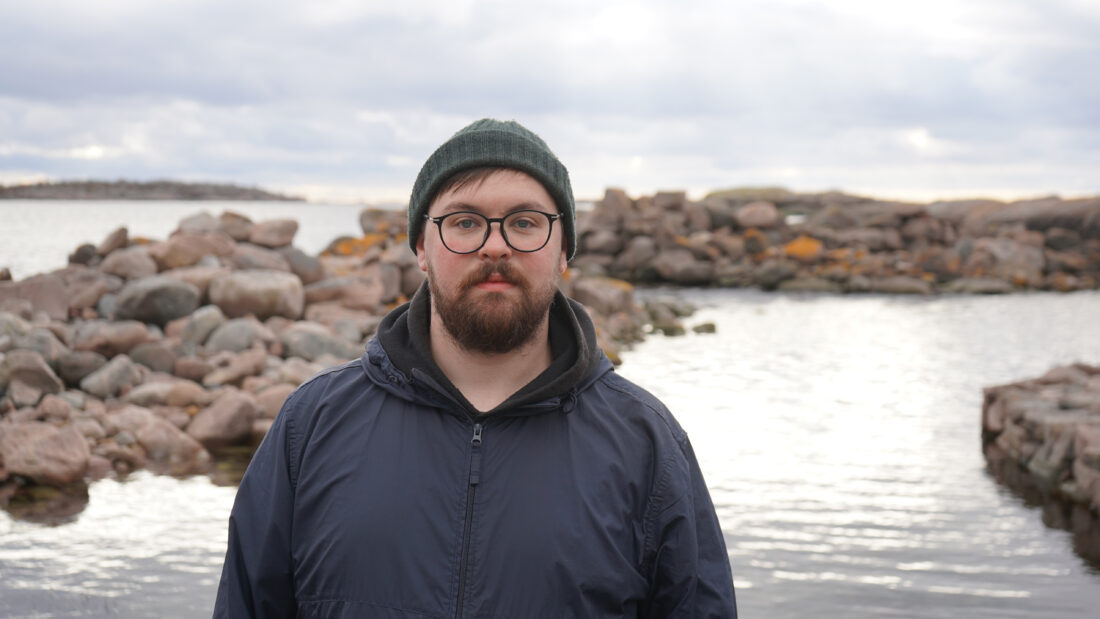
For twenty-one days last October, as part of an artist residency, New Brunswick sound artist Charles Harding and two composer friends cycled back and forth across Kökar, a small Finnish island accessible only by boat or helicopter, to capture its character using various field recorders and microphones, including hydrophones.
Harding found the first night “a little bit spooky, because I suddenly realized I was in the middle of nowhere—in the literal middle of the Baltic Sea, far away from anyone I know [or] love.” The next day, however, Kökar revealed itself to be similar to his native New Brunswick with its beautiful flora and landscape. For the most part, the composers worked as a group. “It was important for us to stay connected to each other throughout the process,” Harding recalls. “We wanted our collective vision and the distillation of our experience to move into the new works.”
Harding and his collaborators planned to explore oceanside ecologies and coastal environments, and gave their project the working title “Impressions in the Sand.” When it turned out there was little sand to be found, the trio decided to allow the rocky island to reveal itself, and to respond to what they were hearing. “It was cool to see how [having] space can fully change your idea about what you want to pursue,” he says.
Harding tends to speak with an upbeat enthusiasm about everything—whether it’s listening to herds of deer clomping around in the dark on a Finnish island or how he wore down his parents in order to get his first drum kit. Growing up in Fredericton, he would transform household objects into musical instruments, eventually sharing the sounds of some of those experiments on Myspace. Computers were also close at hand and part of his creative projects. “Being able to zone in to your own process, for however long, was satisfying,” he says. In his teens and early twenties, Harding split his time between playing drums with the post-punk quartet Cellarghost and composing and recording solo electronic music under the moniker Property//. In the early 2010s, he took the Integrated Media program (now called Foundation of Visual Arts) at the local College of Craft and Design. “In hindsight, it has an unbelievable relevance to [my work] today,” he says.
After moving to Montreal in 2018 to attend Concordia University’s Electroacoustic Studies undergraduate program, Harding became interested in the practice of Deep Listening. “I had never conceived of modes of listening—different ways you can break down sound to have meaning.” He found himself setting aside various ways of working. “In the first couple of years, I had genuinely unlearned a lot of stuff, and [I felt] as though my ‘output machine’ was broken.”
At Concordia, he became part of the electroacoustic composer collective Trajectories—Harding, fellow students Malte Leander and Connor Cook, and their teacher Michael Pinsonneault (who passed away in January 2024)—and began developing ideas in sound and its representation, just as pandemic restrictions were making it difficult to connect. To address these limitations, the collective collaborated via Zoom meetings, shared folders, and recordings of whatever was on hand—not unlike Harding’s early household recordings. The results found their way onto the ten-track album Blood & Breath (2023).
Harding began to contemplate philosophical questions about how the natural world is recorded and played back. “I want to [preserve] the integrity of the environment that I’m [recording] [so it is] minimally affected by my own subjective feelings.” He feels challenged by the process, and by the mediation that a personal gaze might inflict upon the purity of the source material. “Is it fair [for] my gaze [to] define the experience of what I’m recording for the people that will hear it?”
Leander suggested that Trajectories apply to the Åland Archipelago Guest Artist Residence in Kökar, Finland, founded in 1997 and designed to attract international artists from all disciplines. To mark the end of the residency and share some of their sonic findings and creative ideas, Harding, Cook, and Leander offered the community the live performance series “Live on Kökar!” Four videos from the performance are available to view on Harding’s website. In February 2024, Trajectories released Quiet on Kökar on Bandcamp. The digital album features nine compositions “crafted from sounds collected on the island, reflecting on its ecology, human impact, and local life,” Harding writes in the album notes. “Through visits to the Kökar museum and communication with residents of the island . . . new lessons were learned about the vulnerability of the island’s ecosystem as well as the dutiful efforts the community is taking to maintain conscious sustainability in daily life.”
Reflecting on the experiences that have defined his artistic career, Harding is philosophical when contemplating how to respond as an artist when confronted with the politics of environment and climate change. “Obviously I would focus all aspects of my life on this kind of thing, but I only have so much energy,” he says. “Music and sound are [what] I do, so I am constantly trying to think about who is speaking out, and whose voice is important now.”
At the core of Harding’s creative process is a desire to serve as a conduit for the environment. “I want to present sounds [for] people that also inspire them to think a little more deeply and listen more deeply to the world around them.”
ERIC HILL has written about music and culture for over two decades, primarily for Exclaim! His biweekly podcast, Surgery Radio, has been exploring the soft boundaries of experimental, ambient, and pop music since 2004. He has managed Backstreet Records in Fredericton for most of his adult life.