
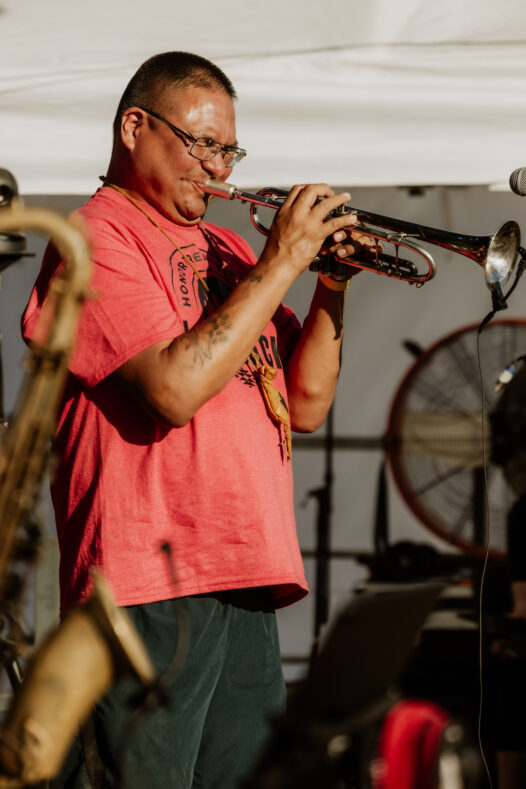
Chuck Copenace is breaking down barriers in his art form, much as Jeremy Dutcher did in merging his classical music training with the words of the Wolastoqiyik people on his two Polaris Music Prize-winning albums. On his 2023 album Oshki Manitou, Copenace constructed a unique jazz fusion, bringing Ojibway sweat-lodge melodies into the world of jazz, à la Freddie Hubbard-esque post-bop, while incorporating seemingly disparate elements, from electronic production to hip-hop beats, thanks in part to drummer Brendan Kinley (Super Duty Tough Work). While Kinley and a clutch of other talented Winnipeg musicians—guitarist Victor Lopez, bassist Henry Onwuchekwa, and saxophonist Kyle Wedlake—helped Copenace create the album, the sound and vision are firmly his.
Each song is built from the ground up, centering on a groove or rhythm, Copenace explains. “I like to start a song from a pad. A lot of them will come when I sit down in front of my sequencer and start improvising on the keyboard with different pads until I find one that I like. Then, maybe if I tweak it a little bit and I like what that does, all of a sudden a pattern will come out of that.”
Copenace has had a lifelong obsession with figuring out the mechanics of music. He relates a story about taking apart an eight-track cassette-player as a child. “I would bring interesting stuff home, and I’d get a wrench and a screwdriver and take stuff apart.” And his curiosity wasn’t limited to the machinery of music. “Electronic music was a big thing—[like] Nine Inch Nails’ Downward Spiral—and there was a lot of remixing of the same song. I was totally into this idea that [NIN’s Trent Reznor] was manipulating these sounds that he recorded, and to me that was super amazing—to make another song just with your computer.”
In the mid-1990s, Copenace sought out the electroacoustic studio in the basement of Brandon University’s School of Music, where he was studying trumpet, and availed himself of the equipment on hand. This allowed him to gain experience while circumventing the financial constraints that he and others faced. “Back then, you needed to have a lot of money for interfaces between professional audio gear and a computer,” he notes. Copenace says that he likely would have finished his degree if not for discovering that electroacoustic studio and feeling a compulsion to join the electronic music world. Nevertheless, he credits a course in twentieth-century music—in which he learned about avant-garde classical composers who were incorporating sampling and computer technology into their work—with expanding his concept of composition.
For Copenace, the jazz world wasn’t as quick to incorporate what he was gravitating toward. “I [didn’t] really hear live bands making this sound or playing a breakbeat style, a house music style or a drum-and-bass style,” he says. Labels like Ninja Tune and artists like Amon Tobin led him to decamp to Vancouver and begin creating music in a way that spoke to that child who took apart and rebuilt audio equipment. “[Tobin’s 1998 album] Permutation—I listened to the hell out of that. He probably influenced the way that I structure music,” says Copenace, adding that he does not compose songs in a verse / chorus / verse or AABA structure but instead conceives of separate sections that are built-out improvisations. “I really focus on bass lines to define what the song is going to sound like,” he says. Surprisingly, it was only after developing this process that the trumpeter—who has been honing his chops since first taking up the instrument in the late eighties in junior high in Kenora, Ontario—began to figure out what to do with his horn.
Copenace has jokingly noted in interviews (including the one for this piece) that he only picked up the trumpet because it didn’t seem like much work to carry—or to play, with only three keys. At the urging of his parents and music teacher Carolyn Easton, who recognized his talent, he was soon taking private lessons, and he joined the Kenora Community Centre jazz band led by Easton’s husband, Barry. “When I look back, I realize everyone had a frantic push that I would latch onto something other than what they might perceive me latching onto. I did have some destructive tendencies as far as breaking stuff, my stuff, and fighting,” Copenace says, noting that the urgency to find him an outlet was especially pressing for an Indigenous child in Kenora, a small city on Lake of the Woods, near the Manitoba border.
While he is grateful that his mastery of the trumpet attracted attention, Copenace notes that ultimately it was an internal thrust that made his connection to the horn so strong: When his mom once said she would take his trumpet away for misbehaviour, that left him thinking, “Well, damn, why would you go there?” Struggles with addiction at one point threatened his relationship to music. “I started getting this idea that partying with friends was just as important, or more important,” he says. But in the 2010s, he connected with Indigenous ceremony, which reaffirmed his connection to the instrument and to music-making in general; all this led to the making of Oshki Manitou.
“When I went to the lodge, that opened that doorway, because then I could understand the songs in the lodge and what has been explained to me,” says Copenace, referring to song structures that had previously not made sense. “As I continued to go to these lodges, the melodies started, as I understood them, and then they started creeping into my process.”
The connection to Indigenous culture is most direct in a piece like “Creator.” Copenace sought permission from Elder Wilfred Buck to use the song’s melody. He wasn’t allowed to use the melody that is part of a Pipe Ceremony, but “Creator,” also known as “Creator Song,” is essentially “Indigenous public domain,” he says. Being able to use it in his version reflects what he loves about jazz: “There’s fusions between jazz and all types of cultural music I’ve seen in different places, and I think there’s always a real willingness to incorporate … [or] bridge between cultures.”
This is especially important to Copenace, who notes that Indigenous culture was forcibly interrupted but not eradicated by colonization. “We don’t know what another two hundred years of uninterrupted Ojibway society was going to create, and it’s been replaced with this idea that we were already done creating when Canada came along.” As a friend said to him in a sweat lodge, Copenace may have still been a song-carrier, but the songs might have been different.
He has the opportunity to carry those songs because, as Copenace sadly reflects, Indigenous cultural creativity is only starting to flourish anew. “The passage of time is putting layers between the trauma of residential school [and the present]. [Without that] there’d just be no space within Indigenous society to sit back and go, ‘Oh, I’m gonna play trumpet’ . . . you know what I mean?”
MICHAEL ELVES is the program director at UMFM, the campus and community radio station at the University of Manitoba in Treaty One territory.