
I am holding a maroon passport in my hand. Inside, its pages spell out the national anthem, one line at a time, in elegant cursive on every double-fold spread. On the cover is the coat of arms, which includes images of an eagle and a lion sitting side by side, three equidistant stars, a sun with eight rays, and the following words engraved in copper-hued Trajan font: Pilipinas. Pasaporte.
The Philippines passport does not allow its holder the privilege of mobility. In April 2024, Arton Capital’s Passport Index (an online global mobility intelligence platform) gave it a low score of seventy-eight—the sum of thirty-nine countries not requiring visas and thirty-nine countries issuing visas on arrival. (Canada, in contrast, had a mobility score of 172.)
Entering Europe with a Philippine passport requires a stamped Schengen visa (an entry permit for a temporary visit of up to ninety days to the Schengen Area of twenty-nine European countries). For my recent trip to the International Music Institute Darmstadt (IMD) in Darmstadt, Germany, my Canadian permanent resident status made the procedure much easier than it was on my first visit. After years of invisibility, I have gained more privilege and can prove I’m not one of “those migrants” that European officials look out for. Nevertheless, my passport alone isn’t enough to prove my worth. I still need a visa. I may not be a desperate migrant, but I am, essentially, a second-class visitor.
“I don’t like the colours of passports. They look depressing.”
C-drík (Cedrik Fermont) is sitting with me in a classroom at the Lichtenbergschule, where the IMD holds its summer courses in August 2023. C-drík spills the beans: His Belgian passport is full of entry stamps from everywhere. “The colour is sad and not positive—there’s a militaristic look to its display of power,” he says, referring to the Leo Belgicus (Belgic lion) that represents the former Low Countries, including the Netherlands, Belgium, and Luxembourg. But his practical concerns obscure this powerful symbol. “I keep a plastic covering over it. My previous passport got wet from monsoon rains in Indonesia, and it got ruined.”
Hopping from one place to another, C-drík maps out an extensive network of the world’s electronic punk, ambient, and noise music scenes. As an experimental electronic artist and producer, he instigates collaborations and releases records under his record label, Syrphe. With scholar and artist Dimitri della Faille, C-drík co-published Not Your World Music: Noise in South East Asia (2016), which takes Southeast Asian music scenes out of the exotic imaginary and into the modern reality where they belong.
A sudden jolt of an e-bow hitting strings opens C-drík’s “Chordophone” (2021). Unlike his past works, this piece avoids any electronic processing to articulate an expansive temporal space with the zither. This simulacrum of musique concrète doesn’t remain confined. C-drík invited artists to create tracks using his samples, culminating in a subsequent album release aptly named Chordophones (2021). The world is a resonating chamber, vibrating freely.
C-drík, who has Greek, Belgian, and Congolese roots, recounts his 1980s teenage years when European listeners had little knowledge of industrial music and EBM (Electronic Body Music, not to be confused with today’s Electronic Dance Music) being created outside of Europe and North America. His curiosity became an obsession. “If I could find music from Japan or the U.S.A., then surely I could find music from Mexico or Indonesia,” he says. This search proved difficult. He joined an arts network that traded tapes and circulated fliers from all over. “Oh, there is punk music in the Philippines!” he remembers exclaiming. His pre-internet-era efforts to contact artists by snail mail were mostly met with silence, but some people answered. Throughout the 1990s, he connected with people from South Africa, Brazil, and Japan.
Although online explorations became easier in the 2000s with Peer-to-Peer (P2P) networks, C-drík wanted to visit places in person, because people were insisting that there were no experimental scenes there. Pooling resources with others, he travelled to Turkey and Thailand to perform, eventually meeting artists like Yan Jun from China. He serendipitously landed a Bangkok gig by forum-posting on the P2P platform Soulseek. During a six-month tour in 2005, he forged attachments with artists in Malaysia, Vietnam, Singapore, China, and South Korea, as well as the Philippines, Taiwan, Macau, Cambodia, and Myanmar.
“Even Myanmar?” I interrupt.
“Despite what people told me, I was convinced that there was a scene there.”
Even his Southeast Asian friends were oblivious. It’s unlikely to find anything underground with a military junta in power, they told him. C-drík believed otherwise: “I’ve heard of politically active hip-hop and punk bands there. And where there is hip-hop and punk, there’s more.” He had to prove his theory first. And so he searched: Myanmar experimental music. Burma experimental music. Yangon experimental music. Myanm/art founder Nathalie Johnston was in Yangon, Myanmar’s capital. So were Serbian sound artist Rastko and Burmese artists like Ko Jeu and DJ Kavas. C-drík reached out, and everyone was enthusiastic about organizing a show in 2014. Even the traditional musician Ko Doo, a lover of experimentation, joined him in a performance co-presented by Alliance Française.
Indonesians Sabrina Eka Felisiana and Annisa Maharani have been making noise on their own terms since 2015 as Sarana. Contrary to their bubbly personalities, the duo’s improvisations are fuelled by nightmares and horrors and filled with dark ambient sounds from synthesizers (Korg’s Kaossilator and Volca Keys), software (VCV Rack, FL Studio), guitar-effects pedals, handbells, found objects, and amplified voices in the Bahasa Banjar language.
Sabrina is all smiles as we walk to an Asian restaurant on Darmstadt’s Mina-Rees-Straße. Annisa is also giddy, but nothing beats Sabrina’s enthusiasm for rice. “You saved our lives!” their rice-starved selves declare.
Sabrina tells me they eschew traditional sounds in their music in order to avoid exoticism. The track “Binatang” from their 2016 debut EP Heal catches my attention as Annisa’s opening lines penetrate the darkness: Aku adalah binatang. Kamu adalah binatang. Dia adalah binatang (“I am an animal. You are an animal. He/she/it is an animal”). It’s a call to one’s innermost primal being. We are beasts not just of our making, but of the worlds we live in.
Sarana’s backdrop is the urban life in Samarinda, the capital of Indonesia’s East Kalimantan province on the island of Borneo, where both musicians reside. Its climate of uber-hot sun and rain is always the butt of their jokes: “Summer-Rain-Da!” Strategically situated along the Mahakam River, Samarinda’s blanket of noise is intensified with the din of shipping traffic. Coal mining fuels the local economy. Mining advocacy networks like Jaringan Advokasi Tambang protest environmental and welfare issues around illegal mining.
Sarana’s participation in the Darmstadt Summer Course 2023 feeds my curiosity. “Would you mind if you show me your passports?” I ask. Their passports are always with them.
“Looking at my passport reminds me that Singapore always has the strongest one,” Annisa says. She is the outspoken English speaker. Rich Singapore is always her easy target for comparison. The turquoise green cover features the Indonesian coat of arms, a golden burung garuda (eagle) that embodies not only Hindu and Buddhist mythologies but also the pancasila national ideology. A page notifies a request to grant its holder the right of passage and protection.
C-drík interrupts my thought: “How do we deal with situations when embassies refuse someone a visa?” Artists travel or pursue studies abroad to partake in a global network. C-drík mentions that composers Slamet Abdul Sjukur (Indonesia), Alireza Mashayekhi (Iran), Bülent Arel (Turkey), and many others ventured into the music centres of Europe in the 1950s. But today’s visa applications often require significant resources, and a refusal doesn’t lead to any recourse or alternative. Gabber Modus Operandi (profiled in Musicworks 147) is a case in point. The Indonesian hardcore techno band, which performs around the world, was once booked to appear in Greece by an agency affiliated with Germany’s CTM Festival. They were refused visas. “I don’t know why the Greek embassy didn’t allow them. They had already come to Europe before. Is it because they think they come here too often?” C-drík speculates. It’s a pursuit of second-guessing. Embassies often withhold their reasons for refusing admission. The United Nations upholds the universal freedom of movement, but borders transfigure it into a powerful commodity.
Whenever I broach the subject to North Americans, the conversations are revealing. As the holders of powerful passports, many don’t know what a Schengen visa is. Predating the European Union, the Schengen Area has served as the jurisdiction for Europe’s visa policy since 1985. I had to apply for one to visit Darmstadt for two weeks in 2023. Aside from filling out the countless pages of nine documents, it required a fee of $118 and an appointment at the Consulate General of Germany in Toronto. German diplomatic missions in Indonesia and the Philippines outsource visa services to VFS Global. Having a third-party agency to support their consular work reflects the huge volume of applications from the Global South.
“It was easier the first time, since Goethe Institut Jakarta sponsored us,” says Annisa, referring to their first European performance at the 2019 CTM Festival in Berlin. “This time, there were additional rules and documents. We had trouble with our kartu keluarga [a registry document that lists family members] because we learned that they needed English translations.”
“They also wanted a cover letter this time,” Sabrina adds.
Submitting applications at the VFS centre also requires flying to Jakarta, and often staying there short-term. I propose a math game: “How much money would anyone in Samarinda need to apply for a Schengen visa?” We add up the expenses: VFS appointment fees, passport courier services, cheap round-trip air fares to Jakarta, local commutes including ojek (motorcycle taxis) and buses, hotel bookings, everyday meals. “It depends how far you are from Jakarta,” Annisa reflects. Visa fees? They got exemptions because of endorsement letters from IMD and Goethe Institut.
Sabrina and Annisa spent more than US $300 each, more than a month’s salary. This excludes visa fees (US $83), mandatory travel insurance, and proof of sufficient funds to cover the intended trip. Indonesia’s Badan Pusat Statistik (Central Bureau of Statistics) reported that East Kalimantan’s workers across all industries earned an average monthly wage of US $257 in 2023. And this is before any borders are crossed.
At one afternoon workshop session, Annisa’s spoken words push their way out of the electronic mush. Sound artist Farzané’s live computer coding generates electronic plucks that intensify into denser clouds. Sabrina electronically processes motorboat sound samples reminiscent of Samarinda’s river freight traffic. C-drík adds swirling noise textures that are visualized by moving spirals on his laptop screen. Antye Greie-Ripatti (who goes by the alias AGF) handles mixing while preparing sound samples for her drum pad. Linda Mudimba scrubs a contact microphone on surfaces to create noise, then C-drík proposes sounds of water. After experiments with ceramic glasses, Linda settles into pouring water in front of a microphone. Water sounds set the backdrop of Annisa’s manifesto.
“We are far from everything…
And we are far from fine…
Dunia yang jahat ini… [This evil world we are in…]
We are forced to face everything we don’t want to see…”
Finland-based AGF and C-drík first conceived the Sonic Writing and Soundings residency for the IMD’s Summer Course to bring attention to the largely unknown electronic music of female artists from the Global South. Set to take place in 2020, the residency was held instead as a digital project in 2021 due to the pandemic. The five invited artists—Lindatumune (Linda) Mudimba (Zimbabwe), Farzané (Iran /Austria), Sarana (Indonesia), Wanjiru Ngure, alias [M] (Kenya), whom we called Monrhea, and Palestinian experimental musician Asma Ghanem—kept in touch and were invited to an in-person continuation of the residency, in cooperation with the Goethe Institut, at the 2023 Darmstadt Summer Course, where they gathered for intensive workshops and a culminating concert. (Asma Ghanem participated in the 2021 digital version only.)
The workshops hold space for hefty discussions about Iran’s anti-authoritarian protests, Borneo’s illegal mining, and Zimbabwe’s women’s empowerment movement. Annisa shows a photo of ferry congestion in the Mahakam River (as multinational conglomerates increased trade, they also adversely affected ecosystems, we are told). C-drík takes a shot at China’s encroaching influence, with advertisements everywhere you look when flying out of Lusaka, Zambia’s capital. Linda corroborates: “Chinese businesses, shops, mining—they’re all over Zimbabwe, too.”
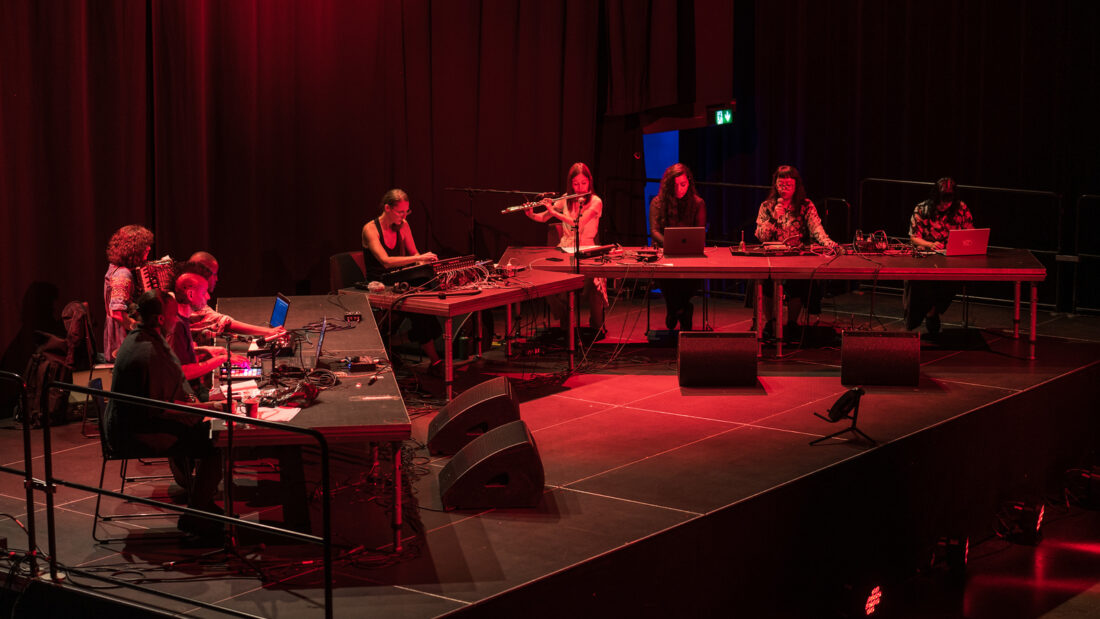
Concert night arrives. The residency artists and organizers are joined by Mira Tulenova (Kazakhstan / Germany) performing on flute, shanqobyz, and voice, and Zelal Ekinci (Turkey / Germany) on accordion. The gold and blue house lights at Darmstadt’s historic Centralstation transform into red hues as we start swimming through atmospheric tides. We bathe in rivers where ships sail in the name of capitalism, mother tongues fight to be remembered, people wander across the steppes (alan), underground water canals (qanat) rise to the surface, neglected territories are reclaimed, and field recordings of dissent shape the future.
Eight pieces form the set, each one a complex journey birthing political soundings: Territory, chaosBEET, Alan (Steppe), Mothertongue, Water Cycle, Hidup Perempuan, Mumakwatano, Vengayiş.
Everyone improvises to conjure dark ambient worlds: industrial and menacing at times, atmospheric yet breathing at best. Sounds float like seaweed on oceans, spelling out entanglements of spoken word, found objects, accordion drones, flute and jaw-harp interjections, field recordings, analogue synthesizers, digital processing, and live coding. Samples of saxophones, protesting crowds, and motor boats emerge. Handbells and yelling in Bahasa Banjar call out into the void.
The totality is difficult to unpack. Each artist is a universe, and the ecosystem a collusion of all universes. Sounds jostle for space, but AGF takes great care to create contours in the mixing. Mothertongue uses text from composer Jessie Cox’s essay “Stories of the Mothership: Charles Uzor and Mothertongue” (published in the 2023 anthology Composing While Black), which explores Switzerland-based Nigerian composer Uzor’s critical outlook on languages; the audience then hears excerpts in English, Tonga, Bahasa Indonesia, Kazakh, and German. Linda, Annisa, Mira, and AGF say, “Out of the fringes, we claim our space: right here, right now!”
Mira plays the jaw harp, and I smile with fascination, only to stop myself. Why am I smiling at stories of oppression? “She remains hidden from the day she was married,” Linda says, ending her spoken word piece. Zelal’s accordion passage in a minor key concludes the whole journey. If I could ask for anything more, it would be Annisa’s yelling, the raging voice of the weary. “My throat would kill me if I yelled more,” she later admits.
Around ten folks show up to an open house put on by the residency one afternoon a few days after the concert. AGF explains the notes on their white board. “We all came from different places, and so we had to find common grounds to start work. All set pieces took off from these notes.” The interest in the electronic impulses outside of Euro-American centrism remains minuscule. It is non-reciprocity with the South, whose artists perpetually keep up with the North. Passports become moot. Unfamiliar cultures remain invisible, far from everything.
“Travelling is convenient once you’re part of this European fortress, even [for] Eastern Europeans, who might find it more difficult,” C-drík says. If you’re from the Global South, it does feel like infiltrating a fortress. The Global North also sees it this way. Infiltration. Protectionism governs public arts funding policy. While funding bodies like the Canada Council for the Arts are distanced from governments, the nation-state always takes precedence. If you live in Canada but you’re not a Canadian citizen or a permanent resident, you can’t access arts funding. Hyphenated identities may signal increased global diversity, but it is an illusion to rely on them. What is arts curation when geopolitics hinder visibilities? Artists compete with richer economies and get visas before being seen. Organizers may spend thousands on travel, but plans go down the drain if artists are stopped at the border and prevented from entering the country.
“It’s not just the artist’s loss, it’s also the countries’ loss,” C-drík says during his Darmstadt talk on global collaboration. The compounding benefits of cultural exchanges and economic interests vanish. I ask him publicly: “We’re dealing with government policy here. Is the arts sector mobilizing to confront governments with this?” C-drík is not aware of any efforts, but multinational networks do fill in some of the gaps. For example, Artists at Risk advocates for the safe passage of artists who face high security risks like persecution and political harassment; the non-profit recently relocated Ukrainian artists fleeing the Ukrainian-Russian war, and Afghan artists during Afghanistan’s Taliban takeover. Some war-torn countries like Yemen and the Democratic Republic of the Congo attract little financial support for cultural exchanges from government foreign policies, according to C-drík. Hearing this, I consider that recent funding programs like the Ukraine Cultural Heritage Response Initiative (from the U.S. State Department) show this disproportionate global attention.
C-drík also raises a bigger issue: “How can we sustain networks once funding disappears?” Border Movement, a platform to encourage dialogue between scenes and bring South Asian artists to German audiences which Goethe Institut has funded for eight years, comes to mind. Budget cuts to cultural programs are rampant as the world seems to shift toward the political right. Resources disappear. Hard-lined borders remain.
Sociologist Benedict Anderson’s “imagined community”—a concept in his 1983 book Imagined Communities which describes a nation as a socially constructed community—remains a beacon of hope, a frame for cross-border networking. The Biennale Jogja’s “Equator Series” curated collaborations between artists in Indonesia and nations in areas around the Equator: in Africa, Latin America, the Middle East, and Oceania. The Border Movement initiative connected Germany with artists from Bangladesh, India, Iran, Nepal, Pakistan, and Sri Lanka. Despite the world’s insistence on Africa’s “poor continent” image, its rich alternative scenes abound. Metal music in Botswana, Mozambique, and Angola? Electronic music in Kenya and Uganda? Manifesting imagined communities, C-drík’s website houses his expansive database of the world’s experimental artists for anyone’s perusal.
An Argentine attendee thanks C-drík after his talk: “You don’t recognize the benefits you have when you’re on the other side of the fence.” She concludes that it’s important to acknowledge this, take responsibility, and apply that awareness in art-making.
“We feel that audiences outside Samarinda—even outside Indonesia—are more welcoming and appreciative of our music.”
Seven months have passed since the Darmstadt residency when I meet Sabrina and Annisa again through video conferencing. Our realities are now twelve hours apart. “Samarinda is a small city. Its scene isn’t big, unlike in Yogyakarta, Jakarta, or Bandung,” Annisa reflects, amid the increasing late-night crowd chatter around them.
Sabrina agrees: “We want to perform more outside our hometown.”
Sarana has performed in Singapore and Germany. They have appeared in interviews and publications like The Bloomsbury Handbook of Sound Art (eds. Sanne Groth, Holger Schulze, 2020). While their work is celebrated online, the difficulty of coming to the Global North still limits their activities. Annisa concludes: “Samarinda is home. We still want to live here, but if there’s a chance to move elsewhere, why not?” Sabrina didn’t raise any objections.
“People told me I’m lucky to do what I do,” C-drík reflects. I recall our conversation at the Lichtenbergschule, when his soft-spoken demeanour emerged. “I don’t believe in luck, because I struggled a lot. But among the little ‘luck’ I have had is getting a Belgian passport.”
The Schengen visa’s green colours conjure mixed feelings. The visa authorizes entry to a place while simultaneously branding the visa holder as someone who needs authorization. The visa’s validity dates are like switches that turn on humanity and artistic prowess on its start date and turn off when the visa expires.
If only global infrastructures could get rid of the problem. My experience in Darmstadt with C-drík and Sarana proved one thing: The world misses out when artists cannot show up and build community. Invisibility plagues the already invisible while hypervisibility shines down on the mobile and visible. Even the protectionism of nation-states enables this in the name of sovereignty. It’s time to dismantle borders, one passport page at a time.
JURO KIM FELIZ is a Toronto-based composer, pianist, and writer. Collaborating with Thin Edge New Music Collective, Ensemble x.y, Liminar, and others, his music has been performed at major events such as New York’s MATA Festival, Nief-Norf Summer Festival, Mexico City’s MUSLAB, the Asian Composers League Festival, and the Yogyakarta Contemporary Music Festival. He is the recipient of the Goethe Southeast Asian Young Composer Award (2009) in Kuala Lumpur and has commercially released music with Ablaze Records. During a Canadian Music Centre Library Residency, he created Nomadic Sound Worlds, a miniseries of podcasts and essays that frames Canadian contemporary music through the lens of global migration.