
The term “experimental art” often elicits vacant looks and furrowed brows, even among artists and arts communities. For experimental artists Roxanne Nesbitt and Anju Singh, co-artistic directors of the Vancouver-based Currently Arts Society (CAS), the nebulous term poses no significant problem. “We keep the definition really open,” says Nesbitt. “I think that’s the value of experimental art. The boundaries are shifting and flexible and permeable. So we don’t spend a ton of time discussing whether something is experimental.”
“As experimental artists, our goal is not to just become really good at one particular skill forever,” Singh adds. “We experiment with other things. For us, it’s about what happens when you put this and this together, or what happens if I do this instead of this. It’s about pushing things rather than perfecting to meet some kind of artistic standard that’s already established.”
The near impossibility of pigeonholing experimental art has resulted in it not being well distributed. This has, in turn, resulted in disconnection between experimental artists in the Canadian community. Nesbitt and Singh, who are both of South Asian ancestry, met in 2020 and founded the CAS that year. It was an isolating time, Nesbitt says, and not only because of pandemic shutdowns. “For artists of colour, [the] movement by arts organizations to make declarations about the lack of diversity in their ongoing operations [brought about] a wave of trying to bring in BIPOC artists . . . but on the organizations’ terms. In a way, it [had become] a fad.
“It seemed weird that [Anju and I] had both been working in Vancouver’s experimental music scene for many years and hadn’t encountered each other,” Nesbitt continues. “That sparked the idea to start this experimental artist archive—a place that was independent of corporate social media and where experimental artists could learn about each other.”
The CAS founders note that important artists were not being documented and should be—“specifically in the experimental realm as a sometimes difficult-to-understand genre,” says Singh, who adds, “Often, even when I meet other artists, I feel like my work is received like it’s strange [because] I work across disciplines. Okay, but I’m an artist. So why wouldn’t I? Why wouldn’t I touch on things I am passionate about?
“Meeting Roxanne normalized how I felt, worked, and what I do,” she continues. “I felt I had met someone I could talk to, and who doesn’t think that the way I work is totally wild.”
As of this writing, Currently Arts has curated two digital archival projects: the Experimental Artist Archive and Undercurrents. The former is an archive of work by experimental artists from across Canada, past and present; the latter archive has a narrower focus, highlighting the work of BIPOC experimental artists based in Vancouver between the years 1970 and 2020. Members of Canada’s experimental arts community can submit work for possible inclusion in the archives.
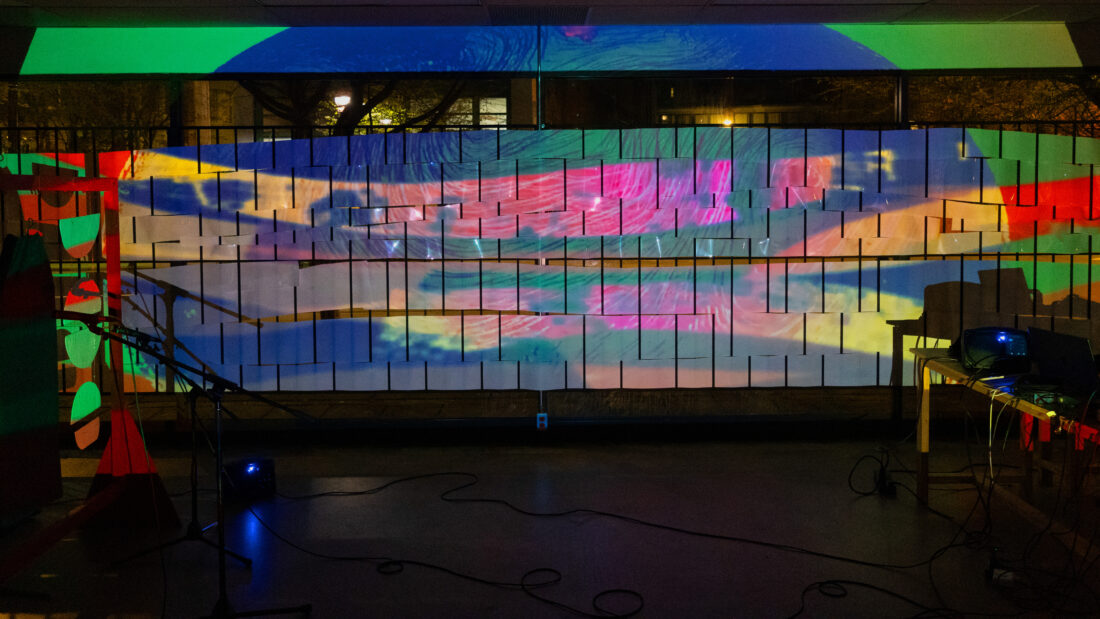
Since 2022, the company has also produced a number of in-person installations and events in Vancouver, including Interwoven, a large scale graphic score / audiovisual installation incorporating architectural elements created by Nesbitt and Singh as part of a residency at 8EAST, as well as two community-based workshops focusing on sound, media, fashion, and interdisciplinary art-making. The Experimental Artist Archive had a public, in-person launch in Vancouver in October 2023.
While Nesbitt and Singh have reached the end of the Canada Council funding they received to work on the national Experimental Artist Archive, they want to find ways to keep it going. “Our hope is to find future funding and future partners to keep building it, and do something more active so it’s not just a passive archive,” Nesbitt says. One idea they are considering is organizing a festival where all the artists in the archive can meet each other.
On its website, Currently Arts states that it rejects “broken and damaging ways of working including product-focused, colonial, and capitalistic working methods.” As Singh explains, “Capitalism demands that we have something to sell, and for experimental artists this means leaving our process and experimenting space, which hinders our practices. South Asians [have been] told that there are certain ways we should behave. There are certain ways that we should be. So if we are going to push back against colonial training from British rule and its impact on our ancestors and relatives, we need to think about what we, as experimental artists, are bringing in from that history, and what we are going to shed as we create as artists.
“This matters to me, because we need to reject the old and broken way of working or our artistic practices will not evolve. It [will have] a seriously detrimental effect on the work we make if we do not shed and question traditional approaches to art-making as experimental artists.”
C.E. GATCHALIAN is a Filipinx queer writer based in Tkaronto (Toronto). He is the author of six books, co-editor of three anthologies, and an award-winning theatre artist and producer. He received the Dayne Ogilvie Prize in 2013, awarded annually by The Writers’ Trust of Canada to an outstanding emerging 2GBTQ2S+ writer. He has been playwright- or writer-in-residence at many notable arts companies and organizations. His plays have been produced locally, nationally, and internationally. His memoir Double Melancholy: Art, Beauty and the Making of a Brown Queer Man was published in 2019 by Arsenal Pulp Press.