
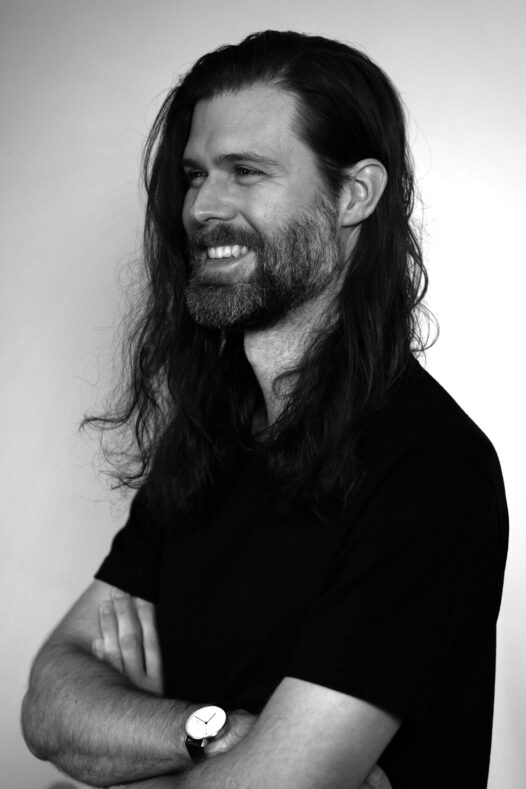
A musical project may have a clear beginning, but sometimes it’s difficult for an artist to know when it’s actually finished. For Evan Dysart’s latest album, Invisible Architecture, a tight deadline provided the push to the finish line that he needed.
The album’s origins can be traced to the thesis project for Dysart’s master of architecture degree, which he received from Ottawa’s Carleton University in 2012. As part of the thesis, entitled “[In]visible Architecture,” he researched sociology, anthropology, architectural theory (including the work of noted Swiss architect Peter Zumthor), and visual perspectives in order to “develop a language of aural perspectives and an understanding of how the invisible characteristics impact your perception of space, [and] to design invisible acoustic spaces that make you feel actual physical spaces.”
Dysart created an octophonic sound recording device that captured the acoustic characteristics of buildings, and built a semi-anechoic listening chamber (walls and ceiling are absorbent, sound reflected only from the floor) with an eight-channel octophonic speaker array which he calls the Octopod. After participants listened to multichannel recordings of ten different spaces, he would ask them to complete a questionnaire. “When given the opportunity and asked directly, [people often] have some level of synesthetic understanding of space, whether through hearing or associations with temperatures, colours, and lights,” he recently told me.
Ten years later, Dysart—who is now based in Vancouver and creates and performs electroacoustic ambient and dance music under the moniker DYSAART—had an opportunity to develop this work further when he was an artist in residence at Vancouver’s spatial-sound studio Lobe. Founded in 2020, Lobe is one of only three permanent studios in the world with 4DSOUND, an immersive sound technology system founded by Dutch composer Paul Oomen. Dysart’s EP had to be completed by the end of his five-day artist residency at Lobe, because he would not have access to their software and space thereafter. Because of the tight timeline, Dysart came prepared with the full composition, and he made use of his existing knowledge of modular synthesis and 3-D modelling from his architectural background.
“When I could hear it in the space and imagine where things would be moving and actually tried it out, there was a whole tweaking process, and mixing that needed to be filtered a different way,” he said.
The fact that the project was created in and specifically for one particular space raises the question of how Invisible Architecture would play in other venues and listening experiences. To launch the album, Dysart hosted a series of spatial performances for small groups at Lobe and released an album version on streaming platforms like Bandcamp. Similar to the process for his 2021 release C-41, Dysart had to mix the stereo version of Invisible Architecture “for kind of a lowest common denominator of speakers, because you’re trying to think of what people will be listening to on headphones, what they will be listening to in the car, what it will sound like on bad speakers or a phone, and what it will sound like on really good speakers. There’s always a compromise, one way or the other.”
Creating the mix for a spatial experience concept album was easier. “It is mixed specifically for one room that exists in one place in the world, and that’s the only place where people will actually be listening to it in its full essence,” he explained. “There’s a whole relationship between the composition and the actual space of the spatial mixing part.”
This past summer, Dysart played a live spatial audio composition at the Bass Coast Electronic Music and Art Festival in Merritt, B.C. “It was only thirty speakers—slightly less than they have at Lobe—but they made a geodesic dome and hung the speakers within the dome. So it was literally an outdoor experience of spatial audio.” The dome was open to the sky in the centre, and there were no physical walls. “The speakers are bringing the space, as opposed to the actual physical space fighting a little bit with the speaker arrangement in an interior space. On top of that, because it was a daytime performance, being able to see the movement of the clouds and trees swaying in the wind [made it more ambient].” With an eye on the future, Dysart is heading to Berlin in September for a five-day artist residency at MONOM—an experimental performance space and studio that houses the first 4DSOUND system, designed and built in Amsterdam in 2012—where he’ll complete the spatial mix for his next album, Simulacra. Dysart plans to continue playing with the relationship between architecture and music, and to create smaller, more mobile spatial audio that works within the acoustics of a city. “What it comes down to is creating feeling and atmosphere.”
ABIOLA REGAN is a freelance writer and poet. Her articles have appeared in publications such as rabble.ca, Herizons, CBC Life, Salon Magazine, and The Capilano Review. Follow her on Instagram @arwriting.