
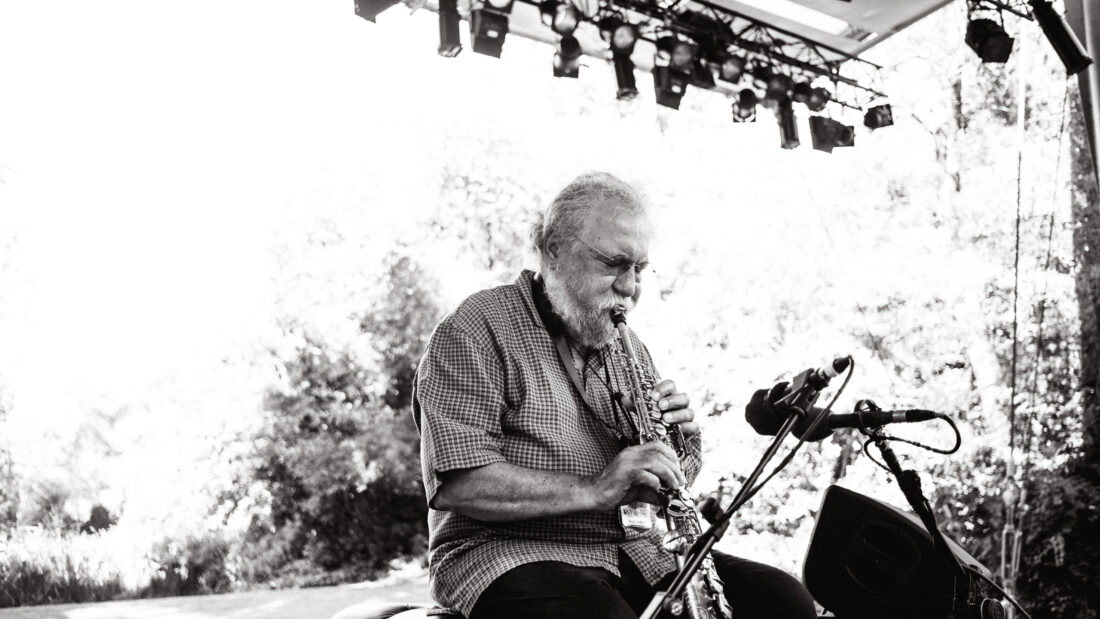
Contemporary music has been blessed by transformational figures such as Pauline Oliveros, Éliane Radigue, and Anthony Braxton, philosopher–composers who further the musical lineages of Olivier Messiaen and John Cage, among others. British saxophonist and free improvisor Evan Parker, who recently turned eighty, is surely among them. In 1968, Parker, then in his mid-twenties, appeared on two of the most significant and distinct building blocks of European free improvisation, one a masterpiece of subtlety, the other of aggression: Karyōbin by Spontaneous Music Ensemble, drummer John Stevens’ fledgling supergroup with Parker, Kenny Wheeler, Derek Bailey, and Dave Holland; and Machine Gun, an octet recording led by Peter Brötzmann. Since then, Parker’s explorations in saxophone techniques (circular breathing, split tonguing, multiphonics), a hallmark of his solo work, have been passed on to musicians on a host of instruments, and he has played with an extraordinary range of musicians and ensembles, from the Charlie Watts Orchestra to the Transatlantic Art Ensemble, which he co-led with Roscoe Mitchell.
Parker’s collaborative projects are compositions that develop and expand over time. This global vision in sound—inclusivist, spontaneous, and entrancing—has become both clearer and more explicit in his recent music. One of the most expansive expressions of Trance Map+—Parker’s ongoing project with British composer, producer, and sound designer Matthew Wright, who performs on live electronics—is TransAtlantic Trance Map, which had its world premiere on December 17, 2022. The networked transatlantic performance united two separate ensembles of A-list improvisers, one playing at the Hot Tin in Faversham, England, the other at Roulette in New York. This stunning performance was also a technical achievement that saw thirteen virtuoso musicians interacting in closely detailed, spontaneous, real-time dialogue without jet-lag exhaustion. (A list of the players and a video of the performance can be found on Roulette’s website.)
Wright, who had an interest in mining Parker’s extensive archive of global field recordings, met Parker in 2005, and a working partnership developed in 2008. Their early collaborations as a duo were collected on Trance Map, which was released on Parker’s label, psi, in 2011. Now renamed to denote its flexibility, Trance Map+ enlisted Spring Heel Jack’s John Coxon (turntables, electronics) and Ashley Wales (electronics), and bassist Adam Linson for its 2019 album Crepuscule in Nickelsdorf (Intakt). Wright has often subtly integrated parts played by other musicians—such as percussionists Toma Gouband and Mark Nauseef—creating work that is essentially poly-temporal.
In any of its incarnations, Trance Map+ continues the development of a central element in Parker’s work: multiplicity, that is, the continuous enrichment of sounds diverse and alike, whether through technique, collaboration, overdubbing, or a combination of all three, in an ecstasy of data, a snowstorm of tones in an impossible laboratory. TransAtlantic Trance Map reflects an evolutionary collective music that has distinguished Parker’s work for decades: Ensembles will double, then continue to expand, in a social discourse that might begin with startling soprano saxophone solos in which lines multiply and morph—miracles of lungs, embouchure, and fingering that can suggest a flock of birds.
Electronics entered Parker’s music well before Trance Map. In the early 1970s, his duo with British drummer Paul Lytton began supplementing its performances with tapes of previous performances. His trio with Lytton and bassist Barry Guy, which formed in 1979, doubled to a sextet in 1990 to become the Evan Parker Electro-Acoustic Ensemble; three electronic musicians were each matched to a member of the trio. In 2010, the ensemble was expanded symmetrically to include eighteen acoustic and electronic musicians for a performance at Lisbon’s Jazz em Agosto, which I attended. Parker revealed the score on an index card to me and remarked, “Paul Lytton is keeping time. One beat every ten minutes.”
In 2001—with the assistance of Martin Davidson of Emanem Records, a central support to English free improvisation—Parker founded the label psi, named for its “associations with irrational numbers, golden ratios, etc., but above all for the Psi[sic] phenomena which I am convinced are at the heart of improvised music-making.” For the decade the label was active, Parker documented a host of interests. He reissued classic recordings of his own (or of close associates like expatriate Canadian trumpeter Kenny Wheeler) and recordings of neglected musicians, like the masterful but undocumented mainstream modern saxophonist Gerd Dudek, an associate from the Globe Unity Orchestra. The label also released music by younger artists such as British pianist Pat Thomas, whose stylistic breadth stretched from Duke Ellington to Randy Weston and beyond; wunderkind American trumpeter Peter Evans (best known then as a member of Mostly Other People Do the Killing), whose astonishing technique developed in part from his exposure to Parker’s solo recordings; and Gouband, whose drum solos opposed every exhibitionist impulse common to the form as he meditatively struck resonant stones together.
Numerous musicians from the electronic realm also appeared on psi, including the veteran duo of Furt (Richard Barrett and Paul Obermayer) and turntablist DJ Sniff, whose album EP was constructed initially from samples of Parker’s recordings and expanded to include other improvisers. Evans and Furt joined the Electro-Acoustic Ensemble, and Evans was often a virtuoso presence in the Parker / Guy / Lytton trio, just as eminent musicians like trombonist George Lewis and pianist Marilyn Crispell had been in the past.
When Parker celebrated his eightieth birthday earlier this year in Faversham, Kent, the performance gathered the now far-flung membership of the band that had first assembled to play together forty-five years earlier, the Parker / Guy / Lytton trio. Two days later, in a continuing celebration, he played at London’s Café Oto with a version of Trance Map+ that included Lytton and Guy.
In July 2023, I was once again in Lisbon to attend the Jazz em Agosto festival, drawn in part by Parker’s scheduled performance in a sextet version of Trance Map+ and his guest appearance with Joshua Abrams’ Natural Information Society (NIS), a hypnotic ensemble that employs drones and exotic instruments to realize Abrams’ extended compositions of overlapping modular phrases in performances that can feel like healing ceremonies. Heard a day after Trance Map+, it sounded like a journey to the roots of Parker’s music.
To some, the projects might seem dissimilar. In Trance Map+, Wright plays laboratory-bright turntables, Peter Evans’ collection of trumpets (standard, piccolo, flugelhorn) glitters, and patch cords explode from Pat Thomas’ synthesizer. In Abrams’ group, Lisa Alvarado’s modest harmonium is powered by hand bellows, and Abrams’ guimbri, a three-stringed Moroccan bass lute, is a distinctively primitive-looking instrument with a goat-hide top and a neck that looks likelier to belong on a farm implement than on a string instrument. Yet there are profound similarities underlying the ensembles’ work, as their two paths lead to comparable places.
Trance Map+ united Parker and Wright with cellist Hannah Marshall, a longtime associate, and the aforementioned Gouband, Evans, and Thomas. The key element in the group’s almost uncanny clarity is Wright’s acute consciousness of sound design. In Lisbon, Parker remarked to me that Thomas is generous as an improviser; I realized his contributions created more space, in part, by making a lot of sounds, something that’s true of the group as a whole. Considered in this light, the title of Peter Evans’ More Is More (2006), his first psi recording, is a declaration of the collective aesthetic.
The clarity might be anchored in Wright’s experiences as turntablist and live producer. “It’s less a question of what I heard in Evan’s music, which is a whole universe, of course, but more what I heard outside of it, the environment around the notes,” says Wright, describing his attention to Parker’s specific musical environment. “In Evan’s solo performances, it seems to me that his ideas, the instrument, and the acoustic space are in a tight feedback loop. He is actively investigating the acoustic space while playing.”
Somehow Wright has found unique solutions to opening the sonic space around a rapid and dense musical environment. More remarkable still is the way the group’s veteran musicians, when asked for general input, respond to and describe this space. Marshall first played in a trio formation with Parker and Wright in 2016, and she brings a profoundly focused, traditional lyricism to the most aleatoric of music. For her, the space in Trance Map+’s music is palpable.
“The image that comes to mind when describing Trance Map+ creating and playing in a space is the murmuration of starlings, a shape or space created by many small parts,” she says. “In the set-up with Toma, Peter, Evan, Matt, and Pat, I have been drawn to providing the bass impetus in relation to Toma’s drums, when the music perhaps needs a kick. And solos can certainly appear and have also provided the basis of larger sections. Matt’s soundscapes appear sometimes to be clouds of colour with certain qualities of shifting momentum, which I feel it necessary to push, mould, cajole, coax, shape, and tame. It’s all kind of animalistic.”
Thomas says the Trance Map+ experience is like “being engulfed in a sea of multiplicity, endless possibilities, all occurring at once, with Evan’s soprano at the centre. I see my job as trying to keep all these possibilities viable and contributing to this beautiful sound when necessary. I feel that sometimes my best contribution is to let things unfold.”
Amid these contributions are the spectacular brassy brilliance of Evans, and Gouband’s mystical percussion work, through which nature speaks, whether he is striking stones together or drumming with tree branches, beginning with the leaves intact and gradually showering the drums in particles of leaves bathed in multicoloured lights.
While Trance Map+ is radically open in both its methodology and the expansiveness of its content, Abrams’ Natural Information Society practises a deeply rooted hypnotic minimalism. In some early versions of the group, guitar and piano would appear; since 2022, there has been an edition with nine or ten members, including six wind instruments. But its usual form is a quartet with an almost dramatically restricted sound palette. Abrams’ guimbri is as much drum as string instrument. The sounds of Alvarado’s harmonium, a small keyboard instrument driven by a bellows, are sometimes altered with effects.
The substitutions of a guimbri for a bass and a harmonium for a piano are hardly arbitrary decisions. The reed harmonium is, in common Indian practice, a drone. The two are machines for hypnosis in their traditional contexts, and they function as that here, with Abrams’ occasional use of a ring modulator pedal as a kind of industrial insertion in a dynamic pastoral. Drummer Mikel Patrick Avery both highlights the beat and contributes to the polyrhythmic dialogue in a way that Abrams likens to Chicago house, the rhythm characteristic of the city’s 1980s DJs. In keeping with the group’s narrow and distinctive timbral focus, Jason Stein plays bass clarinet exclusively.
“Evan Parker is one of the great innovators and masters of both the saxophone and improvised music,” notes Abrams, whose descension (Out of Our Constrictions) was written for Natural Information Society as a quartet with Parker playing soprano saxophone. “I felt there were enough points of intersection with the language of the piece and his language as an improviser that something cool could occur. The handful of times I’ve played with him have been major events in my musical life, whether with NIS or improvising in duo or trio settings. He brings a nearly unattainable level of mastery to the music, inspiring and challenging those sharing the bandstand to try to keep the pace and meet his level of focus.”
The group first played descension with Parker in 2019, and released the seventy-five-minute recording of it as a double LP in 2021. The title is a reference to John Coltrane’s epic 1965 recording Ascension, but the work that it summons up for me is an earlier one, India, which was recorded in several different versions with expanding personnel during Coltrane’s Village Vanguard sessions from November 1961. India is a droning, raga-like work that employs two string basses and a hypnotic rhythm, with Coltrane exchanging his tenor saxophone for the keening soprano, and Eric Dolphy choosing the dry roar of the bass clarinet. The resonance of that work seems somehow reflected in performances of descension, as a special relationship of frequencies. Sound has mysterious emotional and psychic resonances, but sounds are also measurable as frequencies of both pitch and time. In some instances, the two are mysteriously connected. The key technical distinction between the clarinet and other single-reed instruments lies in its conical bore, which results in a particular overtone sequence, emphasizing odd-numbered overtones (1, 3, 5, 7, etc.), versus the even-numbered overtones of a saxophone (2, 4, 6, 8, etc.). Matching a soprano saxophone to a bass clarinet, both b-flat instruments, two octaves apart, reverses the usual dominant instruments in jazz—tenor and alto saxophones, a soprano clarinet— and presents a continuum of sound in which interlocking overtones create a complete spectrum of ancillary pitches. This is especially apparent in modal music, with its highly specific tonal references, and further enhanced by the relatively fluid, even unstable pitch of the soprano saxophone and the compound woolliness and honk of the bass clarinet. It’s a combination made for ritual, for eerie, transformative sound and experience. In Lisbon, Parker and the group exceeded the earlier recorded version, stretching descension to an hour and a half, the then-seventy-nine-year-old Parker pressing it toward its visionary limits.
Stuart Broomer has written extensively on music, mostly improvised, for both general and specialist publications, and his liner essays have appeared on CDs by musicians from some 20 countries. The author of Time and Anthony Braxton (Mercury, 2009), he is currently writing a fantasia on the life of Memphis disc jockey Dewey Phillips. He has been intermittently active as an improvising musician since 1965; his composition Found Theme for the Age of Reason appeared in Musicworks 112. He lives in Toronto.