
The original DIY ethos of making a mixtape—hovering by the radio and hitting “record” on the cassette recorder when the music starts—imparts personal identity on a physical object: It’s an act of curating one’s nostalgia. During my teenage rebellion years in Southeast Asia, I turned to classical music, tuning my radio with calculated precision. My mixtapes crammed Chopin piano music in with Bartok piano concertos, Stravinsky orchestral snippets, and other curiosities. No one around me knew about the classical radio broadcasts airing over Philippine urban life attuned to crime, poverty, and destitution.
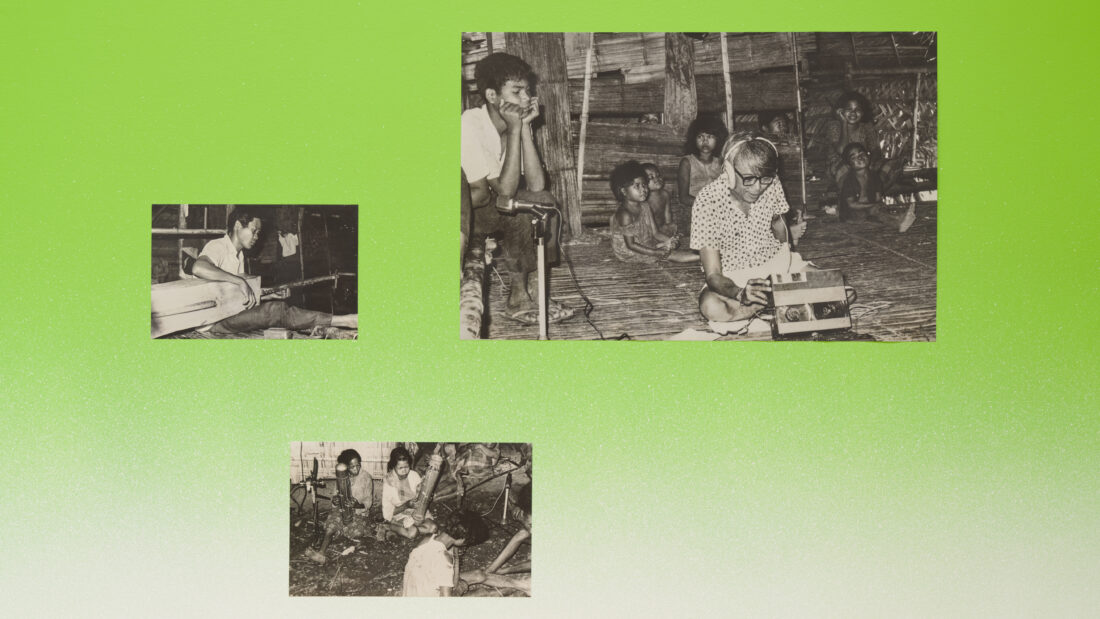
Manila-born pianist turned musicologist and composer José Maceda (1917–2004) curated his nostalgia by turning his recorder toward echoes of lost musical pasts. The imperial forces of the Spanish and American occupations plagued the Philippines for 350 years, gradually drowning out island and mountain sounds over time. Following his piano-prodigy beginnings, Maceda blazed a trail through classical, avant-garde, and indigenous musical landscapes. While earning a Diplome de Virtuosité at the École Normale de Musique in Paris, Maceda had a realization: “What has Western classical music got to do with coconuts and rice?” In the 1950s he studied musicology at New York’s Columbia University and anthropology at Chicago’s Northwestern University; he completed his doctoral degree in ethnomusicology at UCLA in 1963. During this time Maceda also picked up a clunky, professional-grade Nagra III tape recorder and began travelling with research teams and cumbersome equipment to document rapidly disappearing Philippine indigenous musics. He composed works that confront European avant-gardism with indigenous soundscapes. He also searched for a pan-Asian musical logic, organizing conferences and inviting avant-garde luminaries like composer Iannis Xenakis to Manila. In his interrogations of technology’s place in Southeast Asia, tape recorders and radio stations represented the machinery of social sound-making. Unlike his contemporaries, Maceda sought to decolonize the mind.
“Aki is upstairs and will be down shortly,” says Susan Gibb, the executive director of Vancouver’s Western Front, in greeting. The thriving arts centre, which favours artist self-determination over market systems, is a breeding ground for curators. I am here for the opening of “Echoes Beyond the Archipelago,” an exhibition of José Maceda’s legacy curated by Japan-born multidisciplinary artist Aki Onda, with the University of the Philippines Center for Ethnomusicology (UPCE), the partner institution, providing exhibit materials related to the esteemed visionary. It’s a show I cannot afford to miss.
The wall of the main gallery features a large circular diagram and sketches of indigenous instruments. Grayscale photographs grace the other walls, while larger prints lie perpendicular to the floor. A 1963 Nagra III recorder and a book sit on a table. Two television sets play video excerpts, juxtaposing the old (cathode-ray tube TV) and the new (flat screen TV). Technicolour videos interrupt gray, brown, and green sepia profiles of the space, carving human presences among monochromatic worldviews. “No one knew that these existed,” Onda tells me, pointing to a particular wall section. Photos show Maceda conducting the premiere of Pagsamba (1968) at the Church of the Holy Sacrifice in Quezon City, Philippines; women reading texts from handwritten scores; a musician blowing an ongiyong (whistle flute); and two musicians playing their respective agung (bossed gong).
Photographer Antonio Lopez Jr. captured this monumental endeavour for The Manila Times, the oldest Philippine daily newspaper. Onda, who first became aware of Maceda in the ’90s, found the photos in unsorted folders at the UPCE archives in Quezon City, when he was doing research in 2017. “Even the archivist had not seen them,” he tells me.
Pagsamba challenges Western listeners, as the composition’s indigenous practices are not part of mainstream knowledge. Two-hundred-and-forty-one musicians sound gongs, bamboo instruments, and dense speaking and singing voices within a circular formation. Maceda’s spatial diagram for the work has been recreated on the wall by sign artist Cody Swinkels. In the piece, an unapologetic indigenous presence traverses space and time as a Catholic mass transforms into a village ritual. While Xenakis used circular formations in Terretektorh (1966) and Nomos Gamma (1968), Maceda was interested in their sociological meanings. His fascination with the sound-mass structures of composer Edgard Varèse fed into his exploration of collective practices in Asian villages.
Maceda originally conceived Pagsamba as a tape piece for 241 loudspeakers. He studied musique concrète under Pierre Schaeffer at the Groupe de Recherches Musicales (GRM) studio in Paris in the late 1950s. In the GRM archive, Onda found a tape study of Maceda’s first piece, Ugma-Ugma (1963), an acoustic work calling for voices and indigenous instruments. Pagsamba in tape form would predate the “acousmonium”—a widely used spatial sound diffusion system François Bayle invented in 1974.
Onda hands me a pamphlet containing an English translation of Japanese pianist Haruna Miyake’s revelatory interview with Maceda, first published in Music Plaza Magazine. This interview happened alongside the premiere of Music for Five Pianos (1993), commissioned by pianist Aki Takahashi. The pamphlet is exhibited along with a score excerpt and a video of the piece’s 2019 performance in Japan, conducted by Josefino Toledo. “Composers like Tōru Takemitsu relied on European methods with Asian flavours,” Onda says. “However, Maceda used principles directly from Asian musical traditions.” Maceda told Miyake how repetition—drone, as he calls it—is present from classical music to Japanese gagaku (court music). Rather than defining drones as sustained tones, he describes them as constant repeated short patterns in succession—threads that represent the suspension of time and the concept of infinity.
I am no stranger to Music for Five Pianos, having served as a page-turner for a 2004 performance in Manila. Maceda described the piece as “one big drone.” Five pianos weave repetitive strands of sonorous textures, starting with unified cascading octaves, to unravel sound masses in polyrhythmic fashion. Everyone is both a soloist and a cog in the machinery—the musician serves a totality within a utilitarian frame. I lost track of the music at one point; page-turning for a pianist was my rite of passage as a young musician.
National identities never defined Maceda’s vision. He was not interested in turning his music “Filipino” or attempting an East-West fusion. Searching for universals is a past musicological project, but his music lives in neither synthesizing nor segregating worlds. It commands coexistence.
“I’m curious about your story on the shortage of bamboo,” I blurt out in Tagalog to Philippine-born musicologist and composer LaVerne de la Peña, as we meet up in a poké bar in the Yaletown district.
“Much of the bamboo that Benicio Sokkong harvests died out three years ago,” he answers. Sokkong is an instrument builder from the Cordillera region of Northern Philippines. “The instruments he makes come from one lineage. A fifty-year life cycle unfolds where the parent dies, then runs anew with a new parent.”
As the current director of the UPCE, de la Peña is in Vancouver for the Canadian premiere of Maceda’s Udlot-Udlot (1975), part of the exhibition programming. The work was performed twice in 1975 by eight hundred University of the Philippines students—first at the university grounds, then at the Cultural Center of the Philippines for an international festival with the Asian Composers League. While the score calls for hundreds or thousands of people, this sound mural can be adapted for groups of at least thirty. Organizers issued an open call to the Vancouver community for one hundred volunteer participants and received an eager response. Western Front and the Roundhouse Community Arts and Recreation Centre will be co-presenting this performance, which requires many bamboo instruments. The UPCE has taken charge in bringing them to Vancouver.
Bamboo instruments embody undulating cycles. “The Cordillera people have full knowledge of time cycles,” de la Peña says. “The problem is one of language. Bamboo is a generic term, but indigenous terms ascribe meanings for each species.” Maceda himself observed undulating cycles within Southeast Asia. The Javanese gamelan enacts cyclical structures among gongs and metallophones. The gangsa (flat gong) of Northern Philippines resembles a perpetual machine of interlocking sounds. Despite ebbs and flows, deviations occur at the micro level. These ideas birthed Udlot-Udlot—the Tagalog title depicts intermittent disruptions—which evokes continuity through droning events and silences over a large time structure. A group plays mixed bamboo instruments including tongatong (stamping tubes), balimbing (buzzers), and ongiyong. A relentless kalutang (sticks) group executes a drone throughout the piece. Another group sings sustained tones that slide downward, with contrasting coagulations of clacks, buzzes, and hoots.
“Udlot-Udlot was Maceda’s first work using grid notation,” de la Peña says. The one-page score shows a tabulation of sonic events per minute. Massive sound blocks emerge as the non-synchronized rhythms simulate randomness. Participants with mixed instruments play rhythms by choosing coupled numbers within a set. Multiply these aleatoric procedures in orders of magnitude, and pink noise emerges. De la Peña draws my attention to Pacific dances, noting that Hawaiian hula dancers do not need to move synchronously. “They are free to add variations or inflections, which would count as the same idea,” he explains. Western music theory calls this layering heterophony, but it ignores the logic within interlocking phenomena in gangsa playing, or in Javanese and Balinese gamelan.
“Maceda initially wanted interlocking chains out of five kalutang groups,” de la Peña says. The Western Front exhibit displays an earlier version of the Udlot-Udlot score, which includes this detail. “But the 1975 premiere got rid of it. The students played in unison. Perhaps they found it too difficult.” Subsequent performances have followed suit, but de la Peña has insisted on attempting an interlocking procedure for the performance that is about to happen.
Modern glass condominium towers loom over memories of locomotive trains. I enter the Roundhouse Community Arts and Recreation Centre, where the performance of Udlot-Udlot is being mounted. An open corrugated box is full of bamboo instruments ready for action. Onda had rallied the lead collaborators—de la Peña, vocalist DB Boyko, and interdisciplinary artists Elysse Cloma and George Rahi—to hold workshops with community members. Around sixty volunteer participants have shown up, including Maceda’s daughters Kate Maceda and Madeleine Heide. (His granddaughters Rayla Heide and Sarah Maceda-Maciel also take part in the family legacy.) Ethnomusicologist Michael Tenzer joins composers Jimuel Dave Dagta and William Kuo (featured in Musicworks 134) as participants.
During rehearsal, de la Peña and the kalutang players slither through the venue, practising their choreographed walk. Newcomers receive instructions. “The buzzer has to resonate,” Kate Maceda says, demonstrating the correct playing.
Rahi advises on the sets of coupled numbers: “You can always pick a smaller coupling, as the larger numbers demand so much counting space. Getting lost in the whole texture is fine, though.”
One participant says, “Western music wants a unified sound. Here, everyone should sound different.”
Boyko leads a group of singers, reminding them: “Don’t sing pure tones. Explore the richness in that sound.”
I ask Onda about their disciplined approaches. “It’s about interpretation,” Onda replies. Handpicked from various communities, the leaders contribute to shape the work. “Maceda’s systems have grown simpler over time with Udlot-Udlot, opening room for interpretation.”
An LCD projector shows a counter from one to thirty-nine to mark each passing minute of the performance. The Western Front exhibit displays old photos of Maceda’s timekeeping strategy with numbers on large handheld banners. Unlike encrypted conductor cues, projecting time markers blurs the performer-spectator divide. With the audience now filing in, Western Front distributes score copies of Udlot-Udlot for everyone to follow the music as it happens.
Klak klak. Klak. Klak klak. Klak.
Kalutang droning starts. Buzzers sound off sparsely, like raindrops on a roof. A toddler lies down on the floor beside me, jumping wide awake as the singers join in: “O-wa—(k).” Intermittent events unfurl with the singers and mixed instrumentalists, progressing from balimbing and tongatong to ongiyong. A performer unabashedly grooves on his own. Another accidentally drops his tongatong—mishaps add to the texture. Time flows over long periods without downbeat impulses as sounds embody scattered rains among tropical forests.
In the audience. Maceda’s family and affiliates sit alongside ethnomusicologist Nathan Hesselink, composers Keith Hamel, Robert Pritchard, and Serra Hwang, and Maceda’s longtime collaborator Ruben Federizon. A spectator steps forward, identifying themself as one of the work’s original student performers from fifty years ago. Dagta notes how Udlot-Udlot conjures a new-found village, coming together in reunion.
“Filipino Canadians signed up to perform out of curiosity, despite not knowing Maceda,” Dagta says. “Maceda saw Udlot-Udlot as a community effort, with options to perform in any role.”
Meanwhile, Kuo appreciates the unique thinking Maceda offers: “Texture and timbre are important in my music. His treatment of sound masses gives me ideas on further departures from Western notions.” Now recorded in my new mixtape, echoes of bamboo ring among brick walls as I leave the venue.
In September 1972, Philippine dictator Ferdinand Marcos declared martial law. Broadcast media went off air, silencing dissent under the guise of thwarting Communism. Hundreds were arrested, including political figures, journalists, broadcasters, and student activists. Oppressive censorship followed the restoration of some television and radio operations.
Maceda’s Ugnayan (1973) was broadcast in the Philippines on January 1, 1974, the second New Year’s Day of martial law. De la Peña recalls, “You can imagine the eerie silence of 1973—fireworks stayed unlit because people were very terrified of the regime. The Marcoses offered Ugnayan to the people as an alternative in the second year.”
The relationship between Maceda and the Marcos regime remains enigmatic. Following the premiere of Cassettes 100 (1971, for one hundred cassette tapes), Maceda sought support for “Atmospheres,” a massive radio work that originated in his 1969 concept of music from car stereos traversing the freeways of Los Angeles (an avant-garde vision predating Karlheinz Stockhausen’s 1991 work Helikopter-Streichquartett). First Lady Imelda Marcos appropriated this idea into “Ugnayan,” a project to unite the masses under authoritarian rule.
Translated as “correlation,” Ugnayan is scored for twenty radio stations, each simultaneously broadcasting a fifty-one-minute tape. Writing large-scale music for twenty parts with indigenous instruments, Maceda gathered musicians including the composer Federizon and the late pianist Nita Quinto to record all master tapes at Radyo Veritas in Quezon City. (Quinto, née Abrogar, was a longtime collaborator, from Pagsamba of 1968 to the 2004 rendition of Music for Five Pianos). Radio stations received a tape part, timing their broadcasts at six o’clock in the evening.
The Western Front exhibit lists the thirty-seven radio stations that broadcasted Ugnayan, covering Metro Manila and nearby provinces, all within Luzon island. The regime set up 142 “Ugnayan” centres for the masses to bring radios and tune them to all frequencies. Music critic Rosalinda Orosa claimed that anywhere from two to twenty million people heard the work; the largest gathering in an “Ugnayan” centre was 35,000 people. Maceda’s grand project was used as propaganda, prodding people to assemble and relate to each other, as the title implied.
De la Peña tells me his family would avoid anything associated with the Marcoses: “I was a high school student who valued freedom of expression.” The de la Peñas got away with it, but his cousins in the provinces had to join, as the stakes were higher in close-knit communities.
Twenty radios greet the visitors to the Grand Luxe Hall at Western Front. Hanging from the ceiling at ear level, they form four rows that narrow down in perspective. A low-powered FM transmitter broadcasts Ugnayan live on this radio installation. Onda mixed and mastered all tracks, digitized from Maceda’s original tapes. Lying centre stage on the floor, a screen shows the video score.
“A few of them are not working—we have to call back the technician,” Onda says. One radio is emitting white noise instead of its intended signal reception. “We are transmitting between the gaps within FM commercial radio frequencies. Some gaps are narrow.”
Ugnayan opens with the kolitong (zithers), bungbung (low-pitched horns), ulibaw (jaw harp), bangibang (bars), and ongiyong, later progressing into vocalizations, murmurs, loud balimbing, and gong sounds. Beyond its glorified nationalist pandering, the work defies colonial Western musical logics. “People did not understand it,” Onda says. “They knew nothing about avant-garde music. They even knew nothing about indigenous music because of prevailing colonial minds.” Maceda had started studying the traditions two decades earlier, when knowledge of endangered indigenous practices had not reached the mainstream.
Following the 1986 EDSA Revolution (also known as the People Power Revolution) and the exile of the Marcoses, Maceda spoke out to explain that he had agreed to concessions only to materialize the project. Defiance was risky.
“I want his story accurately told,” Onda says. Speculations abound, from his questionable stand on Marcos’s patronage to misplaced interpretations of his musical philosophy. Most radio stations from Ugnayan are now household names in the Philippines. I find it hard to imagine an indigenous takeover of mainstream radio back then. Positioning technology within the ethos of decolonization also remains nebulous. Global North impositions of automation and AI continually captivate twenty-first-century minds.
De la Peña offers his perspective: “Maceda rode the tides of prevailing technologies from tapes and car stereos to transistor radios. Now, we have mobile phones.” Alongside Vancouver’s Udlot-Udlot, a recent restaging of Ugnayan at the University of the Philippines called for mobile phones. “However, Maceda remained people-centred,” he continues. Someone still must play an instrument to materialize a tape recording. Someone must bring a radio to make Ugnayan happen. He theorized in 1978 that hardware (technology) comes with software (human agency). Maximizing human power, not superseding it, renders society functional.
Unlike in Western listening practices, Ugnayan and Udlot-Udlot require human presence. Indonesians attend a wayang kulit (shadow puppetry) performance because it forms part of the social fabric. “You may end up chatting with someone and not pay attention to the action, but the point of the village doing a ritual together is to simply be there,” de la Peña concludes.
Maceda’s cosmopolitanism subverted East-West binaries and interrogated Western composition idioms. “Now is the perfect time to bring Maceda into the foreground [after his] legacy was nearly forgotten for decades,” Onda says. “From the outset, he sought liberation through decoloniality.”
Maceda’s echoes of island pasts reverberate beyond the archipelago, forging a path for a decolonizing ethos of the twenty-first century.
JURO KIM FELIZ is a Toronto-based composer, pianist, and writer. Collaborating with Thin Edge New Music Collective, Ensemble x.y, Liminar, and others, his music has been performed at major events such as New York’s MATA Festival, Nief-Norf Summer Festival, Mexico City’s MUSLAB, the Asian Composers League Festival, and the Yogyakarta Contemporary Music Festival. He is the recipient of the Goethe Southeast Asian Young Composer Award (2009) in Kuala Lumpur and has commercially released music with Ablaze Records. During a Canadian Music Centre Library Residency, he created Nomadic Sound Worlds, a miniseries of podcasts and essays that frames Canadian contemporary music through the lens of global migration.