
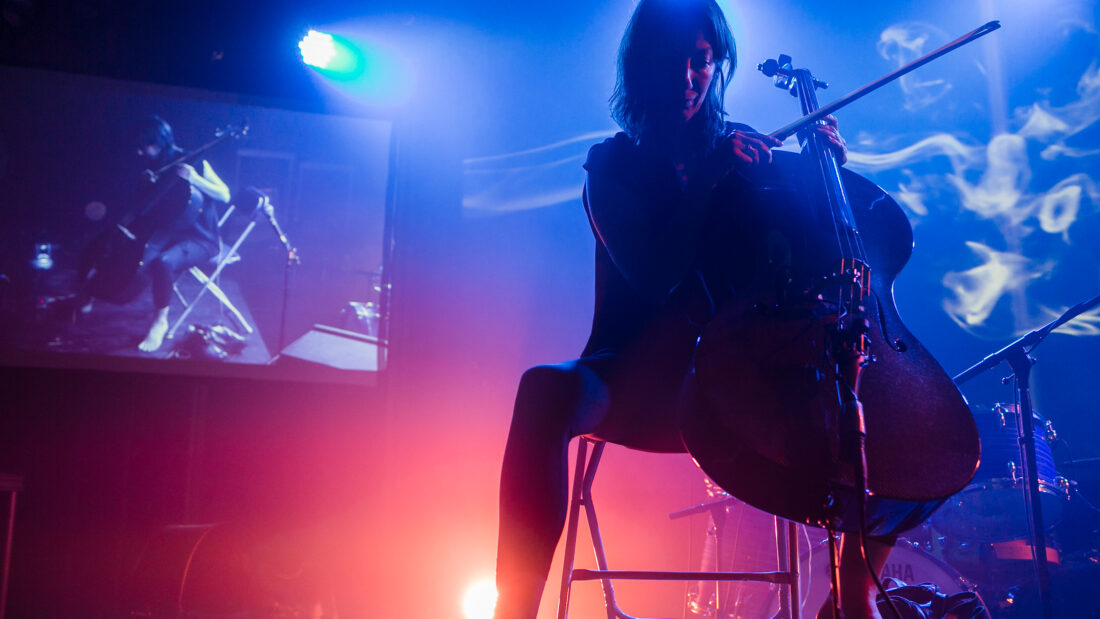
Vancouver-born, New York–based cellist and composer Julia Kent has built an impressive career as both a solo artist and in-demand collaborator and session musician—beginning in the late 1990s as an original member (with Melora Creager and Agnieszka Rybska) of the cello-driven goth-pop outfit Rasputina, through her work in the early 2000s with the baroque-pop group Antony and the Johnsons, and guest turns with genre-bending folk artist Devendra Banhart, singer-songwriters Rufus Wainwright and Martha Wainwright, and no-wave pioneers Swans among many others. Her solo music is instantly compelling, as I discovered when I listened for the first time to “Hellebore,” the opening track of her 2015 solo album Asperities. “Sometimes the accidental thing that you don’t expect or envisage can turn into something that becomes integral to the music,” Kent tells me, speaking about her approach to building songs with her cello and loop pedal. “So, try to embrace chance.”
Born in Vancouver, British Columbia, Julia Kent grew up in a musical household and had a cello in her arms from the age of six. Along with her sister, who plays the violin, she pursued classical training all the way to a postsecondary degree from Indiana University in Bloomington. She found the classical-music milieu stifling and upon graduating chose not to continue formal education any further. For a time, she stopped playing the cello entirely. “I was floundering in terms of what the future was going to be,” she recalls in a phone conversation from her home. After Bloomington, she moved to New York City to work in a classical-music management company but quickly realized that that also was not her calling. In 1989, Kent began working as an editor at the alt-weekly the Village Voice and became immersed in New York’s music scene.
In the late ’80s the city was still feeling the effects of no wave, with bands like Sonic Youth, Swans, and Cop Shoot Cop carrying the abrasive torch. These bands embodied a certain rock ethos, but did so while also eschewing traditional rock instrumentation and tunings. Inspired by the opportunities afforded her via improvisational and rock music, she picked up the cello once again. “[Rock is] much simpler in terms of harmony and technique,” she says. “So I thought, Oh, I can be free in terms of making music and sound on the cello without being constrained by this whole [classical] canon of music.”
Cop Shoot Cop achieved its signature sound by replacing the stock six-string guitar with a bass and an army of samplers. When founding member David Ouimet split from the band, he diverged further from traditional instrumentation in the formation of the klezmer-punk band Motherhead Bug, a twelve-member group featuring a conventional rock backbone of bass, drums, and guitar, and instruments less familiar to rock, such as Ouimet’s trombone, Kent’s cello, and Gamelan percussion. Breaking away from canonical restraints was what motivated Kent to continue with her instrument, and she had no shortage of such motivation in Motherhead Bug.
Around this same time, someone looking for cellists placed an ad in the back pages of the Voice. It seemed like everyone she knew sent her the ad and urged her to respond. She successfully auditioned for what eventually became Rasputina, a cello duo (and sometimes trio) led by Melora Creager. “She wrote all of the music and had a really strong aesthetic vision for the band,” recalls Kent. Creager made cellos the central driving force of Rasputina’s intricate, lively, often beguiling, and singular sound. “Her vision was so unique, and I don’t think anyone at that point was really doing anything with cello in a rock context, where the cello was the main instrument,” Kent says fondly. Rasputina inspired a host of string-led rock outfits, such as cello-powered Finnish metal band Apocalyptica, and became the launching pad for other successful cello soloists like Kent’s fellow Canadian ex-pat Zoë Keating.
Kent recorded and toured with the group well into the ’90s. In 1999, while on break from touring with Rasputina, Kent met singer-songwriter Anohni, leader of the band Antony and the Johnsons. The chance meeting took place at Acadia, sound sculptor William Basinski’s Brooklyn loft, a place Kent describes as a sort of creative hub for New York’s music scene at the time. Anohni happened to be looking for a cellist, but Kent was already committed to touring with Rasputina in support of the album How We Quit The Forest. The two eventually worked together on Antony and the Johnsons’ 2001 single “I Fell In Love With A Dead Boy,” and Kent soon left Rasputina to become one of the Johnsons.
Although Anohni wrote most of material, the band’s arranger Maxim Moston explains that she offered a great deal of space for creativity within the group, pointing to Kent’s arrangement of “Bird Gerhl” on the band’s sophomore album, I Am A Bird Now (2005). “[Anohni] opened the process a little bit to us,” explains Moston, “and let the three of us [Moston, Kent, and violinist Joan Wasser] do songs as we wished—where we would come up with charts for everybody. We quickly developed our own little identities as arrangers. Julia wrote these very florid, very baroque, soaring arrangements. Her songs would build up to these beautiful climaxes. A song like ‘Bird Gerhl’ is just iconic in that way.”
Moston says that Kent had a consistency that centred the group, allowing it to thrive despite changing lineups over the years. “She’s an incredibly poised person. On stage, we’d be moving around, vibing off what’s happening, and Julia’s there just in her beautiful, black dress, one hundred per cent focused, with her blue eyes on Anohni and immovable like a rock. She was a stabilizing force in a way. Anohni always knew that she could rely on Julia to be there with her.”
While groups like Rasputina and Godspeed You! Black Emperor primed audiences for the more prevalent use of strings, Antony and the Johnsons anticipated independent artists like Sufjan Stevens, Patrick Wolf, My Brightest Diamond, and Owen Pallett, who deployed ornate instrumentation and arrangements that recalled the baroque pop of the 1960s, without the orchestral budgets from big studios. Moston frames this early 2000s trend as a confluence of events happening in—but not unique to—New York at the time. “Conservatories continue taking the same or larger amount of kids and churning them out, meanwhile the work for classically trained musicians is definitely shrinking. You used to have all kinds of regional orchestras, everybody played in a string quartet, and in New York City there’d be recording sessions for jingles and for movies,” he explains. “In the 2000s, you had an abundance of talent coming into a place like New York, with not much work. As a musician, you really didn’t have much of a choice but to do different things. At the same time, there were a lot of guitar bands like The Strokes. And perhaps [what we were doing] was a reaction to that.”
Recording and touring with Antony and the Johnsons became a full-time gig for Kent, and took her around the world. The higher demand for string players also opened opportunities for Kent to record with neofolk acts such as Devendra Banhart and Angels Of Light, as well as singer-songwriters such as Martha Wainwright and Norah Jones. “Everybody has their own musical world; it’s super interesting to try to fit into them,” she says. “Everyone expresses what they want in a different way, so trying to fulfil is also really interesting.”
In the midst all that collaborative and session work, Kent had never considered breaking out on her own, until her friend, musician Yann Courtiau, owner of Switzerland’s Shayo Records, offered to release a solo album if she recorded one. “That was really the impetus, because I didn’t think that I could do it,” she says. “It took me a long time technologically just to learn about recording and mixing and all of the aspects of that. It was a big learning curve, but it was super empowering, figuring out how to do all of those things.”
Molson recalls Kent learning the recording process while they were touring with Antony and the Johnsons, “We’d be rushing to our flights and she’d be recording ambient airport noises to put in her album. Julia had always been a creative person, but in the service of other people. It takes a lot of courage to take that leap off the ledge and become your own person.” Kent continued working and playing with the Johnsons until their final album, Swanlights, in 2010, by which point her solo career became the central focus of her work.

Julia Kent at MUTEK 2026 / Photo by Vivien Gaumand, ourtesy of MUTEK
During my interview with Julia Kent, the voice-chat app cuts out occasionally, interrupting the flow of our words and forcing us to repeat things; this is quite fitting for an artist who often creates her compositions by building up looped phrases—a technique she’s been using since her 2007 debut album Delay (Important Records). Using loops to compose means that she can recreate her album material in a live performance. The loops also add a sort of circular effect to her songs as they spiral outward each time a new phrase is added.
“Looping is interesting because it’s inherently repetitive and additive,” she observes. “With looping, for me the problem is always how to take things away, because it’s very easy to add and add and layer and layer. The difficult thing is to figure out how to take things away.”
Berlin-based Canadian musician Aidan Baker, who has collaborated with Kent on some of his own works and in Nadja, the longstanding experimental-drone duo with his wife, Leah Buckareff, observes that, “A lot of string instruments—especially when they’re being used in electronic music or in experimental music in an electronic way—tend to do quite a bit, maybe too much sometimes, and there’s an overload in either technique or virtuosity. Seeing Julia play live, I really appreciated how simple the performance was,” he elaborates. “It was more about the subtleties and nuances that she brought to the pieces and less about flashy playing, essentially. It’s quite restrained in a way, even when it gets big and loud. That gives it a tension that’s still melodic.”
In her solo compositions, Kent deftly demonstrates restraint, carefully incorporating only what serves the songs and the ideas behind them. Her method is never quite so precise, she explains. “I always have a certain amount of material, and sometimes the material will suggest a concept, and sometimes there’s a concept that then shapes the material.” In fact, each album she’s released explores a kind of self-contained idea or thesis, perhaps an impulse informed by her previous occupation as a journalist.
On Delay, Kent explored what her bio refers to as “the private emotional worlds that exist within the disjunctions and disorientations of travel” by incorporating field recordings made while passing through airports. Her 2011 follow up, Green and Grey (Important), which the Leaf Label reissued on vinyl in November 2019, focused on the conflict between the technological and the organic, and incorporated field recordings to embellish that dynamic. “At the time, I was doing a lot of field recording of natural sounds, insect sounds, weather—that kind of thing,” she says. “That became inspiring in terms of using those recordings as a texture of the music. In some cases, I used it as the rhythm.”
Kent is attuned to the ability of instrumental music to express abstract ideas and feelings, and has been quite successful at homing in on the formal and experimental techniques that help bring those ideas to life. Just as Delay grew out of Kent’s process of learning to record her cello via an Avid Mbox (a desktop audio interface), her subsequent albums, all of which were recorded in her home studio, are shaped by the musician’s ongoing learning process. “I feel like I’m always learning, because I’ve added more elements as time has gone on. There’s always something to learn,” she reveals. “Sometimes I’ll find a really interesting sound or texture or effect, and then that can create a whole atmosphere that I can then be inspired to make music around.”
The relationship between Kent’s cello and loop pedal has always engendered a sense of intimacy and immediacy in her solo recordings. On Character (Leaf, 2013), she explores her own interiority using only those elements. That focus makes moments of experimentation, like the warped, ghostly gasps of “Kingdom,” more powerful when they arise. Her 2015 album Asperities (Leaf) displayed Kent at her most audacious, creating a sonic world that complemented the concept expressed in the title, with music that sounded as if she were actively resisting the inherent melodiousness of her chosen instrument.
Much of the material on her 2019 album Temporal had been originally written for theatre and dance. Writing music for choreography seems like a natural extension of Kent’s abilities, considering the precise set of movements she executes while playing cello and triggering loops and electronics with her bare feet. Although the music had been written with other concepts in mind, it feels just as intentional as her previous works. “I was thinking about dance as an artform and the way that it moves in space,” she says about the thematic connections between songs. “It’s a time-based artform, in terms of the way a performance transpires. Dancers, they’re so fearless, they’re just out there using their bodies. It’s a difficult career that also has the pressure of time because it’s difficult to have a career as a dancer after a certain amount of time. Age takes its toll. I was just thinking about all of those things.” She plays with the notion of time in every way possible, starting with the slow, looped, ticking string-plucks that open the stunning “Last Hour Story.”
One of the other benefits of breaking out on her own has been the varying ways Kent has been able to continue to collaborate with other artists and help them see their ideas through. In recent years, she has done an increasing amount of work for theatre and dance, film, and television. In 2019 alone she is credited with five original film scores, the most recent being for Guillaume Nicloux’s French miniseries Il Était Une Seconde Fois (Twice Upon A Time). After our conversation, she returned to preparing an experimental opera that she cocomposed with Athens-based multi-instrumentalist Tilemachos Moussas and performed at the end of September 2019. She has a number of projects on the ready that will take her well into the next year: scoring an Italian documentary on the digital panopticon; revisiting her dance piece Naked, which she did in Germany in 2016 with Canadian choreographer Dominique Dumais; a Belgian tour; and another dance project, this time in Italy.
“Right now, I wish I had a little bit more time just to work on my own solo music,” she says. “But the time will come. I have lots of ideas, lots of material for a next record.” Even as she looks back on the past thirty years of her musical career, Kent still has her attention fixed on the project at hand.
Michael Rancic is a freelance music journalist based in Toronto. Much of his print and online music writing focuses on emerging Canadian artists and on the ways in which public policy influences music scenes. He’s written for NOW Magazine, Bandcamp Daily, A.Side, Vice, Exclaim! and Spacing, among others.