
One afternoon last August, I watched performer-composer Kalun Leung wave his wrist as a shriek of clarinet notes wailed through the high-ceilinged main room at Perte de Signal, a small multimedia studio in Montreal’s Mile End neighbourhood where he’s an artist-in-residence this year. With another swoop of his hand, a cluster of trombone notes exploded from two speakers perched on the wall, then a ripple of vocal calls, followed by a swell of violin strings. When he stopped his arm in one spot, the sounds sustained infinitely, like an uncanny reverberation.
Leung had an x-IMU unit attached to his wrist. The device communicates with a 360-degree virtual space (on his laptop) “painted” with sounds that are represented by bubbles, which vary in size depending on their volume. He created this with Max MSP, an interactive visual programming language for music. Leung recorded musicians’ performances of clarinet, trombone, vocal, and violin sounds, then chopped them up via granular sound synthesis. When the wrist-mounted x-IMU sensor moves, it glides around these granules of sound, which he has placed in Max MSP. Movement does not produce sound per se but, rather, is used to select the sounds that are heard. The gesturing becomes a sort of dance, a wrist-led weaving through the air that gradually makes sense of the seemingly chaotic array of noises splattered across the 3D digital canvas.
“The choreography is a result of the discovery of the sound,” Leung told me.
This interface was developed as part of Conversations with Space and Architecture (2021– ), an ongoing series of site-specific compositions developed using the “mubone,” an augmented trombone that Leung and musical technologist Travis West have been developing and creating with since 2018. This work is an extension of an ethos that Leung has followed since he began playing instruments, which is that there should be no distinction between the musicians and spectators who are sharing the space. At most of his performances, audience members are free to move around. “From day one going into music, I already knew I wanted to break the fourth wall,” he explained. “It’s more like we’re co-witnesses of the performance. I want my role as a performer-composer to be a revealer. I just want to reveal what’s already there.”
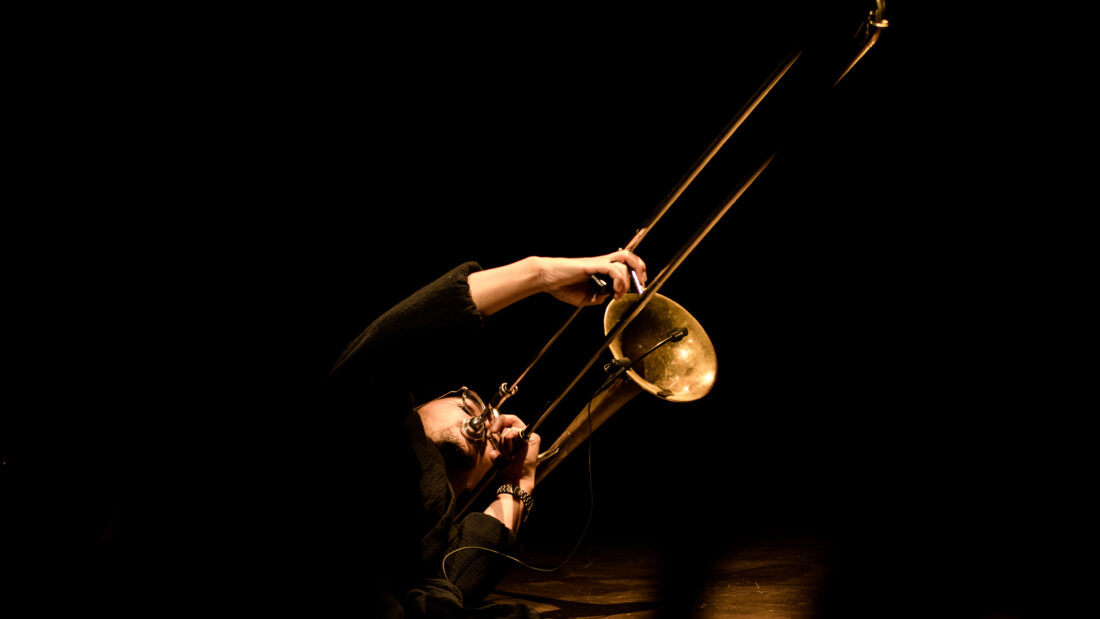
Leung has been experimenting with the trombone, his primary instrument, for more than a decade, and over that time his relationship with it has become increasingly adventurous and rebellious. For him, the trombone is not just a member of an orchestra brass section or jazz combo, it’s a canvas for experimentation, to be warped, played with, and pushed into new sonic spaces. In his world, there are no rules.
Leung was born in Hong Kong and moved with his family to Toronto when he was four years old. At age eleven, his parents sent him to a three-day camp where he and a group of other children engaged in “abstract artistic activities” while supervised by a group of teachers. He didn’t know then that the camp was an audition for Toronto’s publicly funded Claude Watson School for the Arts. He had been studying violin and piano, but the school wanted students to start from square one with a new artistic endeavour. He was asked to select three instruments from a list, and he wrote trombone three times. He’s still not totally sure why. “It’s the weirdest thing,” he said. “I still think it’s super weird. It has no transferable skills. My slide technique, I can’t use that anywhere.”
His first teacher taught both classical and jazz, and Leung practised both, so there was no genre dogma to stifle his relationship with the trombone. When he finished high school, he got a bachelor’s degree in business, then spent a few years working in marketing before quitting in 2014 at age twenty-five, encouraged by a trombonist from the Toronto Symphony Orchestra to return to the instrument.
That summer Leung travelled to Serbia with a childhood friend, Igor, to attend a musical exchange summer camp. Leung had a special interest in Balkan brass band music, and was excited to attend the Guča Trumpet Festival, a renowned gathering of brass players from across traditions. In the fall, Leung entered McGill University’s master of music program, and started a Balkan brass band chamber ensemble. It wasn’t experimental, but it was a step away from the traditional classical repertoire he was learning and playing in orchestra auditions. Leung felt different from many of his peers pursuing a career in classical music. Many didn’t seem to like performing for audiences. “How do you piss off an orchestral musician?” he joked. “Give them a gig.”
Leung moved to New York to attend The New School’s Mannes School of Music, where he earned a professional studies diploma in composition. During the two-year program he studied with bass trombonist Dave Taylor, who was one of the first musicians to perform a solo trombone recital at Carnegie Hall. Studying under Taylor was formative; so was living in New York, with its experimental music traditions and downtown music scene. Leung ended up helping the New School create a program that centres the musician as a performer-composer, with an original voice (the performer-composer master of music degree).
“Performer-composer is coming from the post-classical, post-modernist new music tradition,” explained Leung, noting that since the invention of the printing press and the proliferation of sheet music, composer worship and notation have been the tenets of music study. He is part of a movement of musicians who wish to return to the primacy of creation and performance—or at least the recognition of these as vital, important pieces of a musician’s education, bearing just as much value as sheet music, sight reading, and European music theory. Performance is context-specific, and “lives in the body,” he said. “It’s more social, in a way.”
He secured a grant to study oral traditions in music and demonstrate how curriculum in university-level music education lacks the integration of oral practices. “We’re so obsessed with Western notation and composer worship,” said Leung. “I have quotes from Stravinsky to Schoenberg to Stockhausen basically [saying], ‘The performer is useless. Your job is to transmit the composer’s message.’ That’s a whole musicology topic: this idea of music as performance or music as text.” True performers often find a home in what their more conservative colleagues call “experimental music.” But that tag gives him pause, too. “Experimental music suggests that the thing I do is marginalized or on the fringes, which is true, and which is a position a lot of us adopt,” he said carefully. “But if we want to push through that and centre [ourselves], I try not to use that term.”
All of this feels loaded in a moment of society-wide negotiation about how art is shaped by and interacts with the dominant economic and political structures that guide our lives. Leung isn’t here to write a manifesto, however. “For sure it’s political, I just never frame it that way,” he said. “And that’s OK.”
Before graduating from the New School, Leung had to perform in front of a jury of five members of the brass faculty. All graduates were expected to prepare a selection of excerpts to perform. Leung, however, showed up and did his “weird, improvised stuff,” complete with an amplifier. All of the jurors passed him except the head of the brass faculty, who was a performer with the New York Metropolitan Opera. “He basically freaked out and failed me,” Leung said with a shrug. Because he was the faculty head, he held a veto over the other votes, and Leung was set to lose his degree. Only thanks to pleading from a teacher (and a second, more rigid performance) did he manage to walk away with a diploma. The artistic convictions he developed during his time were more important than any official bona fides. “I knew that these crevices between disciplines are where the cool stuff happens,” he said. “I think of the trombone as a type of constraint. It’s a dumb instrument, in a way.”
The idea that music outside of formal settings was possible appealed to Leung for a long time, but in the confrontation and imagination of New York’s downtown music scene, it crystallized. He witnessed virtually every stripe of experimental and avant-garde music creation that the world has to offer: “You’re like, ‘I want to try that.’ You have to witness it to believe it. That [period], career-wise, was like throwing spaghetti on the wall, but, like, every type of spaghetti. I don’t know if it’s like undiagnosed ADHD or just scatterbrain. I just wanted to do everything.” Leung also did a residency at the Brooklyn Fashion and Design Accelerator, where he took his experimentation further. He created a costume that was also an instrument, like a “musical cocoon.” When the garment buttons were clicked together, they activated field recordings he had made in the Accelerator’s production lab.
Baker’s Lung, a two-week installation at Goi Chieh Institute in Hong Kong, came out of his experimentations with bass trombonist-turned-baker Felix Del Tredici, who owns the celebrated Montreal bakery La Meunerie. Sourdough starter prepared by Del Tredici is fed through a series of pipes. As it expands and its gases create pressure, it pushes air gently through the pipes and out a slide whistle instrument, producing sounds. “The pitch changes because the tube is changing,” Leung explained. “Same principle as trombone.” It’s as if the starter has been given a musical voice of its own. It’s a meditation on the intersections of two practices—baking and music—but it’s also an invitation to consider dimensions of life beyond those we see every day.
“That was a big turning point for me,” he said. “I didn’t have a studio practice, I didn’t have experience with that, but I was like, ‘Damn, I want to engage people in that way to have like a timelessness to a work, but also autonomy for the audience to experience it at their own pace.’” Leung traces back the roots of his multimedia artistic practice to his days at Claude Watson, where every form of art was studied contemporaneously. A class trip to see a performance of STOMP was a lightning-bolt moment: “Is this what music is about? Relating to the world?”
The mubone is a trombone that has been augmented with the same motion-sensor tech used in Conversations with Space and Architecture. Cobbled together with West in 2018, the first iteration featured a Nintendo Wii controller strapped to Leung’s trombone. The x-IMU sensor straps on discreetly without interfering with the operation of the instrument, which is now in its fifth generation. The data it gathers can be used in any number of ways. A trombone is always pointing somewhere, noted Leung, who wrote on his website: “The frame of a building can be used as a graphic score for the mubone to trace, giving the impression that [the] mubone slide is a big sound paintbrush.”
For his installation-in-progress at Perte de Signal, the relationship between the instrument and its surroundings is deepened further. The choreography encouraged by his sound mapping in Max MSP makes the player move around a physical space in concert with the triggering of various sounds. The length of time the player explores a given location is entirely dependent on what they discover in the sound granules scattered across the digital canvas. Part of the goal is to combine the corporeal embodiment of, say, theatrical performance with the more tightly regulated bodily presence of the average orchestral musician.
At the 2025 edition of the Darmstadt Summer Course—the long-running biennial music festival and academy that unfolds over two weeks in Darmstadt, Germany—an independent jury followed Leung and other performers while they attended workshops and performed at open stages. Leung performed with the ensemble No Hay Banda and attended sessions as both an organizer and a participant. He led a mubone workshop, which encouraged musicians to explore and create with it. In a workshop for the brass cohort, he performed an original composition that was transmitted orally rather than via notation. He began by playing something, and the other musicians copied him in a cascading fashion, so that the sound rippled around the room.
On the final day of the event, Leung and double bassist Pietro Elia Barcellona became the first musicians in Darmstadt history to receive the jury-selected Kranichstein Music Prize as composer-performers, a designation now recognized by the institution. It’s proof that contemporary music is finally breaking away from composer worship and using different approaches to evaluating creative work, noted Leung. Many competitions are set up to judge single performances of a composition that has a history of how it’s supposed to be performed, propagated through recordings, the composer’s will, or some idea of “honouring the text.” Leung said that Darmstadt is taking a step away from “Euro-logical practice” and toward what the American composer and performer George Lewis calls “Afro-logical practices,” which are more improvisatory musical traditions from Black musicians.
As a working musician, Leung moves between interpreter and creator. He works with regional symphonic orchestras interpreting classical music, but he also works with No Hay Banda, a Montreal-based non-profit promoting avant-garde music, and collaborates with artists both locally and internationally. He and his partner, trumpeter Emily Fortin, mix mime and Foley sound in their brass duo ék (short for Ékmailluine). Ambient Parade is an experimental marching band project whose formless drone improvisations are “a total circumvention of the traditional idea of marching band as a state apparatus.”
Leung is still throwing things at the wall. Perhaps part of the big idea here is that the wall itself is a part of the work. He and the musicians in his sphere find meaning in everything around them. “Experimental music” is simply a venue where collisions between meanings can happen, where new meanings can be created. “It’s an invitation for people to reconnect with the present, relationally to the space, and to others,” he said. “Whether it’s politically or socially or artistically, you see that another life is possible.”
LUKE OTTENHOF is a freelance writer based in Montreal and an assistant editor at Premier Guitar.