
These days the world of pop music often seems to be winding itself into a kind of ouroboros of nostalgia, with anniversary reissues, reunion tours, and tribute acts programmed at venues far and wide—but are we making enough space in those places for new and innovative music? It may be less obvious, but some of those same issues and challenges apply to the world of classical music, a field for which tradition and meeting prevailing expectations might seem like a goal rather than a hurdle.
Leaf Music founder Jeremy VanSlyke, who is originally from Fredericton, New Brunswick, was partway through a master’s degree in music recording at McGill University in Montreal when he first got the idea for the label. A veteran of youth orchestras and subsequent professional ensembles, he decided to take a broader approach to the genre he loved. “I went into my career in my twenties, or maybe even late teens, wanting to be a recording producer,” he says. “I also realized that though Quebec had a couple of strong classical music labels, Atlantic Canada didn’t have any.”
VanSlyke was inspired by the German idea of the tonmeister (sound master), a person whose training in music and theory gives them a rounded approach to production. The label’s hands-on philosophy grew to become important at every stage of a project. “In many of our most successful projects, we’ve helped to curate and produce and release and distribute everything in one integrated way,” he continues. “That’s the way that Philips Classics or Sony Classical used to work: They had producers in-house and a stable of artists, and they made things happen.”
Launched in 2012 as a versatile venture, Leaf takes on contract work, but its creative focus is on commissioning work and assembling an ever-evolving roster of diverse talents. One of VanSlyke’s initial goals was to develop projects that support artists with ties to Atlantic Canada; the label’s roster now includes the Saint John String Quartet, soprano Maureen Batt, soprano Measha Brueggergosman-Lee, and many more.
VanSlyke is keen to distinguish Brueggergosman-Lee’s work with Leaf from the traditional repertory she has recorded for other labels. “If you record Haydn string quartets, people will know what those are and what to expect,” he says. “Bach has a huge following, but the market is saturated, and recording the same work for the fiftieth time isn’t necessarily a good strategy for a small label.” One of Leaf’s most innovative projects to date is Zombie Blizzard (LM277, 2024), an adaptation by composer Aaron Davis of seven Margaret Atwood poems, performed by Brueggergosman-Lee with Toronto’s Hannaford Street Silver Band. “It’s a commercial risk to put out something like that, because, even though you have name recognition with Measha and Margaret Atwood, it’s not something that you know people are going to fall in love with.”
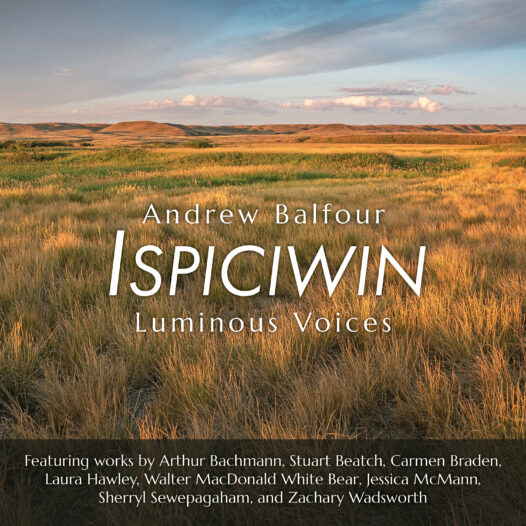
Alikeness (LM296, 2024), a recording by the Newfoundland Symphony Orchestra Sinfonia, opens with a piece called “Angmalukisaa” (“round” in Inuktut), which was composed and performed by Inuk soprano Deantha Edmunds. Earlier this year, the piece won the 2025 Juno Award for Classical Composition of the Year, making Edmunds the first Indigenous woman to win the award in that category. “It’s probably the first time an Inuktut song cycle has been recorded with an orchestra,” says VanSlyke. “This is not a recording that would have been made in Nashville or New York or anywhere in Europe.” Also in that vein is Ispiciwin (LM267, 2023)—its title means “journey” in Cree—an album of commissioned works by mostly Indigenous Turtle Island composers, assembled by Winnipeg-based Cree composer Andrew Balfour. “A choir singing in Cree is uniquely Canadian,” VanSlyke continues. “We have these classical forms, we have chamber choirs, we have orchestras, we have string quartets, but we have to concentrate on things that we can do better than anyone else.”
Appealing to an audience that has slowly embraced streaming over physical media has been both a challenge and an opportunity for the label. “[In 2024] Leaf was close to six million streams—we’re reaching so many more people,” VanSlyke says. Disrupting the status quo is essential in distinguishing albums from the kind of passive background listening that streaming encourages. Award-winning classical harpist Kristan Toczko, who is also Leaf’s in-house graphic designer, is adept at using her online presence to draw attention to the label. Each of her short clips—in which she performs harp adaptations of everything from the music of alt-metal band Tool to songs from the Legend of Zelda video game series—is routinely watched by more than half a million viewers.
“In between the end user and the creator of the music [on many streaming services], the human aspect of the curation is being eroded,” VanSlyke says. “What Kristan is doing is unique, and I believe she’s in the top ten of classical musicians on YouTube.”
Toczko is canny about the importance of these clips in her work and career. “As an artist, my first challenge is branding—how do I make [the classical world and marketing] consistent?” she says. “My personal way of combining the two worlds is to take what I’ve learned through my classical training and apply it to the world of rock. My mission, on my social media channels, is to showcase the harp up close for those who might not necessarily have an opportunity to see this instrument up close, and also to bring people back to the classical music world.”
VanSlyke and his wife, Carrie, who is co-owner of the label, recently moved to Nashville. The decision was made in part for personal reasons, but also to further expand the label’s horizons. Yet maintaining Leaf Music’s base in Canada and the Atlantic provinces is still key to their future. On the day we spoke, he had recently returned from Montreal, where he had been working on an upcoming project called Sayeh-Roshan by Montreal Symphony Orchestra principal double bassist Ali Kian Yazdanfar. The music, VanSlyke says, combines traditional Iranian folk songs in a classical suite esthetic. “To me, this is something else that is uniquely Canadian, something that couldn’t currently be done in Iran because of the nature of the texts.
“It’s an enormous amount of work commissioning that much music, let alone getting it recorded and edited and mixed,” he adds, in reference to Leaf’s recent and upcoming projects. “But that’s an album that reflects what we’ve been up to recently and showcases what we’re good at doing: connecting a whole bunch of facets of the Canadian music scene in different provinces and making something beautiful.”
ERIC HILL has written about music and culture for over two decades, primarily for Exclaim! His biweekly podcast, Surgery Radio, has been exploring the soft boundaries of experimental, ambient, and pop music since 2004. He has managed Backstreet Records in Fredericton for most of his adult life.