
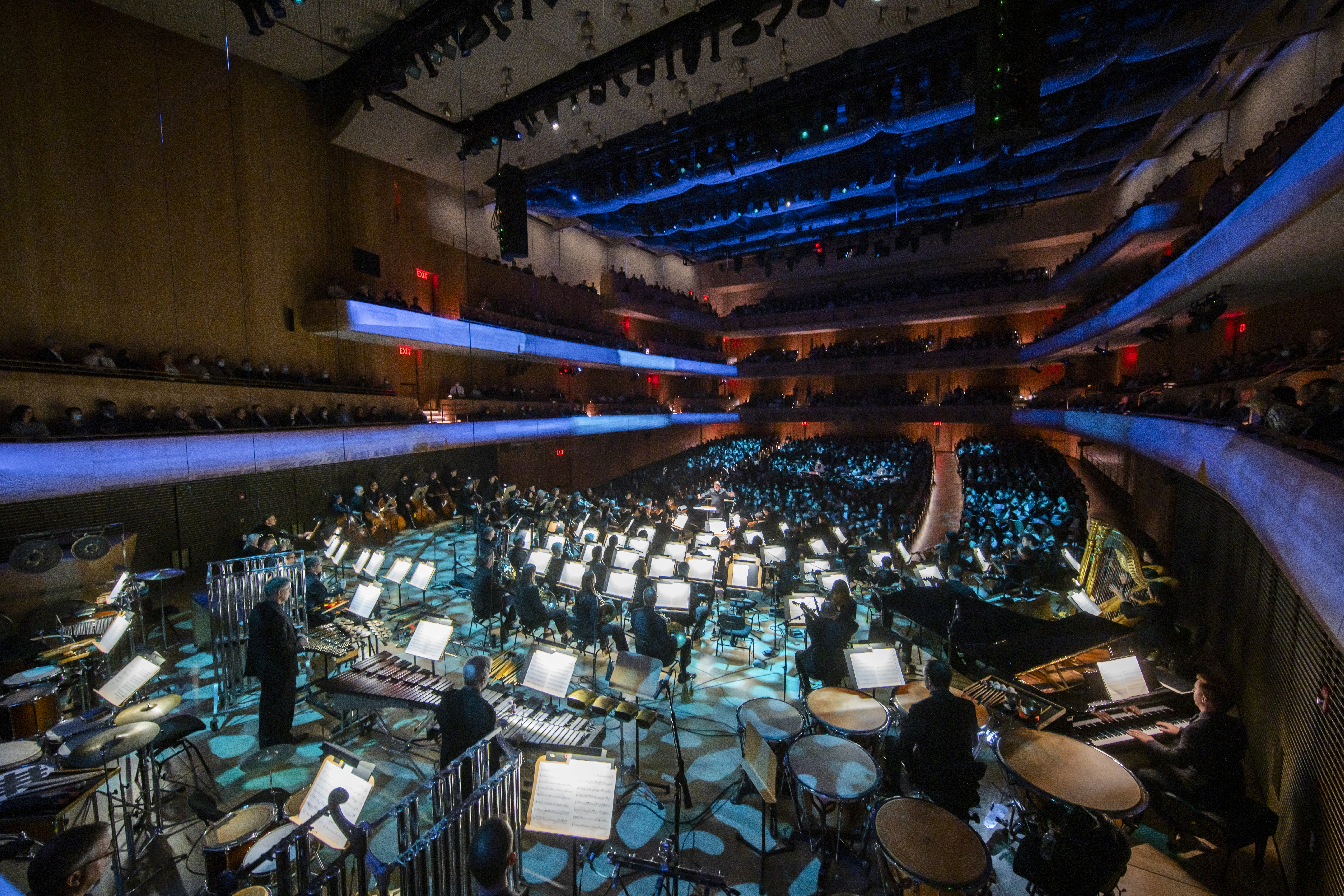
New York City’s David Geffen Hall opened its doors again to the public in October 2022, and the New York Philharmonic wasted no time in settling back into its reimagined home. After departing from Carnegie Hall in 1962, the orchestra performed in David Geffen Hall’s previous incarnation, which was muddled with acoustic problems; the new and improved version now stands tall in the Lincoln Center for the Performing Arts as a cozy home for concertgoers.
The Philharmonic’s first concerts of the season were a homecoming in every way. Audiences had snuggled into their seats in the hall’s Wu Tsai Theater when a man called out in protest during the opening remarks: “There are no toilets on the third tier!” The opulent $550-million renovation was apparently not enough to please one concertgoer, but he was shushed.
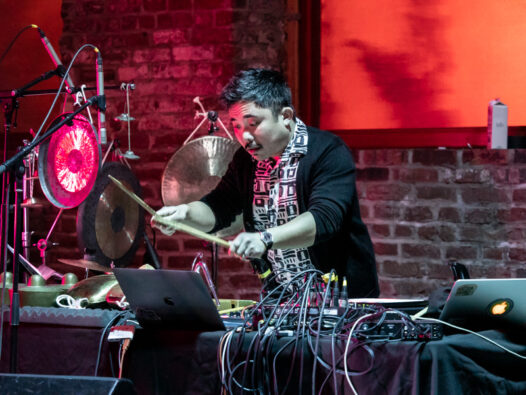
October 13 marked the debut performance of Filipino American artist Levy Lorenzo as a soloist in the hall. Amid the orchestra floor seats, he wielded a MIDI controller, a pad, and a mixing console, unleashing patchworks of spiky sounds with virtuosic ease. The program featured the world premiere of Brazilian composer Marcos Balter’s captivating Oyá for light, electronics, and orchestra, a feast of orchestral colours, light shows, and electronic sound mashups that conjured episodes of frenetic energy. It was a vision worthy of the Yoruba deity that Balter imagines is baptizing the new hall. The improvisatory showdown of electronic sound and light spectacle stood as its centrepiece. The percussion section was in full force, activating every space from the confines of the stage.
The interruption about absent amenities was soon forgotten, as the audience witnessed the theatre being played as a flashy musical instrument. But it turns out that accessibility is a recurring theme for Lorenzo.
Levy Lorenzo could be described as an electronics designer, consultant, sound engineer, or improviser, but he prefers to identify himself as an electronics engineer and percussionist. His master’s degree in electrical and computer engineering at Cornell University brought him to design interactive wonders for sculptures and art installations by interdisciplinary artists such as Christine Sun Kim, Leo Villareal, Alvin Lucier, and Anna Thorvaldsdóttir. His prowess in percussion brought exciting music into fruition with artists such as Peter Evans, Tyshawn Sorey, and Ryuichi Sakamoto. As a percussionist, electronics performer, and sound engineer with the International Contemporary Ensemble, his collaborations with flutist Claire Chase’s Density 2036 project included building an interactive light sculpture. With a doctorate degree in percussion from Stony Brook University, Lorenzo is now positioned as a specialist teaching creative technologies at The New School, College of Performing Arts.
Grasping the breadth of his work feels like taking the subway everywhere all at once. I soaked in the neighbourhood vibe as I waited for our interview in a cafe near Brooklyn’s Prospect Park. When Lorenzo finally arrived, wheeling in a stroller with his seven-month-old baby, the importance of accessibility occurred to me.
Arts scenes continue to address accessibility issues, while people must cut corners because of rampaging war-induced inflation. Existing barriers have confined cultural production to the able and well-positioned. Some struggle to cross artistic borders; others try to cross geographic and socio-economic borders. How many can afford to hear gatekeepers play the same old music for the select few, and endure the absence of toilets?
With the comment about the David Geffen Hall toilets still on my mind, I broached the topic as he took his seat.
“I wouldn’t know if there are no toilets on the third tier,” I said, “but that made me wonder how accessible things were when you first started.”
“My Filipino immigrant parents didn’t want to buy me an expensive saxophone or violin right away,” said Lorenzo, who was born in Bucharest, Romania, to diplomat parents. The family moved to the U.S. when he turned seven, residing in the suburbs of Verona, New Jersey—an hour’s drive from New York. While Lorenzo enjoyed playing the piano, the more economical choice was to join the school band with sticks to play drums. “Then one day there was a xylophone part,” he recalled. “Because I played the piano, I was the only one capable of reading notes.” Lorenzo instantly became the xylophone guy. A supportive music program fuelled his ventures with xylophone solos and led him to join the all-state band during high school.
Conservatory studies were not an option, though. “It’s the immigrant Asian perspective of going to school for something practical,” Lorenzo said, laughing. He excelled in mathematics and sciences and gained admission to Cornell University. Keeping music in close range, he changed direction when he proposed the thesis for his master’s degree: “I wanted to build a MIDI device from scratch, because I knew how to.” After school, he worked as a software engineer and eventually considered quitting the field to pursue music again. The music world had other ideas, though: “I discovered a movement of artists trying to learn coding and build circuits. I already knew how to do that!” Lorenzo’s percussion and electronics adventures eventually led him to build electronic musical instruments that promote accessibility.
“I believe in accessible technologies [that don’t] require large sums of money,” he mused. “I have a vision of facilitating instrument-building workshops that partake in commissioning processes.” This entails commissioning a new instrument and composers to write for it and finding new funding models to keep costs down. “At The New School, I assemble a kit of parts for our instrument building. By keeping it under a hundred dollars for fifteen weeks of work, people learn how to extend something from a cheap baseline.”
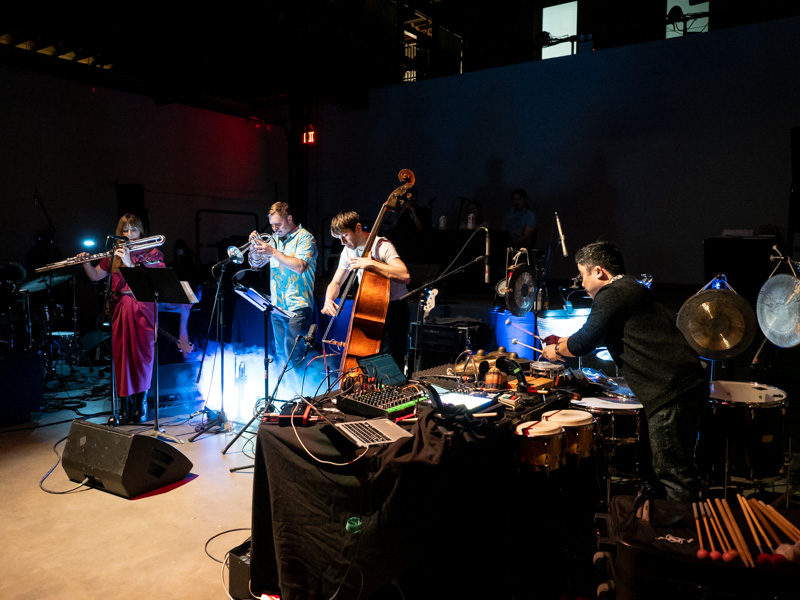
Worlds converge when Lorenzo builds instruments. The programmability of electronics allows infinite connections to be made between input gestures, physical human energy, and the resulting sound. An instrument shapes a specific musical logic through which practitioners establish performance norms and solidify their music-making. Finding new logics to discover new musics creates newer languages involving human engagement, Lorenzo explained. “I always anchor my electronic concepts in acoustic music—knowing how to play scales, practise fingering, use a metronome, and reflect on traditions in musical technique.”
His experimentation started with Intelligent MIDI Sequencing with Hamster Control (2003), his Master of Electrical & Computer Engineering (Cornell University) thesis, in which distance sensors influence three simultaneous MIDI streams through six live hamsters to sound out MIDI instruments, each data stream requiring one hamster for note choice and a second for rhythm choice. Although this was merely a musical device for Lorenzo—“I wouldn’t call it an instrument, because humans aren’t playing it”—it nonetheless marked a step towards creating playable instruments.
For Teacups and Light (2009), four light sensors control the pitch, volume, and rhythm of a custom synth. A MAKE Controller hardware interface “talks” (communicates using protocols) to Max/MSP (an interactive programming software) to produce sound. A light source is pointed at the sensors while teacups are used to control how much light seeps through. A video of his performance of the piece at a 2015 International Contemporary Ensemble concert at Manhattan’s Abrons Arts Center shows him taking hold of the lamp itself to play the instrument.
Lorenzo’s curiosity about vintage technologies is present in Modified Attack (2012), which uses a Logitech Attack 3 joystick to call audio buffers and sound operations for eight audio samples in Max/MSP. On the stick’s neutral position, four buttons trigger kick drum, snare drum, tom-tom, and cowbell sounds. Moving it forward increases volume, while moving it backward triggers low sine tone, high sine tone, fuzzy phaser tone, and triangle sounds. Lateral motion controls the playback rate of triggered samples. This instrument yields surprisingly abundant sounds, given the right gestural actions.
In 2015, Lorenzo was invited by the potato chip brand Pringles to participate in its marketing campaign Percussion Prodigies, a video series featuring percussionists using Pringles cans as instruments. For his Pringles Light Theremin, Lorenzo made infrared sensors talk to a custom synth in Max/MSP via an Arduino microcontroller interface. In a kalimba-like formation, eight Pringles tubes of different lengths sound different pitches while the player’s proximity to the tube tops determines density and volume. All tubes can sound simultaneously, with LED lights for colourful visual feedback. In true marketing fashion, the video shows Lorenzo using lids topped with Pringles chips to play the tubes.
Hex Oscillator and The Binary Synth (2020) are the most compact of his instrument builds. Hex Oscillator has six buttons, four knobs, and two photocells that control six inverter oscillators. (An inverter works by changing a high output signal into a low signal, and vice versa.) A button is pressed to activate an oscillator. Four potentiometers (knobs) change the pitches of four oscillators by controlling their signal feedback time. Photocells influence the other two with a flashlight or a bicycle strobe light. Like Hex Oscillator, the Binary Synth has a six-button layout that controls one oscillator. With Lorenzo’s coded software in an Arduino microcontroller, button combinations (“fingerings”) mimic the binary number system from one to sixty-four in left-right orientation to generate chromatic pitches.
While emerging AI technologies such as chatbots seem to forecast that algorithms will take over humanity, one should remember that humans already embody algorithms. Musicians perform with complex real-time thought processes. Electronic musicians Michel Waisvisz, Joel Ryan, DJ Sniff, and other affiliates of Amsterdam’s now-defunct STEIM (Studio for Electro-Instrumental Music) understood the significance of human engagement from the studio’s early days. In a 1998 essay published for the STEIM Touch Festival, Waisvisz, Ryan, and cultural theorist Sally Jane Norman wrote that electronics and the human touch should enhance gestural skills rather than impoverish them.
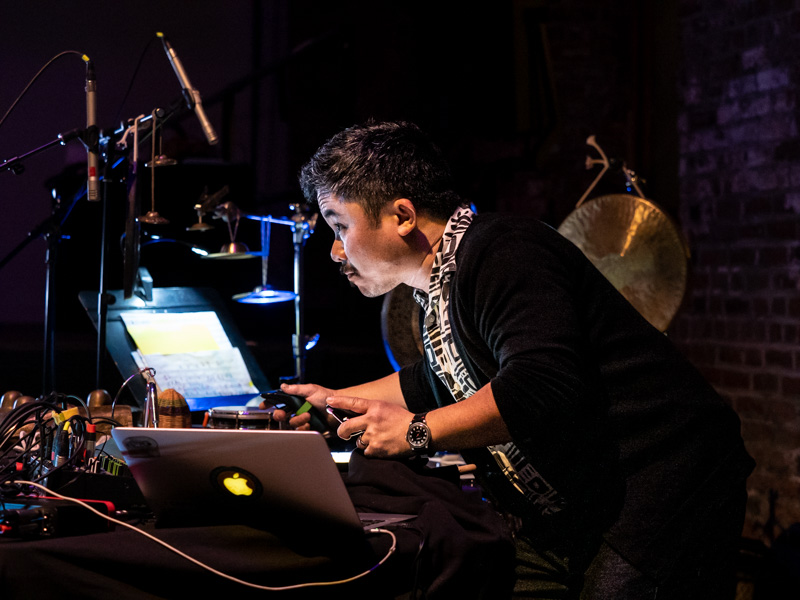
“This perspective anchors on the embodiment, presence, and sense of life within a live performance using electronic gear,” said Lorenzo, whose work has been featured at STEIM. “Playing two buttons might as well mean playing two woodblocks and finding life in a constrained system. I like the immediacy of touching sounds, whether it’s a joystick, a smartphone, a triangle, or a vibraphone.” At the premiere of Balter’s Oyá, Lorenzo relished playing the speakers and the space. He requested to play from the audience instead of onstage, as the position would allow him to connect to his sounds more effectively. While his arsenal—now called the D-tron—uses live-controlled arpeggiators (devices that simulate running arpeggios) on a drum rack in Ableton, only human touch can breathe life into it.
With accessibility comes sustainability. Lorenzo has addressed this point in his endeavours. “What is the endpoint of a violin? Either you keep playing the violin or you quit,” he said. “I built a new instrument for the [New York Philharmonic] performance, and I had to arrive at a point where I was satisfied with it. Now I have to continue playing and cultivating it.” That is true of all the musical instruments he has built; he has performed with them over the years without modifications or reprogramming. The D-tron, for example, made another appearance in a concert at The New School, two weeks after the Oyá premiere.
Improving accessibility to technologies is a goal of The Nstrument Lab, a research group based at The New School’s College of Performing Arts. Founded in 2021 and directed by Lorenzo, the lab focuses on the development of new electronic musical instruments. Its current researcher cohort includes Alexa Letourneau and Ethan Cohn, who devised extensions of objects including a double bass bow and an N95 mask for musical performance. Presentations at their Tech Forward concert series highlighted inventions and new modalities that emphasize performance.
Many people believe that technology is now democratized, but powerful economies have wielded a heavy hand in defining what modern societies should look like. I told Lorenzo that I couldn’t afford a keyboard back in Manila and was a band musician without an instrument. Unsurprisingly, the irony of lacking an instrument loomed in our thoughts. Silence is a rare commodity amid the noise of Filipino urban spaces. Earning the equivalent of $200 monthly as a contracted music teacher in the Philippines contradicts this Global North perception of access, especially with The New School’s demographic: Virtually every student has access to a MacBook Pro. “Not that we have arrived at a democratic place yet,” Lorenzo said, “but we are making progress [in] the right direction, not in the opposite direction. Speaking for my work, I see instrument building as a community-building tool. When I build instruments, I want to find ways to give them away.”
Open-source software and digital tools have increasingly become household staples, something that Lorenzo endorses. He cited the emergence of the smartphone, which can host web instruments he built that can be shared with a QR code. Computer platforms like REAPER, Max/MSP, and QLab are still accessible, if not entirely free. These things remind me of influential Filipino composer and ethnomusicologist Jose Maceda’s point in a 1978 journal article, that technology should be developed with, rather than imposed on, rural localities. “I tell students that technology doesn’t necessarily mean electronics,” Lorenzo asserted. “It could be new tools or methods, whether through cutting bamboo into different lengths or melting metal to produce pitches.” Such examples may evoke antiquated practices, but the fact remains that they have been used for millennia.
Our chat ended on musings of Filipino identity, an inspiration for Lorenzo and a logical connection between old and new technologies. “I even wonder if it’s all about this Filipino problem-solving spirit of finding solutions with limited resources. I think about that a lot,” he concluded. He wondered if his story would have turned out differently if his parents had never set foot in Romania, or the U.S. The practicalities of Manila life would have denied him the musical career he enjoys now—one that started with the stroke of a xylophone bar.
Indeed, remembering villages and primitive technologies is at the heart of redefining not only musical languages but our identities and where we choose to position them. Technologies shape us as a society as much as we design and construct them. For Lorenzo, identities converge old and new logics as his percussion and instrument building maximize the algorithm within the human.
JURO KIM FELIZ is a Toronto-based composer, pianist, and writer. Collaborating with Thin Edge New Music Collective, Ensemble x.y, Liminar, and others, his music has been performed at major events such as New York’s MATA Festival, Nief-Norf Summer Festival, Mexico City’s MUSLAB, the Asian Composers League Festival, and the Yogyakarta Contemporary Music Festival. He is the recipient of the Goethe Southeast Asian Young Composer Award (2009) in Kuala Lumpur and has commercially released music with Ablaze Records. During a Canadian Music Centre Library Residency, he created Nomadic Sound Worlds, a miniseries of podcasts and essays that frames Canadian contemporary music through the lens of global migration.