
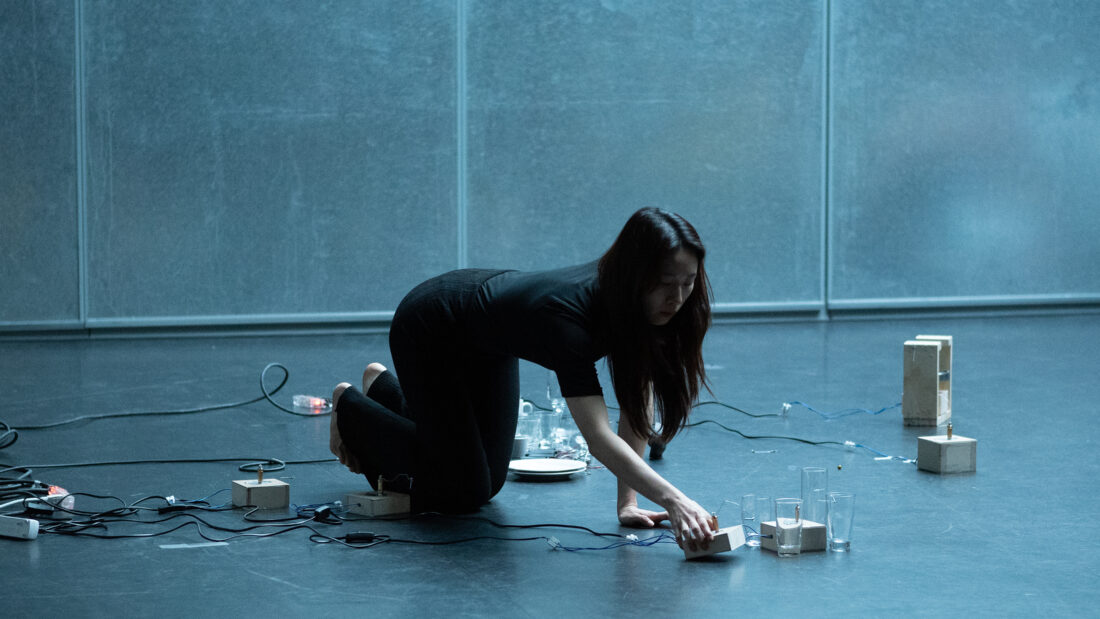
I’m sitting in Lina Choi’s sunlit studio on the edge of Montreal’s Parc Ex neighbourhood on a warm late-winter day. Water is dripping everywhere. Through the large industrial windows, under a brilliant afternoon sun, little rivulets can be seen pouring off a neighbouring roof into the parking lot below: Heaps of snow are dissolving, icicles are shimmering, drops are dripping down onto frozen puddles. The view in any direction is shot through with moving water of all sorts, glistening. From inside the studio, however, up on the third floor and in proximity to a low-level industrial squeal emitting from a neighbouring space, it’s hard to hear the water—that is, until Choi starts explaining what she’s been working on.
“It’s not done yet. I’m still trying to figure out the sounds,” she says, adjusting a few clear plastic tubes and tweaking the knobs on a small desktop mixer. As the volume increases, sounds of water fill the space: the bubbling of a hydrophone immersed in a large bowl of water that Choi skims with her fingertips, a chorus of droplets falling from the tubes onto a series of metal plates affixed with contact mics. Beneath it all, there’s a warm resonance that sounds like a soft mallet ever-rolling on a big brass cymbal. “So the [dripping] sounds will be in the first room, and then the farther you go into the space, you’ll hear the hydrophones, the deep water sounds,” she says. The pieces in progress will be part of Floating in the Depths, an exhibition Choi is mounting at Atoll Art Actuel, an artist-run centre in Victoriaville, Quebec, to coincide with the town’s long-running celebration of new music, the Festival International de Musique Actuelle de Victoriaville, familiarly known as FIMAV, in May 2023. The listing of the exhibition on the centre’s website describes Choi’s work as containing a “great gentleness,” and this feels like an apt way to describe both the artist and her work.
Born and raised in South Korea, Choi first began incorporating sound into her practice while pursuing her master’s degree in sculpture at the Royal College of Art in London in 2018. “There was a sound studio at my school—I had never done anything with sound before,” Choi says. “It was just new, so I thought I’d try it for my art practice, but also for my personal development. I started visiting the audio technician every day.” In the intervening years, Choi has employed sound as a means of exploring themes of perception, play, representation, and social expectation in beautifully understated ways.
In 2020, near the end of her studies and in the early days of the pandemic, she completed a piece entitled The Cacophonic Orchestra, a necessarily hybridized soundwork that includes multi-channel video, a scorebook, and a physical installation. The installation was mounted at Safehouse London, a pair of abandoned Victorian-era houses in East London operated by a community organization of the same name. The work features a series of bare speaker cones with water-filled petri dishes resting on top, laid across the rustic floorboards of an otherwise empty room. As the cones perform a kind of muddled symphony of buzzing, the water in the dishes responds to the movement of the sound. The audio content was extracted from interviews conducted and recorded by Choi, who asked her subjects to talk about their most recent personal event. The artist then digitally altered the responses until all traces of language were removed, and only the person’s tone, cadence, and pitch remained. Each voice was then assigned its own speaker in the array, with each petri dish becoming an individualized dance, distilling the speaker’s vocal expression and transmuting their message.
This tension around the individual experience versus a larger, collective expectation runs throughout Choi’s work. Early on, she explicitly addressed the stifling pressures toward social cohesion that she felt while coming of age in South Korea. During an artist talk in 2019 at Portugal’s Zaratan Art Gallery, she stated: “My work deals with personal desires, concerns, and objects. I grew up in a collective society where the individuals—who make up the collective—are seen as less important than the collective. But who gets to say that? Who gets to judge?” With this framework in mind, one can understand the tiny buzzing petri dishes of The Cacophonic Orchestra as an invitation to lean in and witness the small vibrations that in turn create a larger phenomenon.
As her practice evolved, with performances and installations being mounted in Canada, the U.K., and Korea, Choi’s fascination with the dynamic sonic qualities of water deepened. And slowly, the question of individual representation began to invert itself. “I feel like I’m still talking about relationships between individuals and society, but I don’t want to be so limited,” she muses. “My mind is always changing while I work, so I don’t want to talk about something so serious. Now it’s just water: one thing, same material. But everyone has different responses.”
Her recent work, like the aforementioned Floating in the Depths, offers a more open-ended experience for the audience, rooted in Choi’s experience as a listener. “The work always starts with my curiosity,” she explains. “I’m thinking about the audience, but I don’t want to give them any answers. I don’t want to tell them how to feel.” She cites Water and Dreams, an imaginative mid-century text written by French poetic philosopher Gaston Bachelard, as a guide throughout this current phase of exploration. “It’s really interesting. He’s just talking about water; that’s it, you know? But he’s talking about all the different ideas of water.” She skims a dog-eared copy. “Running water, dead water, narcissism, clear water, family and water, purification,” she reads aloud, adding, “Water is so full of different sounds, and can create so many different emotions. That’s why I’m exploring it. Water is super mysterious.”
In the coming year, Choi will have plenty of opportunity to explore and inspire that spectrum of emotion. She has a series of residencies lined up in small towns, where she’ll be capturing the sounds of local waterways and installing them in gallery spaces, accompanied by her sleek, minimalist sculptures. “I always imagine projects as purely sound at first. I don’t want to put anything in the space, so people will just listen,” she says, looking at her sculptures in progress. “I want sound to be the primary focus in my work. But I can’t lose the physical stuff.
“Maybe I’m afraid to leave the space empty,” she ruminates. “Maybe I have an unconscious need to fill the space.”
Andrew Patterson is a writer-reader-listener living in Halifax, Nova Scotia. He is a programmer for Atlantic Canada’s only music festival dedicated to alternative realities, OBEY Convention.. He also plays bass in Canada’s hardest working ESG tribute band, EFG.