
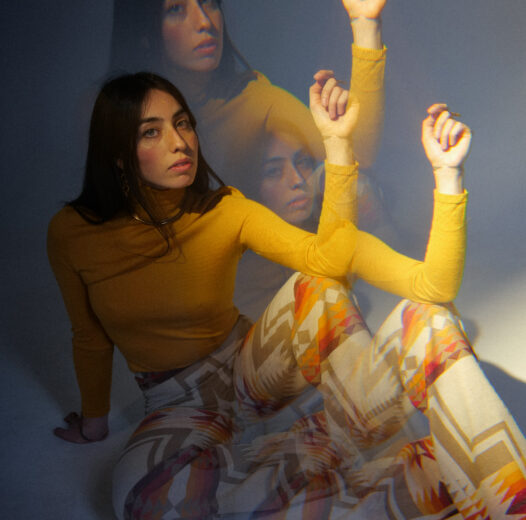
Bassist and composer Mali Obomsawin’s Lincoln Center debut was a free concert held in January 2025 in the café-like David Rubenstein Atrium, a modest venue compared to the famed stages a few blocks north. But after Obomsawin had taken her ensemble to the BRIC JazzFest in Brooklyn and played a set with string musician and folklorist Jake Blount at Joe’s Pub at the Public Theater, the Atrium show was another opportunity for the enclaves of listeners around New York City to discover the various aspects of her music.
“We don’t believe in borders in this band,” she told the full house at the Atrium.
A citizen of the Abenaki First Nation at Odanak in Quebec, Obomsawin moved to Brooklyn this year, adding New York City to the list of places she calls home. “I do a big loop between Maine, New York City, and Odanak these days,” Obomsawin says during a video call in the spring. “I consider myself Abenaki. I’m, like, a citizen, right? But I don’t get opportunities as a Canadian because I don’t have Canadian citizenship, even though I have First Nation citizenship. And in America, I don’t get opportunities as a Native American because I have First Nation citizenship, even though I’m an American passport carrier. The only nation that has consistently shown up for me is the Abenaki Nation.”
Her Lincoln Center set struck devotional moods, including an Alice Coltrane composition, arrangements of traditional Abenaki songs, and a blistering jam that began like a take on Jimi Hendrix’s “Foxy Lady.” The horn-heavy sextet included Montreal-based Allison Burik on bass clarinet. Obomsawin plays with Burik and guitarist Magdalena Abrego in a noise rock trio, and with Abrego in their indie rock duo Deerlady, which self-released Greatest Hits in 2024. Obomsawin and Blount, meanwhile, interpret historical songs as expressions of Black and Indigenous futurism on their album symbiont, which was released in January 2024 on Smithsonian Folkways Recordings.
This year, Obomsawin has been composing and recording a follow-up album to her well-received debut as a jazz bandleader, Sweet Tooth (2022, Out of Your Head Records), and has been performing her score for Julian Brave NoiseCat and Emily Kassie’s Academy Award-nominated 2024 documentary Sugarcane at screenings across the U.S. The new album, Triage, includes jazz-adjacent compositions Obomsawin has been working on with her band for the last couple of years.
“I like to write with shapes in mind, with the impact in mind, physical shapes, the shape of a dance,” she says. “I didn’t ever intend to get attention as a jazz musician, even though some of the instrumentation is the same.
“I like three horns. I need them, you know, that’s the sound that I want. It gives the energy that I need as a bassist, and that I want as a listener. It allows this dynamic range and depth.” Recalling the 1987 album Trio, a touchstone of American song that’s often overlooked today, she says, “Dolly, Emmylou, and Linda—I’ve got to have that stack. That’s what I grew up doing. That’s the magic.”
As with Sweet Tooth and Triage, the Deerlady songs are her compositions, although the music is worked out with her bandmates. “Banter is a really important part of my process,” she says, “being able to hear what each person is offering.” Deerlady is based on lyrics. “You have the cushion of genre and of rock ’n’ roll. Your goal is to push at the edges of the formula.”
In conversation, Obomsawin is at once casual and focused. She listens intently, laughs easily, and discusses social injustice in soft but measured tones. This is true of her onstage presence as well. Her jazz-leaning bands don’t play free improvisation; they play smart compositions that sound relaxed and off-the-cuff. It’s a balance she can’t live without. “If you hear a great storyteller tell a joke or a story a million times, or even hear the same story told by different people, there’s going to be a spine of information that has to happen every single time in order for the story or the joke to work,” she says. “Everyone’s individual interpretation will go off on these tangents and embellishments and different punchlines or different timing. That’s what I hope to put into my music.”
The schools in central Maine, where she grew up, didn’t provide Obomsawin with her cultural history, but the community provided several kinds of musical education. “In my town, we learned that my nation is extinct,” she says. “Meanwhile, my family and my community know that my nation is not extinct. It’s just across the border, in Canada.
“My mom would always ask me what I was learning in school, particularly in history class,” she continues. “Dinner was the chance that she and my dad had to correct the miseducation that was happening, by being like, ‘OK, well, this is bullshit, and that’s bullshit. This you should care about. Here’s a book.’”
Her musical education, on the other hand, was rich. Her father is a musician and introduced her to jazz. The local folk music scene preserved and handed down songs brought over long ago from France and the British Isles, and she was also introduced to the music of her Abenaki heritage. She started playing bass at age ten and went to jazz camp at the University of Maine at Farmington, where visiting teachers included jazz bassist and composer Michael Formanek. She continued her education at Berklee College of Music and Dartmouth College in New Hampshire, where she studied composition, comparative literature, and government (graduating in 2018) while playing in the school’s Coast Jazz Orchestra, directed by cornetist Taylor Ho Bynum. The two found a mutual admiration that continues today. Bynum played on Sweet Tooth and has worked with Obomsawin on her upcoming album, but she says he’s not a mentor, just a “proud uncle.”
At Dartmouth, Obomsawin was already integrating her ancestry into her art and working on the music that ended up on Sweet Tooth. “That always has been a big part not just of her identity but of her scholarship, her work,” Bynum says. “The institution is a great place to meet cool young people, but I find the best instruction comes after graduation, when we’re interacting as artists. I could hear what she was trying to do—pulling together ideas she was getting from Mingus, Art Pepper, Don Cherry, [and] really understanding how deep Indigenous influences go.”
Even with the diversity in style, Indigenous influences run strongly through much of Obomsawin’s work. She grew up aware of the residential schools that older relatives had been forced to attend, although Odanak, established as a Catholic missionary village, was somewhat shielded from the system. She also grew up aware of Indigenous art, in no small part due to her family connection to celebrated Abenaki Canadian filmmaker Alanis Obomsawin, her father’s cousin, who started her career in the 1950s as a singer and storyteller.
“She’s the most famous Abenaki ever,” Obomsawin says, beaming through the computer screen window. “She’s like everybody’s grandmother. She brings Christmas gifts to everyone. She still dances. She is part of our big powwow parade and rolls through in this amazing convertible every year. She’s the queen.”
Sugarcane, which won a Best Original Music Score nomination from the International Documentary Association, follows an investigation of unmarked graves discovered at a residential school in British Columbia, and the impact of abuse on the lives of survivors and their descendants. Obomsawin’s atmospheric, guitar-driven score for Sugarcane is sparse, sometimes tense, sometimes beautiful, and always present without getting in the way of the film’s story.
“When I started watching it, there were six or seven hours of footage,” she says. “[The filmmakers] didn’t have scenes yet, so there weren’t cues. I hardly wrote for scenes at all. I wrote all these themes. I gave them a bunch of material and said, ‘Use this however you want,’ and they said, ‘Create a few more things in this world and in that world.’ They built the edit around the music in a lot of cases.
“I loved doing that score,” she continues. “It was so liberating to get out of my head. I had a task and a lot of material to work with. That’s ideal for me, so I really enjoyed it. I would love to do it again.” As she takes her band on the road to play live accompaniment to the film across the United States, she is, in a sense, improvising on the soundtrack’s themes.
The film’s subject matter plays into how Obomsawin sees her jazz lineage. “This horrible program took kids from their culture, from their communities, forbade them from speaking their languages, singing their songs, but then handed them European instruments, [and] taught them church music but also the popular music of the time, which was military marching band music. And that’s the same as what happened to the Black community.
“So marching bands and little jazz bands were percolating in other parts of the country. We were participants in the development of everything modern that was happening at that time, and influenced by it.”
Within a couple of decades, Indigenous people were appearing on the first recordings of jazz. Illinois Jacquet (whose mother came from what was then termed the Sioux Nation) and Pee Wee Russell (of Cherokee ancestry) were among its early architects. Other players, such as trombonist Big Chief Russell Moore, a member of the Pima tribe who played with Russell and other jazz legends, are all but forgotten.
“Oscar Pettiford was Indigenous, from Oklahoma, and loud and proud about it,” Obomsawin says. “It was happening [but] unnoticed. I mean, Oscar Pettiford transformed jazz bass playing. Mildred Bailey was the first woman to ever sing in front of a big band. Everyone wanted to sound like her in the late ’20s and early ’30s. And Jim Pepper kind of invented fusion, right?
“Delbert Anderson is a trumpeter from the Navajo nation, and he is really loudly and proudly sharing those stories,” she continues. “There was a trumpet player from his nation named J.C. Morgan who ended up composing and working with some really big jazz names. Because there are so many Indigenous nations, these are like separate histories. We need a collective, a collectivity of us, in order to tell the bigger story, like, ‘We’re still here, and we were ground-breaking and we were influential because we’re smart and cool and like everybody else.’”
Along with her own projects, Obomsawin is a member of the Julia Keith Indigenous Big Band. Keith, a singer and member of the Nez Perce tribe, formed the band to call attention to “the history and future” of Indigenous people in jazz.
Maybe a dedicated band like Keith’s will help to get the contributions of generations of Indigenous musicians into the history books, or even get them a book of their own. “I think it actually isn’t quite written yet,” Obomsawin says. “Indigenous jazz musicians—plural—[haven’t] been talking about this long enough for it to be written. I think it will be written soon.”
Kurt Gottschalk is an author, journalist, and broadcaster based in New York City. His work appears in publications in North America and Europe, including Bachtrack, The New York City Jazz Record, The Red Hook Star-Revue, Stereophile, and The Wire and he can be heard on WKCR-FM and WFMU-FM.