
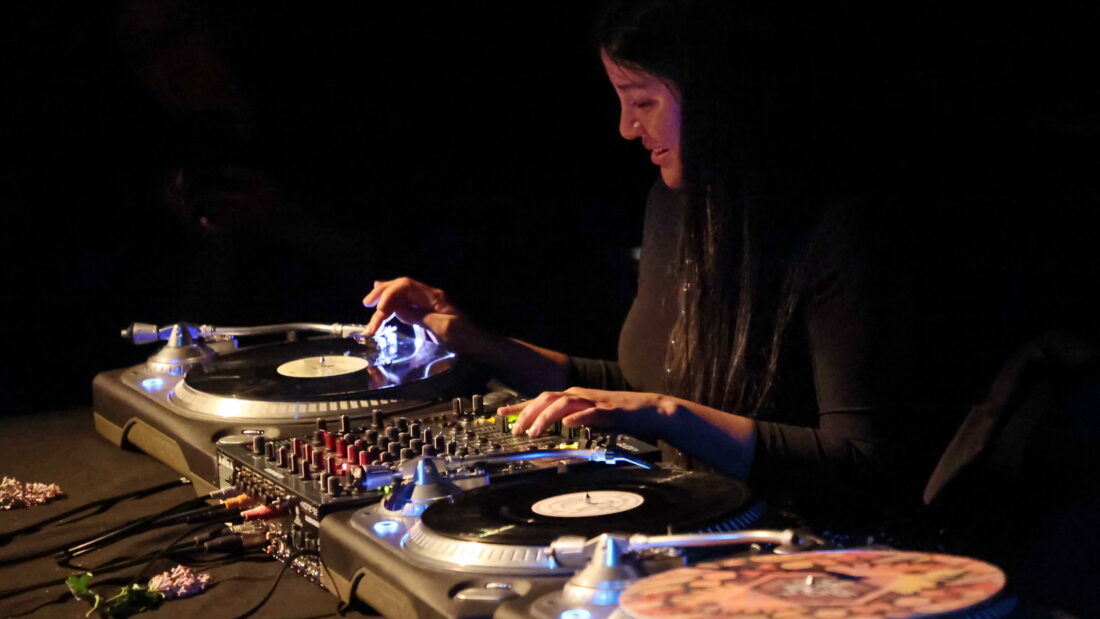
In early June, sound artist and noted abstract turntablist Maria Chávez visited Montreal for the first time in a decade, and she seemed to be making up for lost time. Chávez performed at Suoni Per Il Popolo—the annual month-long festival of experimental, liberatory music in the city’s Mile End neighbourhood—and offered a workshop and a lecture at the International Society For Metal Music Studies’ 2023 conference, held at Concordia University. Over three days, I watched Chávez buzz in and out of the spotlight, perpetually inviting others to join in the creative process. “If I can make a space as compassionate and open as possible, to the point where people feel like they can do what I’m doing—and they definitely can!—that’s what I’m here for: to make the work less about me, and more about us,” she told me at one point. This radically inclusive approach to art-making has shaped Chávez’s work over the last twenty-five years. And in turn, she’s encouraged the world to reimagine the possibilities of one of the most ubiquitous tools for music of the last hundred years.
“The playback technology is so vulnerable. You have this open thing, this tiny little needle that’s reading this tiny little spiral, and it’s open to all the elements, and if you bump it … you destroy it? How can you not touch it? How can you not want to destroy it?” This instinctual fascination is at the foundation of her practice, which over the years has come to encompass sound art, performance, installation, painting, and sculpture. For Chávez—who was born in Lima, Peru and grew up in Houston, Texas—her work is both a response to the materials and a profound critique of capitalism.
“We’re humans! We have to interact with things. It’s so counterintuitive to make something that’s open to all the elements and then say, ‘But don’t let the elements touch it!’ That’s why hip-hop turntablism has been life-changing—a total societal change. These are musique concrète artists, Black artists, who have the audacity to occupy and challenge a space and a technology that white supremacy and capitalism told us was too precious and too valuable to be touched.”
Chávez is leading roughly twenty participants through an evening workshop on turntablism. Four turntables, adjoining cables, mixers, and speakers lie on the tables in the centre of the room, unplugged and disassembled so that Chávez can explain each component of a traditional set-up and invite the participants—most of whom seem to have little to no experience—to plug them in. Chávez approaches her workshops more as skill-shares (as opposed to master classes), a way for people to access high-end equipment in a fun, relaxed environment. After discussing the basic components of the gear, Chávez encourages the group to self-organize and work together to set up the equipment.
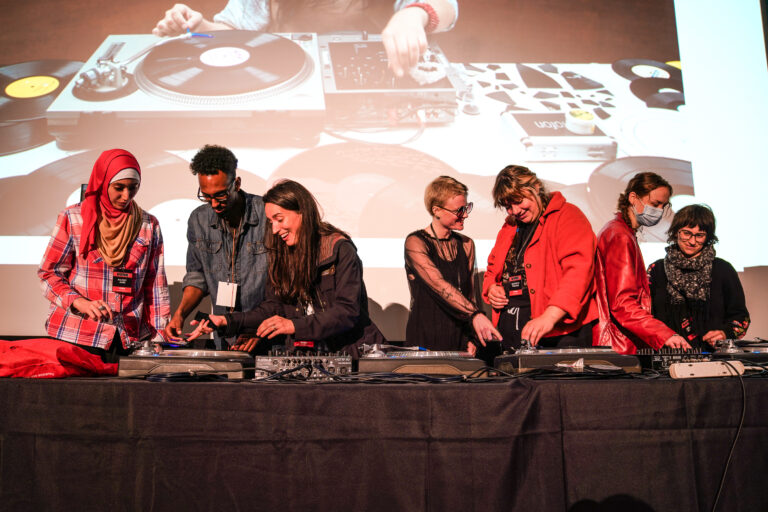
Next, Chávez weaves together practical instruction, historical context, and conceptual ideas in a session that covers the fundamentals of how a crossfader works, as well as how the shellac production for 78 rpm records in the mid-twentieth century was rooted in British imperialism. She also discusses her 2012 self-published book, Of Technique: Chance Procedures on Turntable, which she describes as “a conceptual sound art album.” The book, which documents Chávez’s early work and techniques, contains written and visual scores, diagrams for hand positions, and definitions of vocabulary. Readers can activate the pieces, either through imagination of sounds or their own performances. Some images can be removed, allowing a more personalized engagement, blurring the lines between art object, score, and performance.
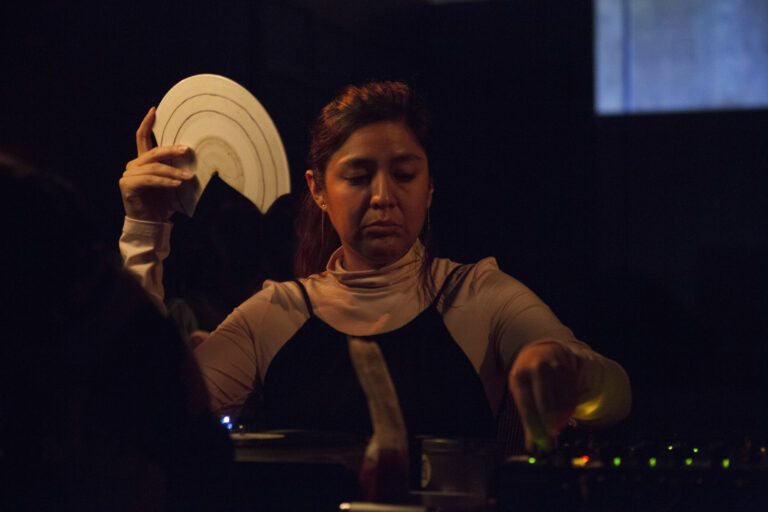
Chávez grabs two stuffed tote bags and starts handing out vinyl records: Edgar Varèse, Jon Collin, Letha Rodman Melchior, vintage hootenanny and instructional records, dustbin Chopin. Some are unlabelled, most lack a sleeve or cover. To perform the gesture she has in mind, these records will have to be shattered, she explains. Participants look shocked and uncertain, but eventually they begin following her instructions: Place the record horizontally in the crease between your hip and your leg, turn your head, close your eyes, and lean into the vinyl until it snaps. Pops, cracks, shrieks, gasps, and laughter fill the room. Shards of records litter the room, landing on the floor, the tables, the equipment, the windowsills. Still wary, the participants are guided graciously by Chávez into what she describes as “the beauty of destruction.”
I suddenly realize just how deep and pervasive the culture of gatekeeping can be when it comes to vinyl records: Even with little to no experience in the matter, these participants carried with them so many strict rules about what they could and couldn’t do. “That’s the grooming of capitalism and consumerism—being so tense and afraid to make mistakes or do something wrong,” Chávez says later. “It’s [what] makes artists so desperate for attention. These ideas of manufactured scarcity and preciousness are dangerous.”
Chávez began DJing on the club circuit of Houston, her hometown, at seventeen. “Growing up, I didn’t have support structures. I was a deeply neglected child,” she says. “My family didn’t have the emotional capacity to give me any kind of guidance, so music taught me things. It taught me how to book shows, budget, organize, tour, play. It taught me to evolve—it was like a parent to me. Art really saved my life.”
One night Chávez saw a needle skip and pop up off a techno record and then fall back down. “I picked up the arm of the player and tried to do it again, and my boyfriend got really mad at me. We had the biggest fight. He was so angry, telling me I wasn’t allowed to do that. So I hid the record and tried it again when I was alone, and it did it again. I was fascinated.” This fascination led to Chávez’s earliest experiments with unorthodox turntablism. As she attempted to incorporate these new techniques into her practice, the male-dominated scene around her resisted.
“I tried to get more experimental with the crew I was with, but they weren’t having it, and they kicked me out,” Chávez continues. “They said I’d never DJ in Houston again, and they were right. Suddenly, I couldn’t book a gig to save my life. I was devastated! I cried for weeks. At the time, I didn’t realize it was actually a good thing.”
Not long after this expulsion, Chávez met Houston trombonist, composer, and educator David Dove, who told her about experimental improvisation sessions he was facilitating. The late Pauline Oliveros, who was often in town tending to her aging mother, was a frequent and significant presence at the workshops; the Deep Listening founder became a mentor and was a lifelong inspiration to Chávez. “They gave me a safe space to experiment. And as soon as I had that, I was able to evolve and grow. Everything took off from there.”
From that time forward, Chávez was in a constant state of evolution: performing alongside punk legends Lydia Lunch and Thurston Moore, pursuing residencies with the Merce Cunningham Dance Company and the Dia Beacon, landing a research fellowship with Goldsmith’s London, collaborating with composer Otomo Yoshihide and conceptual artist Christian Marclay, and presenting sound installations and lectures around the world. Her unique, open-ended approach to sound allows her to move deftly between fine art institutions, museums, academia, and festival settings. The professional acumen she’d acquired as a young DJ and the experiences in listening, composition, and improv she’d garnered from the sessions with Dove and Oliveros gave Chávez the foundation from which she rose to international acclaim.
Chávez’s practice as an artist and performer is dialogical. “My relationship with my fanbase is so much different than, say, a pop star’s. Because pop stars are distant; it’s all very ‘genius’ and ‘other’ when they’re on stage. Whereas with me, everyone is equal. I start off by saying, ‘I’ve never heard this before, you haven’t either, let’s play together!’ I’m not trying to be a genius, I’m just trying to create situations. I’m trying to be an instigator; to see what the reaction is and find ways to fold that reaction into the work and make it part of the process.”
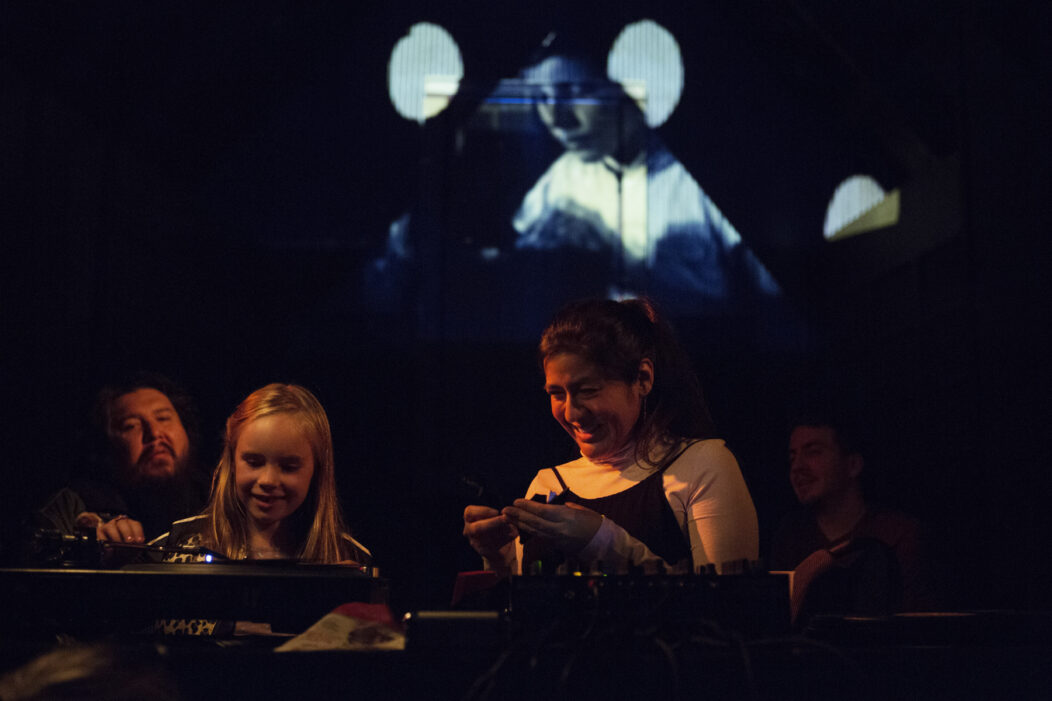
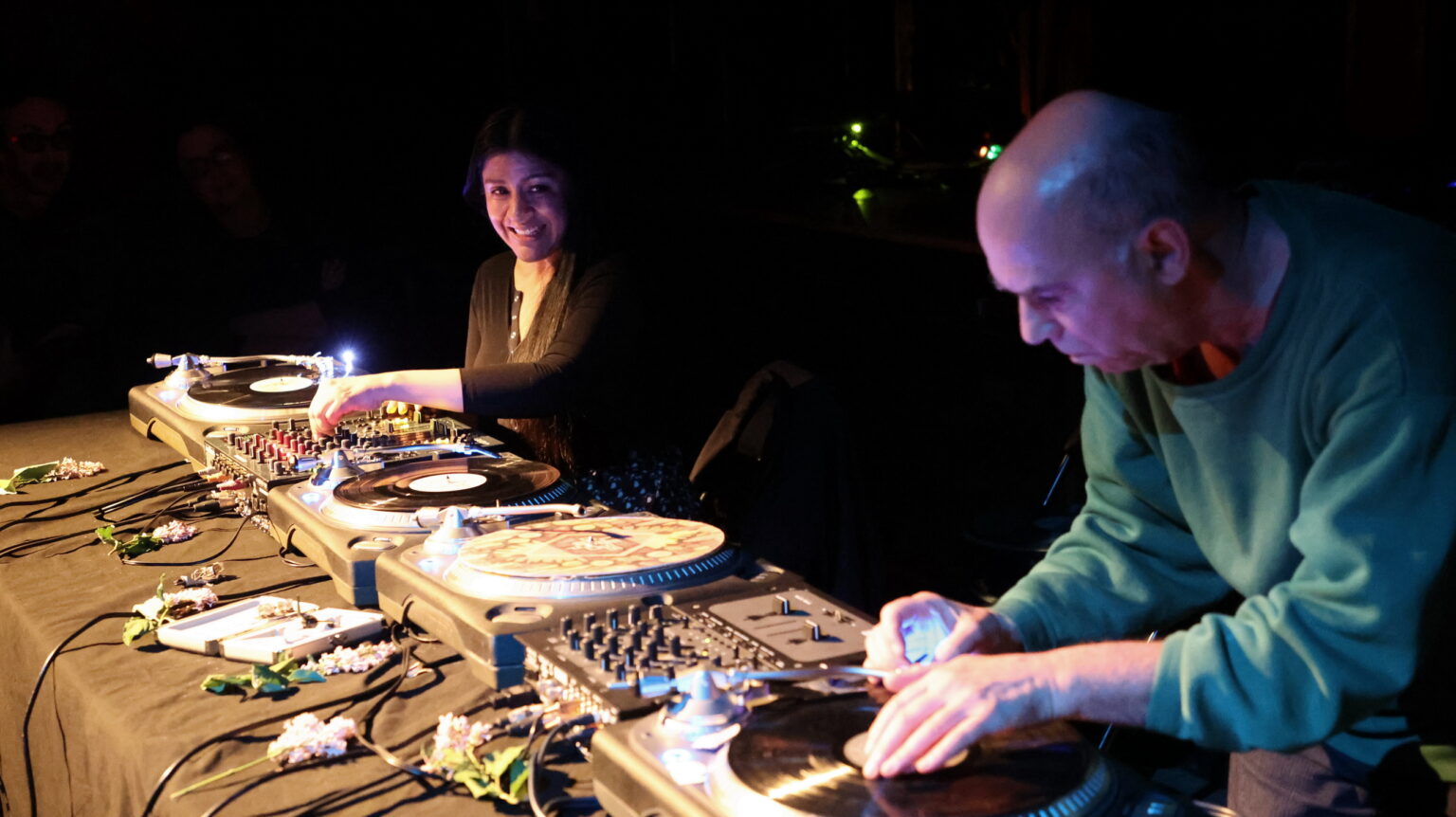
Chávez’s performance in Montreal kicks off in a dimly lit Sala Rossa, the legendary small-scale concert hall at the heart of Suoni Per Il Popolo. Chávez is set up on the floor in front of the stage, with four turntables in front of her. The audience is seated in arced rows a few feet from the performance area. Chávez explains that, like the audience, she has no foreknowledge of what’s about to happen and that chance factors heavily in her work. After setting a few platters spinning, she begins to root through her totes for scratched and shattered records. Her “packing at the last minute” energy turns into a focused curiosity as she gathers and stacks vinyl on the table beside the players.
Segments of the set feature what she calls her “most valuable breaks”: shards of shattered records in which the spindle hole is intact. Using specially designed double-headed needles known as RAKEs (invented by Dallas-based DJ Randal Sanden Jr.), Chávez is able to play multiple shards at once on a single platter, sometimes in combination with a “base record” underneath that fills in the gaps in between. What this process sounds like depends on the moment: Bits of outmoded speech from instructional records are spliced rhythmically with delicate nylon-stringed guitar. Washes of heavy static burst from within orchestral clamour. In this hauntological dimension of her practice, Chávez positions herself as an excavator who gives new life to discarded bits of the collective sonic tapestry. “Searching through the sand for tombs,” she likes to say.
Old sounds are revived alongside plenty of spontaneous contemporary noise: the gnarly zip of needles skating across grooves and the thud when they run into the edges of broken records. The side of Chávez’s closed fist makes a low-level bass rhythm as she bumps the side of a turntable, skittering the tone arm. Percussive shards of wax are dumped onto spinning platters as agents of chaos, spinning off, hitting the table or the floor of the venue. The artist snaps a few records in her hip, the popping sound followed instantly by bits of vinyl clanging off the edge of an audience member’s metal folding chair in the front row. Sudden shrieks and chuckles arise from the crowd as they shield themselves from vinyl shrapnel or crane their necks for a better view of the action.
Chávez invites two friends (who are also performing at Suoni), Montreal experimental turntablist Martin Tetrault and British guitarist Andy Moor (The Ex), to take turns joining her behind the spinning platters, grabbing errant bits of vinyl from the scattering and adding their own sonic curiosities to the tumult. The performance closes with a spontaneous collaboration between Chávez and the opening acts, Big|Brave guitarist Mat Ball and Toronto sci-fi turntablist SlowPitchSound. The trio work their way through an eerie blend of troubling feedback, haunting vocal samples, and mechanical crackling.
The performance flows through dynamic layers, unpredictable factors, and shifting soundscapes. Throughout, Chávez meets the moment, whether she is offering ebullient, tangential conversation between pieces or crouching down to witness a spinning record as its sound unfurls.
Chávez’s Montreal performance was one of her first live appearances in four years. In 2019, she underwent experimental surgery to address a rare brain disorder. First diagnosed in 2017 after three years of symptoms, the disorder caused painful, uncontrollable facial spasms and intense headaches, among other debilitating discomforts. The rarity of the disorder and the enormous cost of treatment in the U.S. medical system forced Chávez to dig online for information and possible solutions. On a Facebook group for people with the same disorder or similar conditions, she learned about a doctor in Japan who offers a low-cost alternative to the approved U.S. procedures. She flew to Japan with her mother, underwent surgery, then spent a month recuperating. Homebound, under heavy medication, and in profound pain for many months, she was declared cured after two years. Chávez tells me that she still suffers from “bad skull days” when she experiences intense brain fog and fatigue. Though the effects of the surgery and the lengthy healing process continue to inhibit her to some degree, Chávez has returned to her practice with new-found strengths.
“Over the course of my medical sabbatical, I figured out I no longer need to surround myself with people because I know how to be safe for myself. I no longer need to be heard because I’ve learned how to hear myself. I’m parenting myself now. I’m parenting the trauma of my inner child and working my way through that.” In tandem, she’s developed a new sense of artistic freedom and resilience from the white supremacy of the industries surrounding her.
“The first eighteen years of my career, because I look the way I do, was a nightmare. But now that I’ve written the book, and worked hard [to get here], there’s really nothing anyone can do to kick me out anymore. I’m just grateful to be alive, to have survived the medical journey that I had to go on. And to finally be able to see my career as clearly as possible.
“I can do whatever the hell I want now, y’know?”
Chávez has recently become occupied with sculpting. In a studio in Tuscany, Italy, she has been carving larger-than-life sculptures of vinyl record shards out of white Carrara marble, a material that has been quarried in the area for thousands of years and was used to build the Pantheon in Rome and the Washington Monument. “Part of the reason I chose this material is that it has such a prominent history as being owned and controlled by white, male bodies. It’s also been proven to stand the test of time,” she says. This work feels like a natural extension of earlier visual pieces such as Topography of Sound, a collection of paintings and drawings that explore stylus needles and record grooves on a microscopic scale, resulting in stark images that resemble mountains and canyons. Though, knowing Chávez’s track record for radical techniques, where she takes Carrara marble is anyone’s guess.
“How can I make my artwork inclusive to all bodies, not just people who can hear and see? That’s something that’s really important to me, especially after my surgery,” she adds, explaining the inspiration for this recent endeavour. “The marble sculptures are really accessible in that way because [people are] encouraged to touch them. People who are blind can touch them and feel what a sonic groove feels like. People who are deaf can see it and see a representation of sound. I’ve also been imagining turning these life-sized sculptures into a giant skatepark. So if you’re skating in the groove, or ollying at the edges, you’re the needle. That’s the sound piece and the performance.”
Andrew Patterson is a writer-reader-listener living in Halifax, Nova Scotia. He is a programmer for Atlantic Canada’s only music festival dedicated to alternative realities, OBEY Convention.. He also plays bass in Canada’s hardest working ESG tribute band, EFG.