
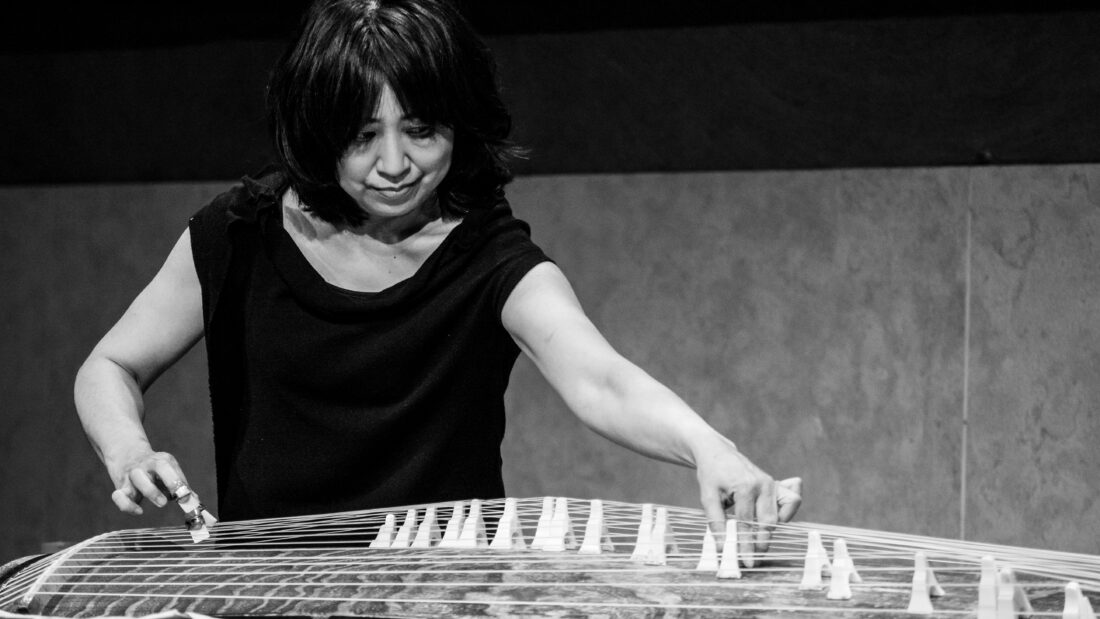
My imagination never lingered on dragons, the stuff of legends and good fortunes, until I came across Japanese koto instruments being sold at an online auction site. Thirteen tetron strings laid taut on six-foot paulownia wood bodies, requiring adjustable bridges to tune them and three finger picks to make sounds. The dragon symbolism was not lost on me—the beast gyrated with spiralling bridges and strings on its curved shell. I took the bait, made a bid for one, and had it shipped from Japan.
A player plucks strings around the koto’s head near the horns (bridge saddle). Fabric shells adorn the mouth, but are removed when it’s played in public. The flamboyant tailpiece harnesses coils of excess strings. Legs appear as small attachable pegs or a full-body wooden stand. Its sharp plucked tones create empty silences between them that command equal attention. The koto’s history spans more than a millennium, from seventh-century Chinese imports in gagaku (Japanese imperial court music) to modern avant-garde and electronic innovations in solo repertoire. The seventeen-string bass koto, which is pitched an octave lower, and the twenty-one-string koto further stretch its possibilities.
Global trade wars in 2025 plunge the world into an unpredictable frenzy. Fraught with the United States’ claims of “trade deficits” and “subsidies to foreign economies,” this chaos exposes the volatility of free trade and globalized supply chains that long enriched the Global North. At the same time, I ask: Have dragons imagined sustainable futures? Have they forged strong communities? Have they migrated and found new homes, or are they stuck to their rigid identities?
Competing with loud free-jazz wanderings is tough work. In a video of a 2017 show at Tokyo’s Shinjuku Pit Inn, Michiyo Yagi steps up her game as she shreds unabashedly with an electrified twenty-one-string koto in drummer Paal Nilssen-Love’s big band Large Unit. Yagi’s strength, volume, and distorted overdrive take the place of an electric guitar soloist. I find myself wondering how a dragon can roar and find belonging through this cacophony.
“Electrifying the koto came from necessity,” Yagi responds. Unable to converse in Japanese, I interview her via an email exchange, with assistance from Mark Rappaport, Yagi’s husband and manager. Rigging a koto isn’t as radical as it sounds. “No one hears me clearly when I play with drums and electric instruments,” she explains. “A microphone under the koto sounds terrible, with risks of feedback. Contact mics aren’t great either.” As gigs increasingly demanded a solution, singer and guitarist Takuya (formerly of the ’90s Japanese rock band Judy & Mary) referred her to his luthier. He rigged her seventeen-string and twenty-one-string kotos with Piezo pickups, internal preamps, and quarter-inch jacks.
Born in Tokoname, Yagi, whose mother was a koto teacher, showed little interest in the koto until her late teens, when she heard a koto piece by composer Toshiya Sukegawa (1930-2015) on contemporary classical radio. Her first teacher, Satomi Kurauchi, a former Sawai Koto School apprentice, eventually led her to the masters Tadao and Kazue Sawai in Tokyo. “I became an uchi-deshi—a live-in apprentice—of the Sawai couple,” she says. In this common system in Japanese arts, chores and responsibilities are delegated to live-in apprentices. “We cooked, cleaned, did laundry, greeted visitors, handled administrative work, and assisted in concerts. We practised when there was time, getting lessons with either Tadao or Kazue, if we were lucky.” Starting late in koto meant she was subjected to unpleasant hazing among fellow apprentices; this incited her to work harder to become a better player.
Yagi later joined the Kazue Sawai Koto Ensemble on tours that included a performance at New York’s Bang on a Can Festival in 1989. That same year, the Sawai school sent her to Wesleyan University in Connecticut, where she was a visiting professor of Japanese music. She also taught koto, premiered the works of composers at Wesleyan, and was exposed to the music of Christian Wolff, John Cage, and Conlon Nancarrow. Meeting composer John Zorn was a turning point. “He introduced me to New York’s ‘downtown scene’ musicians like Elliott Sharp, Zeena Parkins, and Marc Ribot,” she recalls. “I knew how to improvise, but this tenure made me take improvisation more seriously.”
She eventually veered into radical explorations of improvisation and free jazz, propping the koto dragon alongside loud beasts. Her debut CD, Shizuku (1999), was released on Zorn’s Tzadik Records. Many years of collaboration followed, notably with Paal Nilssen-Love, Tamaya Honda, Eivind Aarset, Hideo Yamaki, Lasse Marhaug, and the late Peter Brötzmann, who became a mentor. “Peter referred to me as [his] little sister but he also made me a strong player,” she says. “Our music was brutal, and I had to develop stamina to keep up. He didn’t go easy just because I was a female with an old, limited instrument.”
I listen to “Oboro (Haze),” the second track on Bibi (Jazzland Recordings), Yagi’s 2023 album with composer Dai Fujikura, who sculpts soundscapes with electronics. In her music, I hear clouds that sound as if you could touch them. Its translucence refracts light into nebulous shapes on a spring morning. Fast, rhythmic synthesizer bleeps and undulating sound bodies accompany grainy tones from a looper. “Using drumsticks, I played rolls on the strings of my electric twenty-one-string koto,” she tells me, adding, “Fujikura wanted to write a concerto for me, but he found my music and liked it so much that he lost interest in composing for me!” Fujikura started inviting her to Japan’s annual Born Creative Festival, where he is artistic director, which set the stage for Bibi—a made-up word to suggest a “subtly beautiful” listening experience.
The winter gloom of a February morning greeted me as my plane landed in Vancouver. Inside the Annex performance space, a harp shared the stage with a drum kit. A pad controller and a grid of stompboxes sat on a table beside the harp. Percussion controllers, a waterphone, hamon (metal slit drum), “Nano Garden” effects processor, mixer, and other accessories were beside the drums. Montreal harpist Sarah Pagé and percussionist Patrick Graham were set to perform the final show of a tour promoting their album Littoral States (Envision Records, 2025). In their performance of “Aethers,” Graham’s polyrhythmic percussion generated colourful pulsations while Pagé wielded a bow—or sometimes two—to make the harp sing. Ambient gagaku worlds transformed into plucked harmonies that were sifted through sparse, percussive heartbeats. I didn’t see a koto onstage, even though the bass koto is a highlight in Littoral States.
Pagé sighs, “It’s seven feet long. The airline wouldn’t accept it as checked luggage.”
Eight days later, Pagé sits in her studio at Morin-Heights, two hours north of Montreal. I ask if people know her as a koto player. “Montrealers are more aware of it now, but I don’t present myself much like that. I don’t like putting the wrong foot forward.”
Pagé first dreamed of the harp at a young age, admiring Arthur “Harpo” Marx of the comedy group the Marx Brothers. Soon after earning a diploma in classical guitar from Vanier College in Montreal, she began studies with harpist Olga Gross. “I went to her as a punk goth at nineteen,” Pagé says. Her goal was to audition for the harp program at McGill University the next year, which she did successfully.
“Jazz musician friends started inviting me to play gigs,” she says. Mediocre orchestra work culture turned her off. “I moved to Montreal’s Mile End. I could walk the harp [down] the street to all of my gigs.” Playing harp in various jazz and folk styles unleashed Pagé’s creative impulses. She co-founded the indie folk band The Barr Brothers and performed on albums by Lhasa de Sela, Nadah El Shazly, Joni Void, the big band Land of Kush, and the Celtic trio Bùmarang. She started using electronics and stompboxes regularly. She played arrangements of koto repertoire with flutist Yuki Isami.
Opportunity finally struck for a koto encounter. Her partner, Jonah Fortune, a double bassist and shakuhachi (Japanese bamboo flute) player, got a professional development grant to study shakuhachi in Kyoto for three months. She joined him and studied with koto virtuoso Chieko Iwazaki. Lessons revolved around jiuta—traditional vocal music with shamisen (Japanese thrree-stringed instrument), koto, and shakuhachi. “I would attend a group lesson early in the afternoon, practise with everyone until dinner time, have dinner, then practise more with them until the evening,” Pagé recalls. In the old-school fashion, everyone learns each other’s assigned pieces as a group, getting better each week. But classes can go wild; it depends on who shows up. “If you’re forced to play along someone’s difficult piece, you drown and let it run its course. Just do better next time.”
The I Ching is prominent in “Pushing Upwards,” the third track on Littoral States. Bowed bass koto and waterphone emanate calls of the ancient earth. Finding its footing, the wood gradually awakens. Time ceases to exist. Low plucked solo melodies lead into colourful hamon drum taps that sound like echoes of water droplets in clay jars. Electronics transform every hit and pluck, beaming bright outbursts of consciousness. The wood finally pushes itself upward into worlds unknown, without rest but without haste.
Surplus shops selling Japanese imports are abundant in the Philippines. Found in malls, marketplaces, and makeshift locations, these shops sell a wide variety of used items: kitchenware, appliances, furniture, house decor, toys, trinkets—even vehicle parts and heavy equipment in some locations. I call Japanese anthropologist and koto musician Hiroko Nagai, who is based in Manila, and ask her to explain this phenomenon. “Japan is an aging society,” she says. “When people pass on to the afterlife, families sometimes decide to sell their belongings and clear up space. Second-hand shops usually export such items to places like Southeast Asia and Africa.” A recent check revealed that the price of kotos in Manila’s surplus shops ranges from the equivalent of $75 to $125; by comparison, a fairly decent used koto in Japan is in the $800 to $1,500 range, and a new, concert-grade koto can cost anywhere from $2,000 to $30,000. “They would sell old instruments here five years ago,” she says. “But now we have access to very good instruments. Even concert-grade ones.” Instead of assembling a body out of wood from different trees, a koto-maker would cut all the pieces from one tree and match the grains to form a consistent body—which later would have ayasugi (zigzag-pattern) grooves carved inside the sound board—for a better-sounding kuriko (concert-grade instrument).
Manila may seem an unlikely place for the koto, but the rise of ethnomusicology after the Second World War fuelled interest and research into the universality of music traditions. Free from Ferdinand Marcos’ brutal dictatorship, the University of the Philippines College of Music was able to establish its Museum of Instruments in 1991. Consequently, the UP College of Music, among other schools, received both instrument donations and visiting teachers; one of them was Tadashi Naganawa, who would eventually become Nagai’s teacher.
Nagai studied piano in her teens. “I specialized in Bartok, won a composition award, and pursued world music studies,” she says. Her interests later shifted into rock bands, synthesizers, and emerging electronic scenes. After receiving her master’s degree in anthropology from Rikkyo University in Japan, Nagai travelled south to do field work in the Philippines. She later received her Ph.D. in anthropology from Rikkyo and stayed in the Philippines, where she got an academic position. On the side, she worked with folk musicians Bayang Barrios and Joey Ayala.
When the kotos arrived at the UP College of Music, her interest in the instrument was renewed. After studying with Naganawa and doing gigs for years, she now runs UP’s koto program, which is in its third decade. “I bought eight kotos myself and loaned them out to the program,” Nagai says. “The global pandemic in 2020 halted in-person classes. The college had to loan out kotos for students to use at home.” She also turned to producing film scores, using the koto for Alvin Yapan’s 2016 film Ang Tulay ng San Sebastian (The Bridge of San Sebastian).
Kazue’s vision of global koto communities is unfolding around the world. It’s not just about trade exports; freedom of movement also matters. “I took over the koto program, but I’m not sure if I’m qualified enough,” she says. “I didn’t work for a shihan [a master teaching licence issued by koto schools], so I sought learning opportunities for myself and the students.” She collaborated with affiliates in Thailand, Singapore, and Australia to organize student workshops, performances, and tours across borders. This network led Nagai and her colleagues to form the Global Koto Music Network in 2020. The network’s website holds a database of members around the world, contemporary koto repertoire, and resources for artists and enthusiasts.
I listen to Mokurei (Tree Spirit) from Yagi and Fujikura’s album Bibi and imagine physical excesses—surpluses of things attached to strings to modify their sounds. A prepared bass koto invokes invisible timbral shades not heard in natural states. Yagi’s rhythmic sukuizume (thumb plucks in alternating directions) and extended surizume (noisy pick slides across strings) drill relentlessly, exercising Fujikura’s saturated synth overdrives that accumulate into a capacious presence. Digital excesses dissipate, unmasking string strikes and plucks where spiritual presences ultimately reside.
Players rely on a kotoya-san (technician) to restring and repair instruments. Nowadays, a kotoya-san also takes charge of concert productions and koto transport. All of them are based in Japan, presenting a challenge for koto owners abroad. Either you travel there with the koto for servicing or hire a kotoya-san to do the rounds outside Japan. It’s a costly working solution for North Americans. “Many makers say that pin kotos [which fasten strings to the body using metal pins instead of the traditional knot and tie that requires great physical strength] sound inferior,” Pagé tells me. DIY string replacement is easier with them, using a crank. “It initially seems self-serving—if makers make more pin kotos, the kotoya-san gets paid less to service kotos,” she says. “But they’re crucial not only to us but also to shamisen players. It’s never simple.” If many kotoya-san lose their livelihoods due to less demand, the whole community suffers.
Western music dominated Japan’s music education after its adoption in the Meiji era. The ivory trade ban in 1990 affected the production of instruments; many practitioners revere ivory for providing the optimal sound. While Nagai notes the decreasing sales of Japanese kotos over the decades, she’s optimistic about the instrument’s prospects. “The Ministry of Education called for reintroducing traditional music in Japan’s compulsory education [curriculum] in 1998,” she says. “The koto remains the most popular [instrument], making it a necessity in public school teaching.” Not to mention its resurgence in popular culture, with the manga series Koto Oto Tomare! Sounds of Life (2012) and the metal band Wagakki Band using traditional instruments.
Yagi finds the koto’s sonic palette limited. Since electrifying her kotos, extending their sound with stompboxes and pedalboards has become necessary. “I want more sustain and reverb,” she says. “Distortion cranks up the Piezo mic’s smooth tones that guitars and basses swallow up.” Yagi feels at home with atonal sounds, but I wonder how she feels about improvising against fixed Western tunings. “Some players request sticking to a key. But the koto detunes anyway, so I learned to let it run its course and expect more musical results. Meanwhile, Brötzmann would orbit around tonal centres and I would tune myself accordingly while playing.”
While discovering musical kinships, Yagi has to date released thirteen koto albums, from original avant-garde pieces and improvisations to jazz-rock, experimental, and free jazz. Despite the electronic flairs, Yagi still draws inspiration from koto tradition as a jiuta practitioner. “Look at it this way: The koto is simply a box with strings over it,” she says. “You’ll find similar things around the world. If you consider all cultures as yours, you’re no longer special—[this is] precisely why understanding a specific tradition creates originality.”
Pagé, who is now studying under the Sawai school with Curtis Patterson, expresses a sympathetic tone in terms of living traditions. “With dying languages, we lose accumulated histories of cultural wealth,” she says. “But the West has metaphorically frozen its classical arts in a museum. Traditions should respond instead to people’s needs today.”I glance over at my koto, its mouth littered with lacquered decorations bearing a gold “maru ni tachibana” family crest. (Clans in Japan have passed on the tachibana—citrus flower—in a circular design as a revered crest for centuries.) Its customized wooden case with braided tassels bears a stamped name and date inside. This koto might have been a lavish gift to a certain “Sachiko Ando,” commissioned on “the 12th month of [Emperor] Shōwa’s 44th year” (December 1969). One could only guess how this tachibana-marked heirloom piece ended up in an online auction. For what it’s worth, the world has a better future with singing dragons and diverse belonging.
JURO KIM FELIZ is a Toronto-based composer, pianist, and writer. Collaborating with Thin Edge New Music Collective, Ensemble x.y, Liminar, and others, his music has been performed at major events such as New York’s MATA Festival, Nief-Norf Summer Festival, Mexico City’s MUSLAB, the Asian Composers League Festival, and the Yogyakarta Contemporary Music Festival. He is the recipient of the Goethe Southeast Asian Young Composer Award (2009) in Kuala Lumpur and has commercially released music with Ablaze Records. During a Canadian Music Centre Library Residency, he created Nomadic Sound Worlds, a miniseries of podcasts and essays that frames Canadian contemporary music through the lens of global migration.