
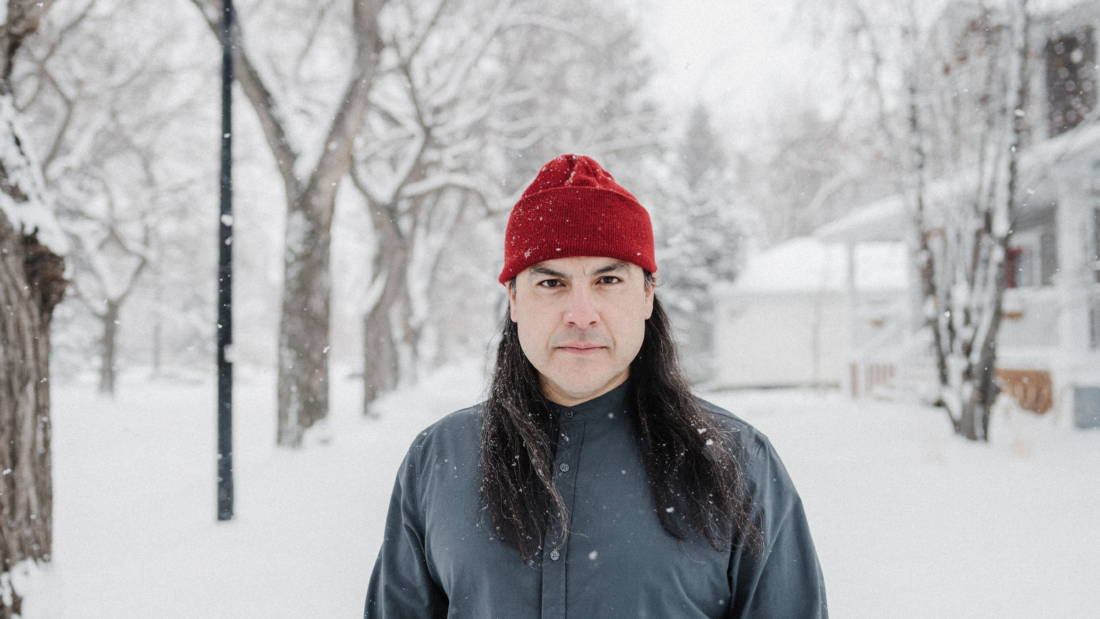
On “nôkosiw,” the opening track of nêhiyaw (Cree) drummer Marek Tyler’s 2024 solo debut ASKO, his mother’s voice tells the listener, “As an artist you’re not the creator.” With ASKO, also the name of his solo project, he is shifting from the indie rock of nêhiyawak—his previous amiskwaciy-wâskahikan (Edmonton)-based band with guitarist Kris Harper and bassist Matthew Cardinal—to the realm of electronic soundscapes. The album is a collaboration with his relations. Like an estuary that filters water flowing to the ocean, he is the conduit for the stories and sounds that make up its kinetic and woozy compositions. “You’re just a tool, you’re one of the brushes,” his mother intones.
After nêhiyawak’s 2019 album nipiy brought the trio accolades and recognition, a popular audio streamer invited them to curate an all-Indigenous playlist with the title “by us, for us.” Tyler felt unsure about the invitation and asked his mom what to do. “Put down your tobacco, ask the question, and then call me in four days,” she said. When they reconnected, her words summed up why the invitation didn’t feel right: “You don’t own it.” Music doesn’t belong to the maker; it moves through them.
Speaking to me from Treaty 6 territory in early summer, Tyler is warm and welcoming, quick with a joke, and wholeheartedly present. He tells me how Alan Greyeyes, the Winnipeg-based director of the sākihiwē festival and Tyler’s manager, encouraged him to document his mother’s protocols. That way, people could understand the efforts he and his family put into the work and know that the information he shares has been vetted. Greyeyes’ idea spurred a process of cultural exploration that evolved into ASKO. During the COVID-19 lockdowns, Tyler and his mother, who is an educator and knowledge keeper of Onion Lake Cree Nation, listened to archival recordings of his great-great-grandfather. His uncle Dale Awasis and esteemed educator Dr. Diana Steinhauer helped interpret the old Cree spoken on the recordings. With his advisers, Tyler identified the teachings, and selected the powwow songs and family dances that could be used to interpret them through music and offer them back to his community. That meant expanding his set of tools.
“I don’t think many people want to hear just rock drums,” he laughs.
He took online Ableton courses in sound design, synthesis, and MIDI-mapping. He also brought in “proper synth players,” his nêhiyawak bandmate and electronic composer
Cardinal and Cassia Hardy, formerly of the punk group Wares. “For me it was ‘search and destroy,’” he says. “I was just trying to find a sound.”
In the welcome letter she wrote for Tyler’s ASKO website, Michi Saagiig Nishnaabeg musician and writer Leanne Betasamosake Simpson describes the project as “a teaching lodge that you enter into with hesitation and humility. It is an immersive experience in which, if you bring an open heart and an open mind, you will learn to listen in a different register.” ASKO is propelled by rumbling hand drums and sibilant brush strokes, coloured in with astronomical synths and metallic whirring, and wedded to rhythms that hop and jump with acoustic force. Tyler translated his great-great-grandfather’s recordings of old Cree into a musical language for the body. The album’s rhythmic foundation was inspired by particular movements and dances. The track “nisis” (uncle), for example, gets its bass drum pattern from the footwork of chicken-dancer seth cardinal dodginghorse. On the archival recordings, Tyler’s great-great-grandfather speaks about the importance of passing on cultural teachings to the next generation at a time when the Canadian government and others in positions of power were working to erase that knowledge. The story of the dance describes how the prairie chickens gave the dance to a man and warned him that if he didn’t pass it on to others, they would return to take it back. The song has an insistent groove, snaking percussion, and warbling bass—a sleek style that, as the story dictates, Tyler must share, or risk having it repossessed.
The album’s second track, “nikâwîs,” was inspired by a story Tyler’s aunt shared before she passed on. “When I dance fancy, I just want to carve like an eagle,’” she told her nephew. He matched the cape work in a fancy dancing video, focusing on a dancer who had a quieter demeanor than the others. The track is powered by thumping drums and electronics that sweep across the sonic field like a bird in flight. Tyler also sampled a bell from a residential school, sonic material he had initially gathered for his contribution to the Witness Blanket, a large-scale art project created in 2013 and 2014 to honour the children and survivors of the abusive residential school system. The bell is re-pitched and warbles with fragility, in and out of tune. “It was such a horrible thing to think about,” Tyler says of the school bell. “I was like, ‘No way—let’s make this beautiful as well.’” In “nikâwîs,” it rings as the drums fade for a moment, like a whisper of peace. Tyler’s repurposing of the bell signifies his belonging to a generation that lives with and seeks to heal from the legacy of residential schools, despite the rise of a revisionist, anti-historical and anti-Indigenous movement that is violently pushing back on calls to search the landfill sites of those schools.
Tyler has adapted ASKO for live performance so that it respects the cultural protocols it explores and honours. Because traditional drums can’t be brought into venues where alcohol and drugs are present—ruling out the majority of live music settings—Tyler sampled the physical drums, including a six-by-three-foot elk-hide frame drum. He uses the program Sensory Percussion to trigger the samples during his live performances; the program has dynamic capabilities, meaning the sample pad will react to the intensity of Tyler’s touch, like a real drum. Tyler also added a visual element, so that his touches can launch video and text onto a screen. When possible, Hardy and Cardinal join his live shows, as well as drag artist Cedar T, whose performances helped inspire the euphoric breakbeat-driven “wâkôhtowin.”
Although performances of ASKO are a “high-wire act,” Tyler says the complexity allows him to convey the concepts and teachings woven into the melodies and rhythms through live performance. His goal is to ensure people know that it’s OK to come in the door. He recalls an experience in Wrexham, Wales, when he walked into a bar filled with old white men who didn’t know what to make of him and Cedar T, who was in full regalia. After a moment of uncertain silence, people started talking again, and eventually came over to shake their hands.
When he’s touring the music of ASKO, Tyler tries to visit a friendship centre or a school where he can give a public talk on the project and its teachings, to bring community into the lodge. His outreach centres on art as a collective process—as opposed to that of the mainstream music industry, which focuses on promoting geniuses and stars—and reorients the role ego plays in artistic expression. He used to close his eyes while practising and picture the crowd at a show. “Do they think this is cool, are they going to like it?” he’d ask himself. Since starting ASKO, he doesn’t see the audience anymore; he sees family. “I think it’s because I started working in a cultural way,” says Tyler, who spent decades as a drummer in bands. He jokes that although he is susceptible to the flattery of a grateful audience, that’s not where his attention is. “The people I look up to don’t celebrate themselves, they celebrate those around them. Does what I’m doing make me stronger, my family stronger, my community stronger? If that rubric is met, then we’re in a good place.”
That doesn’t mean learning and sharing are easy. A few summers ago, Tyler assisted at a high-attendance ceremony. He recalls lighting smudge, and was starting to stoke the flame when his uncle stopped him. “He was like, ‘No no no, don’t blow on it, you’ll make it rain.’ My uncle was teaching me in public. Instead of feeling embarrassed—which I did—or getting mad or recoiling, I had to realize [I was] learning in public. Everyone who saw that happen also had a moment to learn.”
Even our conversation is an example of learning in public; Tyler is sharing with me, opening the door to some knowledge I endeavour to pass on. He is doing this with Indigenous kids in mind. He wants to set an example through his music for those who want to learn cultural protocols.
When I ask about his work with the Indigenous Music Office (IMO), he says, “We have an opportunity right now to create space for the next generation, because they’re coming through. [My] industry work is about me learning from the next generation, saying ‘OK, what do you need?’” Founded in late 2023, the IMO provides mentorship programming for Indigenous people who are interested in the management and business sides of the music industry. The IMO has a mandate to launch an Indigenous Music Fund, though its source of funding is complicated. In 2024, the CRTC ruled that major streamers had to pay a portion of their revenues into funds like the Indigenous Music Fund, and the streamers are fighting the decision in an ongoing court battle.
The next generation of musicians needs to be able to make a living by working in the arts. “You want to decolonize? Become economically sovereign, make a living—don’t depend on anyone,” Tyler says. He has particular policy items in mind: regulations that would mandate Canadian commercial broadcasters to dedicate five per cent of their programming to Indigenous music; and funding streams that encourage artists to hire Indigenous session musicians, technicians, and other behind-the-scenes players. Measures like those would help Indigenous artists find steady work and, in many cases, remain in their home communities rather than move to large cities. Over the past three decades, Tyler has been doing just that; now he is figuring out how to continue making music as he enters his fifties. “I want to grow old with friends,” he says.
His next project, still in the early stages, may involve an archival recording of a prairie battle. In the meantime, he and Cardinal are scoring filmmaker Cody Lightning’s next feature, Smudge the Blades, about a hockey team on a reserve. He anticipates the next ASKO album will come together more quickly, since he’s done the work on protocols and ceremony. The path isn’t about meeting the music industry’s needs, but rather about stepping back, asking questions, and waiting for the answers to come when they’re ready.
ROSIE LONG DECTER is the editor-in-chief of Maisonneuve Magazine in Montreal. She releases music with the band Bodywash and her solo project Una Rose. Her work has appeared in New Feeling, Billboard, This, Xtra, and the anthologies Letters from Montreal (Véhicule, 2022) and Absolute Pleasure (Feminist Press, 2025).