
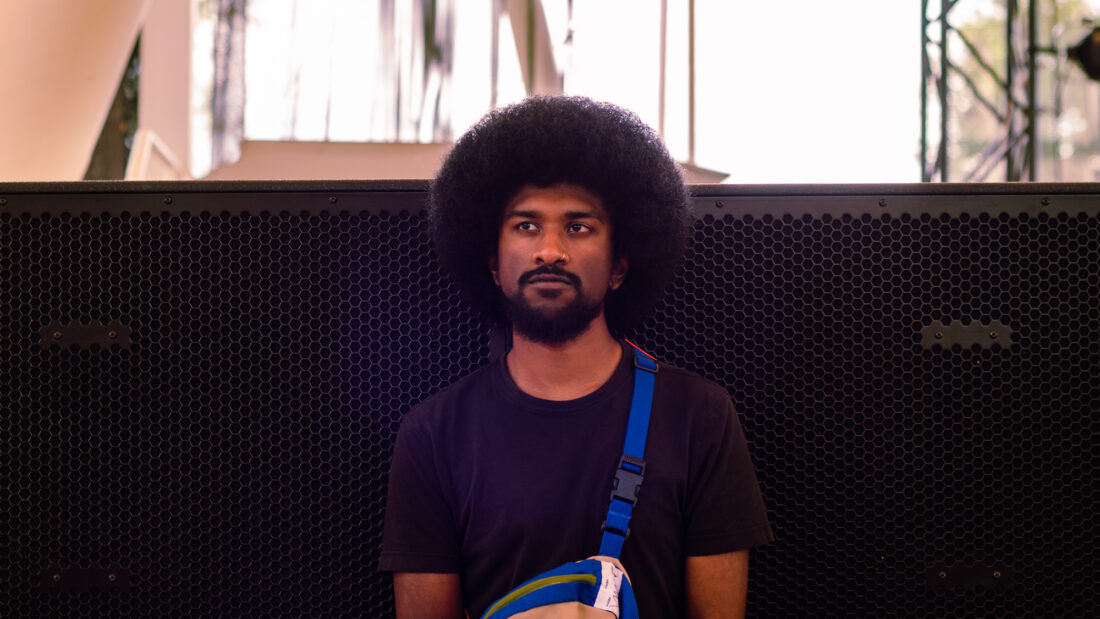
The opening track of guitarist Mustafa Rafiq’s album If I Were a Dance, featuring music recorded in 2020, provides two points of entry. One is through words—visceral, personal poetry composed and recited by Edmonton-based poet Dwennimmen. The other is through the instrumental sounds that bloom behind the poems: sparse, crackling sonorities that gently swell and bleed into one another, cushioning Dwennimmen’s voice as she speaks. On the second half of the album—a live set by Rafiq and tabla player Bhuyash Neupane recorded at Edmonton’s Latitude 53—those instrumental sounds shift into the foreground, as reverb-heavy electric guitar and tabla are spun together into a slow, dense felt.
The album, Rafiq tells me during a video call from his home in Edmonton, reflects a much longer practice of searching for music that carries a sense of space. “Sparseness was what I was going for when I was young,” he says. “I was getting all these pedals and trying to find a way to blow this instrument out: make it long-tone, and make it long-form. To play less, but not hold back.”
A stalwart in Edmonton’s experimental music scene since the mid-2010s, Rafiq has developed a malleable practice of spacious, improvisatory guitar playing that shape-shifts seamlessly between drone-based washes of resonance and denser, heavily layered textures. When we speak, he has just returned home from accompanying Calgary saxophonist Jairus Sharif (Musicworks 144) on the tour for his 2023 Polaris Prize-longlisted album Water & Tools, with shows in Montreal, Toronto, Ottawa, and Halifax. Now, Rafiq is deep in preparation for a slate of Alberta shows and a 2024 debut album release with Takleef Ensemble, the seven-piece improvising collective he founded in 2021 to explore collaborative approaches to catharsis through music.
He calls this approach self-determination music, referencing John Carter and Bobby Bradford’s 1970 jazz album of the same name. “That’s all I want,” he says. “I want to know that what I’m doing is right for me, and that it’s channelled through a legacy of Black music, of improvised arts, and of collaborative work. My practice now is one of trying to figure out my language, trying to figure out heritage, trying to find ways to pull from that, while also solidifying who I am.”
Born in Edmonton, Rafiq delved into music as a teen, playing guitar and forming a punk band in high school. In 2014, while attending Austin Psych Fest (now known as Levitation), he walked into a live performance by Japanese post-rock band Mono. “They were playing these completely instrumental, long-form songs with reverbed-out guitar,” he recalls. “I had no idea that music I would care about could sound so orchestral or give me an opportunity to enjoy that kind of sound. I came home and started scouring YouTube for more music like that.”
In the months and years that followed, Rafiq began performing solo under the moniker Family Injera, blending electric guitar, field recordings, and ambient electronics, and released music with pianist Josh Tokarsky as the duo Pyramid//Indigo. He also met Edmonton-area experimental music organizers like electronic musician Parker Thiessen, Saw-whet Records founder Ethan Bokma, and Gerry Morita of Mile Zero Dance, all of whom opened a door to local left-field music and the city’s interdisciplinary arts community. Soon Rafiq was hosting shows. Under the moniker Sweaty Palms, he aimed for a cross-genre, intergenerational ethos, booking concerts in Edmonton nearly every week from 2015 to 2019: two hundred shows over the span of five years.
Since then, his circle has only widened. Alongside his ongoing work with Takleef Ensemble and Sharif, Rafiq has continued playing in his duo with Neupane and has plans for an eventual tour. His new group, Golden Sun Trio, includes Bokma on electronics and violinist Nadir Bellahmer; their debut release is set for September 2023 on Berberophone Recordings. He’s also developing a new solo electric guitar record dedicated to his late uncle Shahzad Ali that references the drone experiments of Family Injera—but this time released under his own name.
Rafiq is obsessed, he says, with listening to it all—to be either onstage or in the crowd for every musical thing that happens. Deep care is embedded in everything he does. The echoing spaciousness he built into his own soundworld serves as an invitation for other improvisers to intuitively fill in the gaps; as a bandleader he is committed to building people up and connecting them with one another.
“Music was how I found community,” he says. “I found people that agreed with me, who really saw me as a human being. And I just thought, ‘Oh—I want to do this forever.’”
SARA CONSTANT is a flutist and writer specializing in new music. She holds degrees from the University of Toronto and University of Amsterdam, and currently works as the digital media editor at The WholeNote magazine and as an organizer of the Toronto Creative Music Lab. She is based in Toronto.