
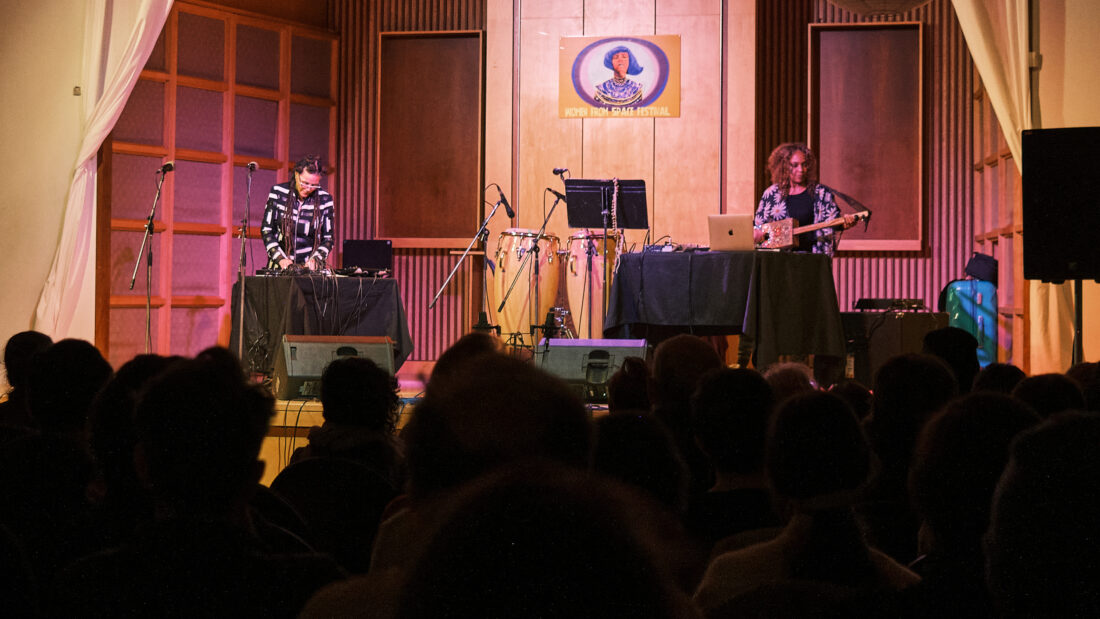
“How is wonder experienced in your life?” This text has been placed in a small gold frame, tucked under a tree-like structure with leaves of dazzling colour, and left for curious concertgoers to find at Women From Space (WFS), a four-day festival that celebrates and creates space for women’s innovation during the International Women’s Day weekend. This year’s edition is being held at Toronto’s 918 Bathurst, where it is standing room only on the final night as anticipation grows for the third and final performance of the evening. Nicole Mitchell and Coco Elysses, both internationally renowned figures in creative music—as well as the only two women, so far, to serve as chair of the Association for the Advancement of Creative Musicians (AACM)—are about to take the stage for their first ever performance as a duo.
Coco Elysses is often described as a modern-day Renaissance woman. She is a multi-instrumentalist who can most often be heard on percussion, diddley bow, and electronics. As a composer, she has won numerous awards, and was the first African-American woman to win a Joseph Jefferson Award for Original Music in a Play (Tilikum, 2019). She is a published poet, a busy voiceover artist, and a stage and screen actor.
Nicole Mitchell entered Chicago’s creative music scene in the ’90s and quickly emerged as an innovative voice with groups such as Samana (the first all-female group in the AACM’s history) and as a member of Chicago saxophonist and composer David Boykin’s group the David Boykin Expanse. Her virtuosity as a flutist is undeniable and has resulted in countless awards; she’s won the flute category of the DownBeat Critics Poll every year since 2010. A prolific composer, she writes for a wide breadth of contemporary ensembles, including her own Black Earth Ensemble, which she has led since 1998.
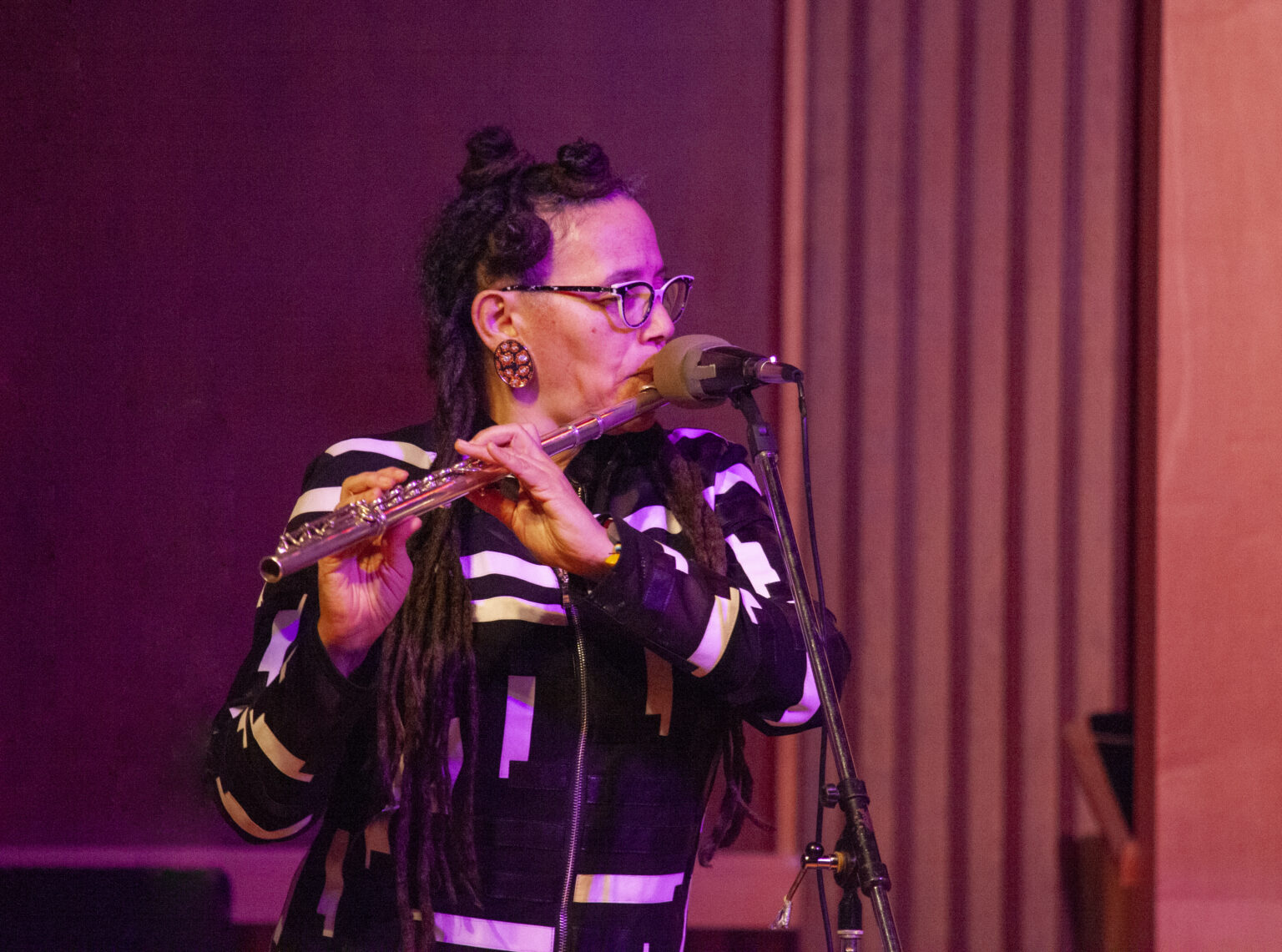
At the duo’s Women From Space performance, the first sounds to emerge are from Mitchell’s flute. The notes reach upward and outward at warp speed with dazzling virtuosity. The extended palette of sonic colours she accesses by mixing her own voice with the sound of the flute is one aspect of her playing that is often singled out. Mitchell has noted throughout her career that part of the motivation for using her own voice is a desire to leave evidence that a woman was present. In her recent book, The Mandorla Letters: For the Hopeful, Mitchell touches on this aspect of her performance practice while expounding on her idea of beauty for the reader. She writes: “Beauty, in the way that western hegemony dictates it, is not nearly whole enough to embrace all of us, especially us others. In my musical development, I’ve reached for what I call the edge of beauty, venturing out into spaces where one becomes uncomfortable and unsure whether what they’re experiencing is beautiful or not. I seek this edge sonically. I add my singing voice or a growl to my flute sound to make the atonal melding of textures, because I see discomfort as a doorway to new revelations—new worlds.”
In Elysses’ own contrasting display of virtuosity, cables are flying in every direction as she seemingly rewires the entire stage in order to draw particular sounds out of the abundance of musical devices around her. Suddenly she jumps to the congas and joins Mitchell. It’s as if there had been a signal between the players that the audience failed to see—a feeling that repeats itself throughout the concert.
This first piece lasts almost twenty minutes, twisting through startling and surprising moments filled with passion and precision, as well as hypnotic sections that evoke a sense of ritual. Elysses’ first words in the performance are heard during one such section when she utters, “The ancestors are here,” perhaps calling to mind for some the AACM’s slogan “Great Black Music, Ancient to Future.”
After a warm reception to the first piece, Mitchell speaks to the audience: “Hey, Toronto. Wow! Women From Space. Very excited to be some of those women.” Indeed, the duo’s vibe is in sync with the name of the festival they are headlining. Ideas from science fiction are present in much of the work Mitchell and Elysses have created or participated in during their separate careers. Now they are performing in a space where hologram recordings of past festival performances play beside a lost-in-space photobooth, an alien-looking tree glitters from floor to ceiling, and the bar serves signature cocktails named in honour of female Star Trek characters. (Mitchell’s parents named her Nicole as a tribute to the actress who played Lieutenant Uhura on the original Star Trek, Nichelle Nichols.)
“It’s not every day that you can just email your hero to ask if they’ll come to your festival,” says saxophonist Bea Labikova, who co-founded Women From Space with fellow saxophonist Kayla Milmine in 2019. She had invited Mitchell a few years ago, but pandemic restrictions held up the visit. “Fifteen years ago, one of her shows rewired my brain,” Labikova enthuses. “She’s inspiring to me as an artist, and for a lot of women she’s a trailblazer.”
Now approaching its sixth decade, the Association for the Advancement of Creative Musicians (AACM), which is responsible for popularizing the phrase Great Black Music, is a multigenerational collective of musicians and composers that has been at the forefront of creative music since its formation in Chicago in the mid-’60s. Over the years, AACM membership has included a veritable who’s who of visionary artists: Muhal Richard Abrams, Anthony Braxton, Roscoe Mitchell, Amina Claudine Meyers, George Lewis, Tomeka Reid, and Henry Threadgill, among many others. In 2009, Mitchell became the first woman chair of the AACM, introducing a period of strong female leadership that continues today, with Elysses now serving as the second female chair alongside a majority female executive team that includes Mitchell. Although there were other important collectives fostering Black music that rose up in the U.S. during the same period, the AACM has not only survived to the present day but is thriving in the twenty-first century, and maintains a position at the forefront of innovation in music.
“It’s a family of folks that love to experiment with stuff,” Mitchell tells the WFS audience. “So you see we’re trying some new stuff up here, with lots of technology and instruments.” The AACM’s tradition of multi-instrumentalism and the use of little instruments is most often associated with its flagship band the Art Ensemble of Chicago, and is certainly represented by this duo. Elysses performs on diddley bow, kalimba, turntable, percussion, and voice, and Mitchell on flute, kalimba, a variety of electronics, and voice. The diddley bow—a single-string instrument—originates from instruments played in West Africa, Mitchell explains: “It’s also considered, in that framework with which [Elysses is] playing it, one of our oldest instruments from African-American folklore.” The duo’s second piece begins with a diddley bow solo. Elysses plays the instrument with a slide on her left hand, which allows her to glide between pitches. Her striking rhythmic sense is still present, but now it is blended with a soaring lyricism. When she turns on her wah-wah pedal, the audience’s delight is audible. The piece manoeuvres through a series of electronic atmospheres. Together they come to a pulsing groove, with Elysses playing a heavily processed kalimba and Mitchell alternating between playing her flute and using her voice to recite excerpts from an evocative text that I would later learn was written by Elysses.
Though some of the text was written before the performance, Mitchell tells me afterward that the music was totally improvised. “We went over a few things a few weeks ago, and then we said, ‘Nah! We’ll just do it in the moment.’ It just gave us a sense of what we were working with.”
Toronto has fostered connections with many AACM members over the years. In 2022, Anthony Braxton gave a duo concert with fellow saxophonist James Fei as part of Toronto’s Tone festival. Composer and organist Amina Claudine Myers presented her Improvisational Suite during the FutureStops Festival. However, despite their frequent visits to Canada at the invitation of major festivals and academic institutions, opportunities to hear either Mitchell or Elysses performing their own music in Toronto have been rare. “We definitely have AACM members that have come here often,” Mitchell tells me. “We haven’t really had that access, and we were talking about that today: how it’s such a short flight from Chicago and from North Carolina, and it’s amazing that we haven’t really been here that much. You know, it’s not that far, but this, I think, is one of my first invitations to play.” Given the ever-present excitement at WFS all week leading up to their performance, the invitation was long overdue, and will hopefully be the first of many for both of them.
Back at the concert, as they begin their third and final piece of the night, it is clear to all in attendance that Mitchell and Elysses are excited and inspired. The concert had begun with Mitchell’s virtuosic flute playing, and now we are treated to Elysses’ own virtuosic vocal percussion. At times, Elysses’ vocalizations sound as though they could be informed by percussive vocal traditions such as beatboxing, North Indian Bols, and South Indian Konnakol, but it’s also clear that she is sharing the unique result of her own creativity. As her vocalizations surge in wave after wave of high-velocity rhythm, Elysses interrupts herself ever so briefly in order to interject, “Sounds like Busta Rhymes.” The audience explodes in laughter.
“It’s so freeing not to take yourself too seriously,” explains Elysses later.
“And the thing is, what is the point of playing music anyway? It’s supposed to be fun!” Mitchell says, adding, “We’re part of a bigger group that’s very silly, a quartet called Black Earth Sway. That’s the point of the group, to just be authentically ourselves—not trying to prove anything, just do our thing and have fun. I think that’s important for music. Especially now!”
After the concert, Mitchell and Elysses are gracious and generous with the audience, staying to talk with many fans. Eventually a small circle which includes some of their old friends forms around them, though it never feels as though they are holding court so much as holding space. They answer questions, but also ask questions about the local Indigenous peoples, and what work is being done for and with these groups. They ask about the families and friends of the people sharing this circle and listen warmly. An elder in the community is present, and when they are told it is her birthday today, they acknowledge her wealth of important knowledge and history; at one point while we are listening to her, Mitchell turns to me and says, “This is your story!” To me, this moment crystallizes why the AACM has remained a shining example of leadership in the development of a worldwide creative music community under their stewardship.
When I ask if we might expect a record from this duo, Mitchell replies in the affirmative before offering some final insights into the music they have created. “There were a lot of discoveries that we were surprising ourselves and each other with. I made sounds with my electronics that I had never made before—ever!” she exclaims. “And I felt like I got to another place with expression that I hadn’t gotten to in any other context before.
“We have a lot of history. We knew each other before we had babies. I mean, we actually had babies at the same time! And we came up in an all-women group called Samana. It’s the first all-women group in the AACM. Over all of these years we’ve played in a lot of different contexts, and we’ve been good friends.
“That’s what defines the context of collaboration between a duo: the relationship you have as people.”
Patrick O’Reilly is a composer, artist, and a community-driven fixture in the Toronto creative
music scene.