
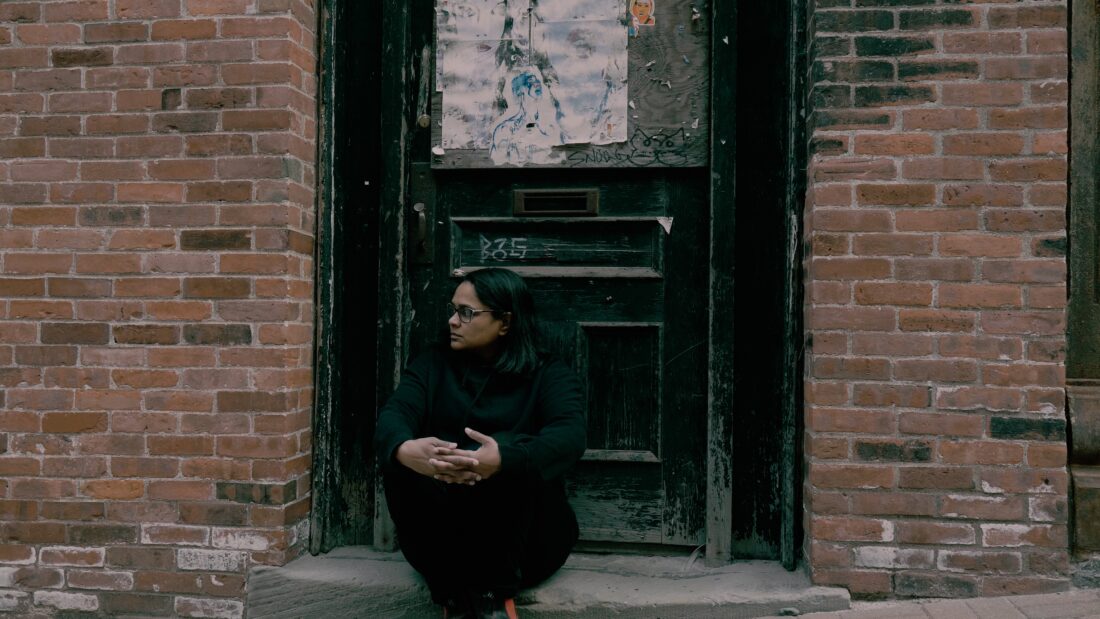
Saudade is an untranslatable Portuguese word that may refer to nostalgia or melancholy, but also touches on the elusive feeling of joy that comes with recall and self-discovery. It’s also the apt title of trumpet player Nicole Rampersaud’s debut solo album, on which the songs never overstay their welcome. Some pieces feel like they are dropping into memories, rifling around for an emotional key, and quickly unlocking an exit. Electronics create a variety of contexts and textures that allow the trumpet to act as the primary voice among the echoes and whispers of more complicated sonic ideas.
Collaboration has long been a cornerstone of Rampersaud’s career. At the peak of her time in Toronto—when she was playing in a staggering number of ensembles—she tried recording a solo album a few times, but wasn’t happy with the results. “I was trying to replicate what was happening in a live performance on a recording,” she says. “It just doesn’t translate.”
Rampersaud grew up in Scarborough and was the first member of her family to venture into creative pursuits. “I was a pretty petrified kid, didn’t sign up for anything, too scared to do anything.” When she was in grade four, the band teacher visited all the classrooms to sign up new players. “I didn’t want to stick out, [I didn’t want] to put my name forward.” But it turned out that Rampersaud stood out because she was the only student in her class who didn’t put their name forward. Essentially pressured into auditioning, she was invited to join the band and had to pick an instrument. On the fateful day when the school band teacher gathered all the instruments and students in the school gymnasium, Rampersaud tried to figure out which one would be the simplest to play. “I looked at a clarinet and thought, ‘I’m going to screw that up.’ Too many pieces to put together, too many buttons. Same with the flute. Then I saw the tuba, which is three buttons, mouthpiece goes into one thing. [I thought I could] handle that, but it was just too big. Finally, the trumpet was the compromise—three buttons, mouthpiece goes there, how bad could it be?”
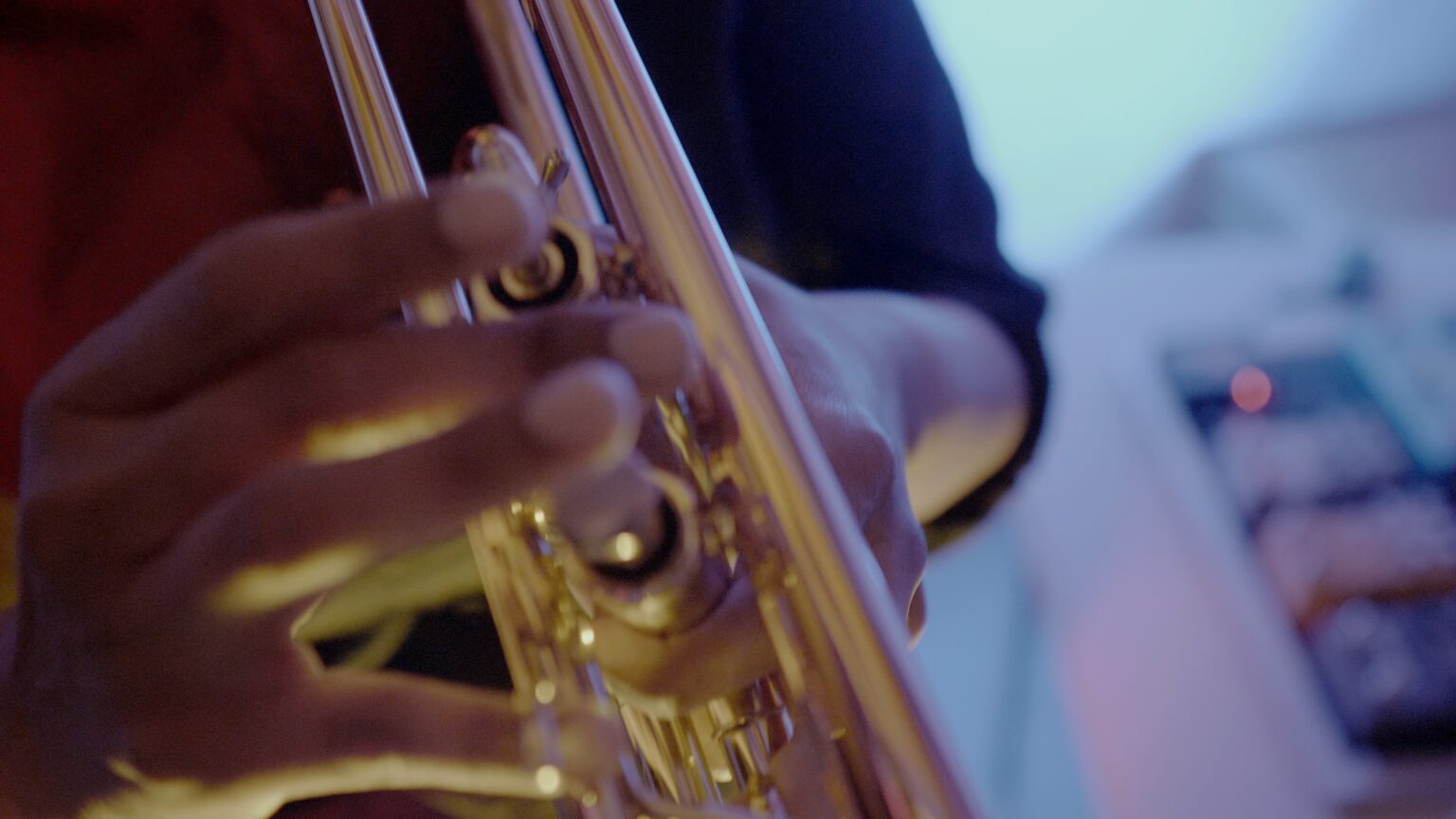
There was no dramatic “a-ha” moment in discovering the trumpet. Rampersaud pursued music mostly on her own, without music camps or private lessons. She built her practice in a kind of vacuum and ended up applying to the University of Toronto’s Bachelor of Music in Performance program, where she entered the jazz stream alongside students who’d had more preparation. “I almost dropped out a few times because [my experience was] being self-taught and being told I was good—but was that ‘You’re good for your circumstances?’ The jump in terms of talent and experience was overwhelming. Looking back, I wonder how the hell I got in.”
While the program taught her an approach to music she calls “Big J jazz,” Rampersaud found herself growing more interested in other approaches to music that she discovered on her own in the university library. “I was probably a bit of a brat and a shit disturber, so for a while I resisted. Chase Sanborn, my private teacher at the time, and I butted heads because of that. In the library, I was discovering Ornette Coleman and Don Cherry and Booker Little. [Their playing felt like a] singular sound and aesthetic compared to the bebop and swing we were being taught.”
Rampersaud obtained her bachelor’s degree in the early 2000s and went on to pursue her master’s at the New England Conservatory of Music in Boston, where she was exposed to a broader spectrum of techniques and world music traditions that allowed her to shape her own approach to the trumpet. Her facility in a wide variety of modes led to invitations to play in Macedonian, klezmer, and Turkish bands, all of which felt freeing and validating. In the later 2000s, she spent time playing in Boston, New York, and Philadelphia before returning to Toronto in 2010.
The Association of Improvising Musicians (AIM) Toronto became something of a home base where she expanded her interest in collaboration beyond play and into the area of organization. “I enjoyed creating opportunities for folks, and playing with folks from different backgrounds, whether they come from school or not,” says Rampersaud, whose versatility as an improviser, composer, and player-for-hire led to her involvement in projects led by Ken Aldcroft, Joe Sorbara, and Anthony Braxton. One of her main gigs—which is still active—is contributing to saxophonist Brodie West’s group Eucalyptus. “[Rampersaud is] a rare kind of musician who sounds completely herself in any context,” West says. “She is an enigma, super intelligent, and fearlessly transcending conventional values. She is no show-off, and she plays what she feels.”
After returning to Toronto, Rampersaud reconnected with Joseph Shabason, her contemporary at U of T and a fellow traveller who straddles boundaries between academic and pop sensibilities in modern music. Citing an interview with William Parker, in which he talks about how important it is for musicians to “find their people,” Rampersaud says her work with Shabason follows that credo. She talked to Shabason and pianist and composer Thom Gill about creating a project that spoke to their similar experiences at U of T.
“We came at it from three very different backgrounds, but had the similar experience of not finding our people and feeling left out,” she says. Shabason called upon Rampersaud to take over trumpet duties from JP Carter, whom he’d met during his time playing with Dan Bejar’s Destroyer. “Nicole can approach the instrument as both a lyrical and textural one,” Shabason notes. “Her ability to manipulate air and sound with the trumpet and create texture and sounds outside the basic Western scale system is just amazing. With the music that I make, which is more about layers and textural composition, Nicole’s additions are always perfect because she knows when to soar on top of it and be lyrical, and when to tuck underneath and do things that are atypical for the trumpet.”
Although these outlets were rewarding contexts in which to play, they were also beginning to impede the kind of personal artistic development that requires more time and space. Between 2013 and 2018, Rampersaud and her partner, fellow AIM member Evan Shaw, had been splitting their time between the Maritimes and Toronto, and in the late 2010s they decided they would feel most at home, both creatively and in life, in rural New Brunswick. “At that point, I was still doing a lot of sideperson work, all of it great—at my peak I was in fifteen bands regularly,” she says. “At a certain point I felt like I had hit the ceiling as far as growth. Going from gig to gig and rehearsal to rehearsal, every project was great, and I felt great to be contributing to them. But I wanted something different, and the opportunity to pursue some things that I had been wanting to do.”
Rampersaud soon developed an interest in making field recordings and incorporating them into her work—a new direction that emerged as she was settling in to the new landscape. “One of the things I fell in love with in the Maritimes was the access to nature, and I’d always been intrigued by field recordings. The fall before we moved, when we were just visiting, I brought a small zoom recorder to the river near where we stayed and managed to [record] a group of mergansers [fish-eating ducks] that were flying up and down the river. The air in the bones of their wings sounded like whistling.” She soon started incorporating birdsong and other nature recordings into a series of multimedia presentations.
Far from feeling isolated, Rampersaud quickly found her people, forming duos with guitarists Joel LeBlanc and Arthur Bull and linking up with Halifax organizations such as the creative music hub Suddenly Listen as well as the EVERYSEEKER festival, where she served as the inaugural composer-in-residence in 2019. While COVID-19 soon closed the door on most of these opportunities, it also opened a few new ones. The forced disconnection sparked Rampersaud, violinist Parmela Attariwala, and percussionist Germaine Liu to imagine and develop a collaborative project—a virtual space for interaction called Understory (“Understory’s Sonic Ecosystem,” Musicworks 140). Although the idea arose in response to the already daunting task of uniting players from geographically separate scenes, the pandemic made the project more crucial as a means to keep artists at work.
Taking a break from concert performances finally gave Rampersaud the time and energy to focus on resetting her approach to her solo practice, which included working with electronics and live processing—both instrumental in the creation of Saudade. “That was completely different from what I’d been doing in my solo trumpet practice up until that point,” she says. “I got some great advice from [electric violinist] Hugh Marsh around where to start with that. Joseph Shabason as well was great, and Sandro Perri, who edited and mixed my new album, was a great mentor.”
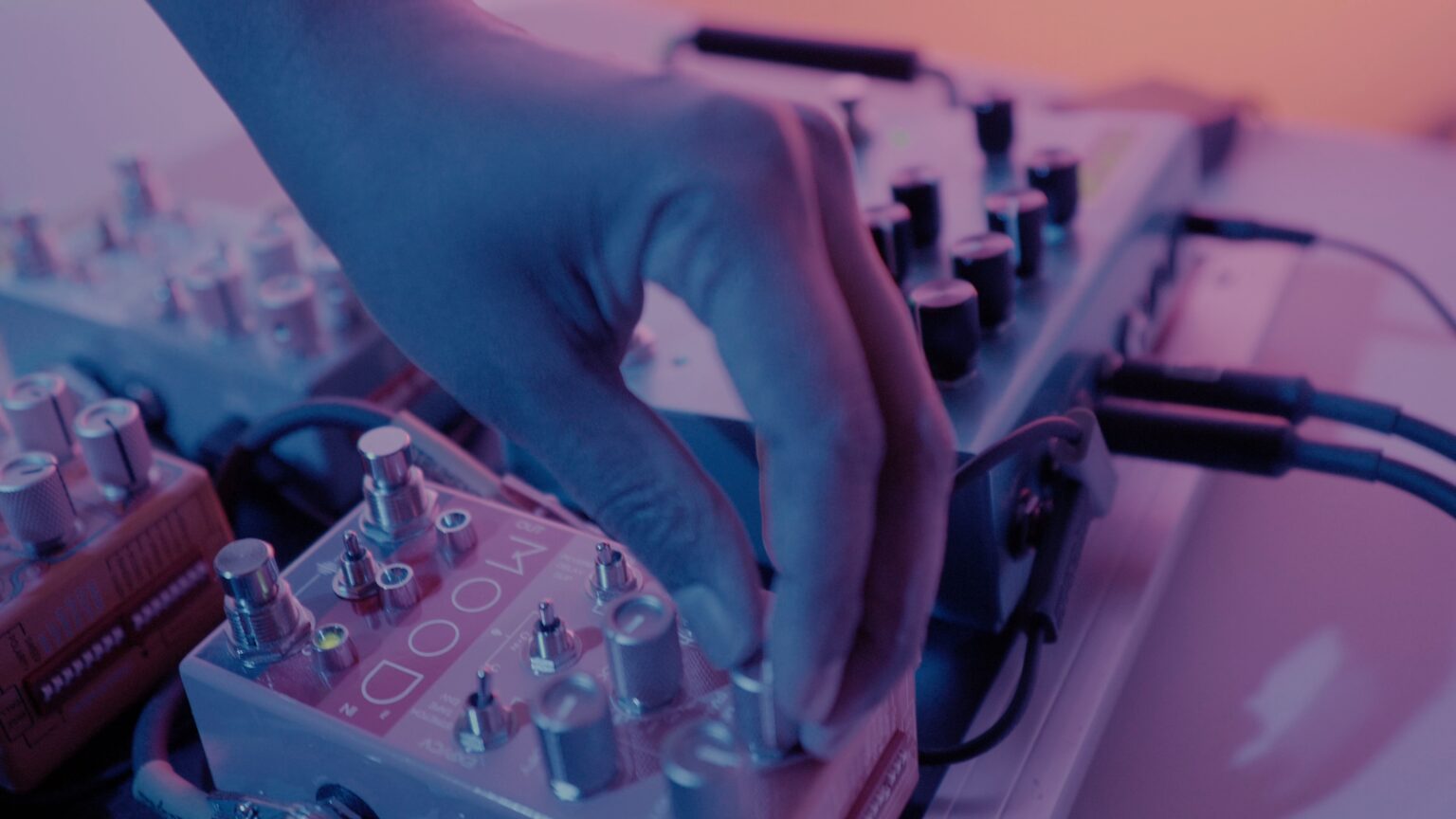
Despite being comfortable with software programs, Rampersaud chose to employ guitar pedals in both the recording and the performance of her new material. “I knew right away I didn’t want to [use] a computer with Ableton. I know myself well enough to know that I’d just be drawn to the screen. [You get] something tactile [with] a guitar pedal that you’re not going to get with a computer. I call the types of pedals I use ‘chaos machines,’ because they’re essentially different flavours of Micro Loopers for glitch or granular processing. While I have a rough idea of what each of them will do, I [actually] don’t know.” This setup creates a fertile middle ground where composition allows space for improvisation as well as spontaneous interaction—even in the case of solo play.
On “A Tourist in My Youth,” the opening track on Saudade, a breath sound drops down through a spiral of electronic time stretches before resurfacing as a flock of fluttering trumpet notes. It serves as both a witness to Rampersaud’s growing practice and a briefly abstracted recollection of her history. With label support for her solo album and a range of concert appearances and gallery installations for her video and field recording work on the horizon, Rampersaud has entered a new phase of creative work. Yet, regardless of geography or the evolution of her technique, it’s clear her temperament will lead her back to the collaborative dynamic.
“I’m coming at all this with this intent of not wanting to be the centre,” she says. “The pieces I’m composing now are almost frameworks for co-creation. I find that way more satisfying.”
ERIC HILL has written about music and culture for over two decades, primarily for Exclaim! His biweekly podcast, Surgery Radio, has been exploring the soft boundaries of experimental, ambient, and pop music since 2004. He has managed Backstreet Records in Fredericton for most of his adult life.