
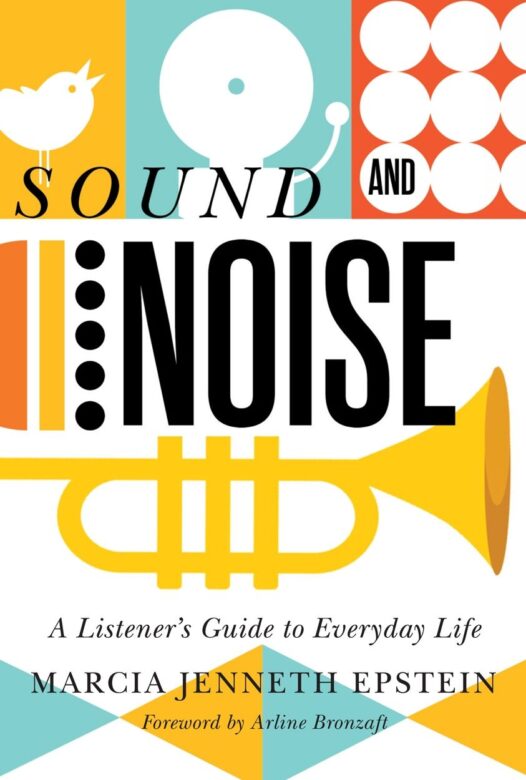
Canadian musicologist and historian Dr. Marcia Jenneth Epstein is the author of Sound and Noise: A Listener’s Guide to Everyday Life (2020). She listened to Lola de la Mata’s album Oceans on Azimuth in advance of her conversation with writer Angus MacCaull about how the body interprets sound. This interview has been edited for length and clarity.
What is sound?
In technical terms, it’s a vibration carried through a medium like air or water or anything else that moves in response to vibration. When you’re talking about sound in general, it involves the perception of that vibration, usually through the ears but also through the skin and any of the fluids in the body that respond to vibration. So you’re actually hearing with your blood, bones, and muscles as well as your ears. It’s just that the ears specialize in amplifying sound.
Does that mean the vibration responses in the blood and the bones travel to the brain’s auditory cortex?
Yes, but it’s usually subtle. If you have a really loud sound, you can feel the vibration in your bones. That’s why huge rock concerts are a thing. People want to feel that vibration. But it also happens when you’re listening to chamber music or speaking with people.
What makes one person interpret something as noise rather than sound?
A lot of it is previous conditioning: What associations have you had with sound? Did you grow up in a loud environment, or was it serene? What is your previous experience with listening? All of that factors into how you respond. Also, can you listen to something that isn’t human-made— something that results from wind, like tree leaves flapping—and hear it as music? When you listen to a herd of sheep in the countryside, they all have different voices, and they can set each other off, making sound that is almost analogous to a choir or an orchestra. It’s not what we would call music, but there’s a communication pattern that you can hear among the sheep.
Are patterns the reason why we interpret certain sounds, such as music, as pleasurable rather than as noise?
Absolutely. Music has intention. If you’re listening to a one-year-old speaking, for example, it’s pretty chaotic, but that’s normal. That phase, chaotic speech, helps them develop rational speech. After a while, the range of possible sounds they make and recognize narrows down and focus on the speech of the people who care for them.
Is that analogous to what happens with musical tastes in adults?
Possibly. There’s a cliché that musical tastes are set by the time you’re eighteen. It’s not true. It’s always possible to get bored with what you’re accustomed to. When I’ve taught classes on basic ethnomusicology, or classes on how to approach and interpret sound, I recommend students pick a country they know nothing about. Listen to the music from that country. It will expand musical taste.
How about Lola de la Mata’s album Oceans on Azimuth?
Her background as a violinist shows through in the way she uses sound, the way that she combines different idioms.
Why is it music?
Because there are patterns that we can follow and understand from our experience with other types of music. If you listen to the idioms in postmodern classical [music], her work is not unfamiliar. It fits into a continuum because of the way she’s using instruments. Patterns are extended so that a note, or a series of notes, is held for a long time, and you get bits on top that stay in tune. That’s a standard structure in composed music. Our hearing is given a pattern to latch on to. After we become familiar with it, she establishes a new pattern, switches back and forth, or adds other patterns in. That’s how composition works. If it’s too much of the same thing, it gets boring. If it’s too much change, it’s chaotic.
Are you suggesting it’s not just the presence of patterns, but also patterns that refer to other patterns—such as patterns used in a musical tradition?
If it’s completely unfamiliar, listeners have a hard time latching on. It’s all about what you’re accustomed to hearing, and whether you enjoy stretching your limits and listening to completely new material. The actual tinnitus tone used in sections in her work makes it interesting, even if it’s not a pleasant sound. The unpleasant can be quite interesting as well.
FYI: Dr. Marcia Jenneth Epstein’s Sound and Noise: A Listener’s Guide to Everyday Life was published in 2020 by McGill-Queen’s University Press.
ANGUS MACCAULL is a Canadian journalist and poet with work published in Newsweek, Maclean’s, The Toronto Star, The WholeNote, and The Walrus. He is currently working on a memoir about losing a music career to tinnitus.