
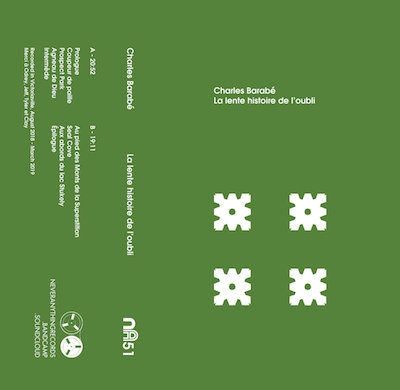
Based in Victoriaville, Quebec, the prolific electronic composer Charles Barabé has become a preeminent figure in the North American tape-label underground with a varied five-year streak of releases for notable imprints such as Jeunesse Cosmique, Orange Milk, Crash Symbols, and Astral Spirits. Encompassing screwball collage, synthesizer vision quests, and hyperreal ersatz-orchestral sonorities, his catalogue intrigues the listener with its stylistic volatility.
La lente histoire de l’oubli (The Slow History of Oblivion) his fourth release on Seattle’s Never Anything Records, offers yet another facet. Digital time-stretching—changing the duration of sound without altering its pitch—has become so ubiquitous that it has achieved meme status online. A search on YouTube for “800% slower” results in countless examples of the technique being applied to well-known pop songs, to both humorous and harrowing effect. Barabé’s cheeky decision to base this entire album’s gently oozing music around such a commonplace treatment is a bold choice in a field where innovative signal-processing is privileged and applauded. And some might struggle to see past it.
Yet if one surrenders to this characteristic surface quality—the diffuse pixelation of percussive attacks, soft quavering clouds, the steady seasick feeling—the ear almost forgets the source of this quality, and in a manner that’s deliciously evocative of the album’s title. As one comes to inhabit this precarious musical landscape, the artist’s careful, painterly approach grows increasingly audible. In abstract electronic music, digital manipulation is prevailingly used as a gesture that propels the narrative of a given work through dramatic timbral fluctuations; Barabé, however, allows other aspects of the compositions to drive while he wields the processing like a camera. The purpose is to present material from different angles and proximities, revealing and magnifying its various latent attributes.
In addition to providing a delicate new insight into Barabé’s elusive compositional identity, La lente histoire d’oubli’s gorgeous ethereal plumes gently assert a refreshing perspective on electronic music. It’s an astute reminder that, amidst the crusade to unlock the medium’s supposedly limitless possibilities, sometimes operating within familiar and transparent confines can be the catalyst for new and singular expressions.
Nick Storring is a Toronto-based composer, musician, and writer, and a contributing editor to Musicworks. His music has been presented and performed by the Esprit Orchestra, Eve Egoyan, Quatuor Bozzini, Beijing’s Musicacoustica Festival, and Vancouver New Music. An avid collaborator, Storring has composed for films by Terrance Odette, Ingrid Veninger and, in collaboration with Dafydd Hughes, for the National Film Board’s award-winning Web documentary High Rise: Universe Within (2015), directed by Katerina Cizek. He’s also scored productions by Litmus Theatre and MT Space, worked with celebrated choreographers Yvonne Ng, Marie Josée Chartier, Brandy Leary, and Deepti Gupta, and created music for “ambient gaming environment” Tentacle, which was mounted at New York’s Museum of Modern Art in 2011. Storring’s writing has appeared in Exclaim!, The Wire, and AUX.tv. He also contributed liner notes to Alga Marghen’s reissue of the ’60s band Intersystems’ entire recorded output, as well as RVNG Intl.’s box of early psych trio Syrinx’s reissues and previously unreleased material Tumblers from the Vault.