
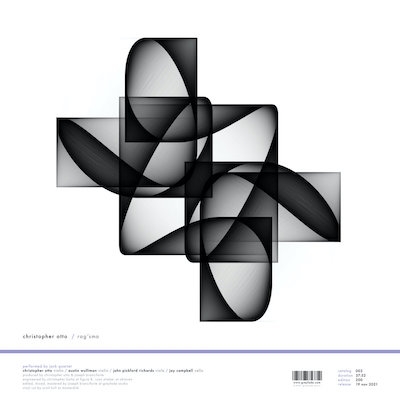
Microtonal tuning systems have provided the underlying architecture for some of the most intriguing and sumptuous works of the past century; yet even among adventurous listeners, there is still some prejudice about these approaches. In the press release accompanying his debut release as a composer, Rag’sma, Christopher Otto attempts to dispel these assumptions. “I don’t think one needs to understand the mathematics at all to enjoy this music,” he states plainly. Otto is known as one of the violinists of the JACK Quartet, one of the world’s premier contemporary-music string quartets. Their reputation partly stems from their masterful interpretations of works in just intonation—music based on microtonal adjustments to the harmonic series.
Conceived for either two or three string quartets, Rag’sma gradually blossoms over nineteen minutes. Both versions are found on the album, each performed by JACK. The key to Rag’sma’s shimmering otherworldliness is its namesake: a ragisma is an interval so miniscule (a ratio of 4375:4374) that most would deem it imperceptible. That doesn’t stop Otto from employing an ultra-slow drift of precisely this span to pry open an entire world of colour. Suffice to say, this performance is nothing short of a virtuosic feat in precision—one that few other ensembles in the world could even attempt to execute.
Rag’sma offers a full, lustrous sound that seems to transcend its instrumentation. Aside from the titular interval, Otto’s material tends toward pure sonorities, giving the impression that the strings have merged into one single instrument. As the minute differences of frequency emerge between each subgroup, they send gentle quivers throughout these flocks of tone. The mechanics of the piece seem more transparent in the eight-player rendition, yet the additional layers of its twelve-player counterpart is both more sonorous and more disorienting. Throughout each iteration, rather than affecting the overall tonality, the subtle modulations of pitch produce an undulating metallic sheen of ever-changing hue.
Rag’sma is a radiant, mesmeric, and utterly singular listening experience, but also a beautiful demonstration of microtonal possibility. Regardless of the listener’s grasp of the underlying math, Otto’s meditation on perception itself is palpable through his elegant dissolution of perceptual boundaries.
Nick Storring is a Toronto-based composer, musician, and writer, and a contributing editor to Musicworks. His music has been presented and performed by the Esprit Orchestra, Eve Egoyan, Quatuor Bozzini, Beijing’s Musicacoustica Festival, and Vancouver New Music. An avid collaborator, Storring has composed for films by Terrance Odette, Ingrid Veninger and, in collaboration with Dafydd Hughes, for the National Film Board’s award-winning Web documentary High Rise: Universe Within (2015), directed by Katerina Cizek. He’s also scored productions by Litmus Theatre and MT Space, worked with celebrated choreographers Yvonne Ng, Marie Josée Chartier, Brandy Leary, and Deepti Gupta, and created music for “ambient gaming environment” Tentacle, which was mounted at New York’s Museum of Modern Art in 2011. Storring’s writing has appeared in Exclaim!, The Wire, and AUX.tv. He also contributed liner notes to Alga Marghen’s reissue of the ’60s band Intersystems’ entire recorded output, as well as RVNG Intl.’s box of early psych trio Syrinx’s reissues and previously unreleased material Tumblers from the Vault.