
Much of Florian Hecker’s downright preposterous music could easily be regarded as the absurdist vanishing point of technological vanguardism in computer music. Both boisterously noisy and eerily austere, with its hyperactive bursts of sound, his music often feels as though it’s untouched by human agency or intuition. Devoid of elegant contours—or the mere hint of concession to conventional structure, taste, and production aesthetic—the music often seems afloat in an autonomous two-dimensional digital universe. Perversely, it’s this alienated vomited-out-of-the-back-of-a-computer sound that makes the music so intriguing.
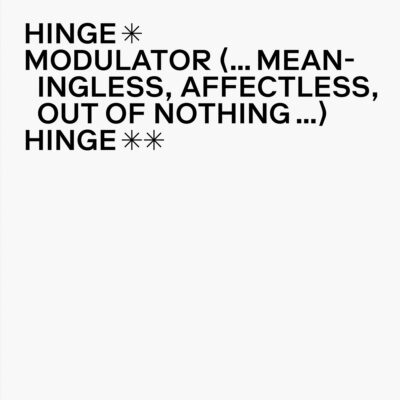
Recently, though, Hecker has turned his attention to the conjunction of psychoacoustics and text. So, although you might think that enlisting maverick vocalist–composer Joan La Barbara as a collaborator would warm things up with a bit of visceral energy, expectations are subverted. La Barbara’s role on Articulação is to recite, with minute, microtonal inflections, texts by Reza Negarestani on the album’s twenty-five-minute opening track, Hinge*. The result is extreme in its monotony, yet nothing short of mind-bending. Negarestani’s libretto—which colourfully elaborates upon the notion of “chimerization” in relation to culture and nature—is both dense and evocative, and the musical treatment exploits perceptual research to create dizzying aural effects. As the listener is bombarded from both channels with distinct but related sets of textual information and images, compound ideas form and dissolve, mirroring the elusive quality of the text. When completely immersed, the listener is almost hallucinating—attention flitting from one idea to another, to both ideas simultaneously, and then to simply the sonic profile of the vocalizations. In addition to voice, Hecker inserts shards of manipulated speech, which further disorient and distract the listener.
The middle track, Modulator (. . . Meaningless, Affectless, Out of Nothing . . .), is a sustained journey into Hecker’s disjunctive spectral abstractions. Though certainly rich and intriguing in its own right, its fitful stream of noises doesn’t have quite the same dazzling impact as the opener.
The final piece, Hinge**, unsurprisingly explores the same text as Hinge*, but employs different speakers and more blatant use of processing, which gradually altogether obliterates the intelligibility of the speech. It’s a strange interpolation between the twitchy monolithic Hinge* and the whimsical volatility of Modulator.
Something that less charitable critics have failed to see in Hecker is his playfulness. While the subject matter on this disc is rich, serious and deeply intriguing, there is mischief at play in the way that he delights in rewiring the act of listening. Regardless of one’s tastes, this disc won’t likely be on regular rotation, but its extreme, rarefied world of interleaved text and hallucinogenic applications of the sound are undeniably something very special.
Nick Storring is a Toronto-based composer, musician, and writer, and a contributing editor to Musicworks. His music has been presented and performed by the Esprit Orchestra, Eve Egoyan, Quatuor Bozzini, Beijing’s Musicacoustica Festival, and Vancouver New Music. An avid collaborator, Storring has composed for films by Terrance Odette, Ingrid Veninger and, in collaboration with Dafydd Hughes, for the National Film Board’s award-winning Web documentary High Rise: Universe Within (2015), directed by Katerina Cizek. He’s also scored productions by Litmus Theatre and MT Space, worked with celebrated choreographers Yvonne Ng, Marie Josée Chartier, Brandy Leary, and Deepti Gupta, and created music for “ambient gaming environment” Tentacle, which was mounted at New York’s Museum of Modern Art in 2011. Storring’s writing has appeared in Exclaim!, The Wire, and AUX.tv. He also contributed liner notes to Alga Marghen’s reissue of the ’60s band Intersystems’ entire recorded output, as well as RVNG Intl.’s box of early psych trio Syrinx’s reissues and previously unreleased material Tumblers from the Vault.