
At first, there is no performer. Or rather, the cube is the performer. A metal-framed cube, its faces open to its interior, hovers in the centre of my computer screen. LED lights line its exterior, pulsing across the geometric edges, while a softly abrasive synth tone hovers at the edge of the sonic landscape. My feeling of anticipation is rewarded when a performer enters and begins to manipulate the cube, throwing the sound of the world into relief. The performer here is Alexis Langevin-Tétrault, a Montreal-based composer and sound artist, and the world I’m describing is “Hypercube (one).” Langevin-Tétrault’s work stages an encounter between man and machine that generates a remarkable synthesis by its end. If the beginning of the work feels anticipatory and hesitant (Langevin-Tétrault’s touch is gentle and infrequent), by the end it approaches something like transcendence—he patiently works with the (seemingly responsive) cube to build a wash of warm drones across an eighteen-minute runtime. It is a work hinged on a choreography of both sound and light as they meet the performer—its vision is speculative and fashioned around technology, certainly, but the work remains rooted in the body and how it touches the cube. After nearly a year of engaging with art, performance, and listening almost exclusively online—a medium that doesn’t usually afford a means of presenting embodiment—stepping into the world of “Hypercube (one)” feels like a recalibration. Here is the body attempting an uneasy harmony with technology—reaching out, almost touching.
“Hypercube (one)” was recently presented under the banner of HYBRID—Cutting Edge Canada, a collaboration between Montreal’s MUTEK and Germany’s Hellerau European Centre for the Arts that exhibited a series of more than twenty live premieres and archival performances across four days in March 2021. The sensuous corporeality I encountered in “Hypercube” turned out to be an attractive, if unlikely, tether in my experience of the virtual festival. The works of HYBRID, while wide-ranging in their sonics and their visuals, could broadly be indexed within the categories of electronic music and new-media arts—meaning that experimental uses of technology formed not only the condition of possibility for this event (that condition being the online platform allowing me to tune in from my living room in Montreal), but also featured prominently in the works themselves.
Yet even in this doubled digital world, the body persisted as a reminder of the human presence animating the scenes on my screen.
This body-technology relation drew me to the work of Ouri, a classically trained musician whose performances stage a collision between analog call and synthetic response—a collision that becomes visible through her embodied performances. HYBRID presented a performance that Ouri filmed for MUTEK’s online festival in 2020. In the video, she sits calmly in the middle of a high-ceilinged, generously windowed room, her limbs wrapped around the body of a cello and inclined towards an array of pedals and synthesizers on the floor below. Moving patiently between cello, voice, and their manipulation, Ouri creates music of wondrous beauty in the tradition of contemporaries like Julianna Barwick and Mary Lattimore. The architecture of the film only heightened my response to her rich, textured soundscapes—my eyes soaked up the almost reverent touch of fingers on strings and the quiet peace of her kneeling.
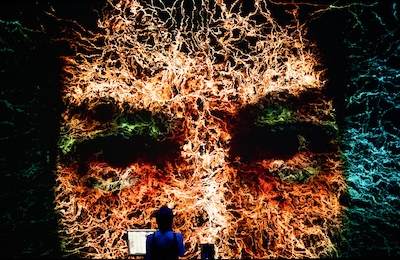
A performance by audiovisual artist Line Katcho expanded the resonant potential of the body. Katcho’s electroacoustic music is noisy and kinetic. But at least compared to the artists already mentioned, Katcho remained relatively still during her performance—she stood at a plinth with a small set of digital tools and her eyes moved between her instruments and a large, generative image on the opposite wall. The scale of the visuals shrank Katcho’s presence: filmed from behind, chin up, she appeared almost childlike. The colours and shapes that danced across from her thus engaged the body in a different register—a sort of prismatic refraction. Every so often, Katcho’s visuals would generate a gesture that felt almost human, animated by something like a sonic puppet string. And at the end of the performance, after her music reached its arpeggiated acme, Katcho superimposed footage of a human face onto the denouement.
As an audience member, I didn’t know what to make of this face. Maybe it was the way it reminded me of the presence of the spectator—the way its rippling surface seemed to capture how our own bodies incline towards and respond to musical performance. Or maybe it was its positioning in relation to Katcho—here was a face-to-face encounter, which for many is the exemplary image of our ethical responsibility to one another. In any case, I was moved. I might even have been touched.
Brennan McCracken is a writer from K’jipuktuk (Halifax) living in Tiohtià:ke (Montreal). He is currently completing PhD studies at the Department of English at Concordia University.