
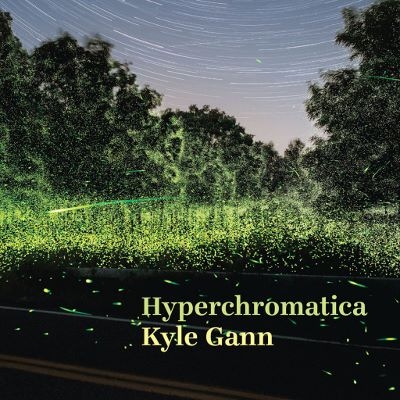
Kyle Gann’s eccentric and extravagant double-disc set Hyperchromatica is easily one of the year’s most fascinating releases. So don’t let him convince you otherwise: his tacky titles for the work’s movements (“Spacecat” and “Galactic Jamboree,” for example), the relentless annotation of his liner notes, and the somewhat wanting fidelity of the recording itself certainly could provide ample fuel for cynics. However, clearing away the clumsy and occasionally garish framing reveals Gann’s uncanny sensitivity and imagination in the face of what for most would be an insurmountable challenge—crafting more than two and a half hours of engaging music for three Disklaviers (grand pianos that can be computer-controlled) tuned to a thirty-three-tone scale. There isn’t even a trace of meaningless novelty or étude-like rigidity. Rather, the music exhibits hallucinatory fluidity, sliding seamlessly and disorientingly between disparate aural worlds. His keen awareness of microtonal potential acts as a lubricant for these shifts—bending and extending recognizable gestures, and erasing the distinction between timbre and pitch.
Just as Conlon Nancarrow (whom Gann wrote a book about) folded boogie-woogie and ragtime vocabulary into his innovative player-piano music, Gann’s nod to Nancarrow is only one ingredient of his recipe. The overall architecture seems closer to Debussy’s Préludes, albeit glimpsed through a prismatic twenty-first-century lens. Each piece paints its own distinct image, simultaneously asserting cohesion within a larger arc. Notable in this fragmentary through-line are the surreal allusions: one catches wafts of Balinese Gamelan, jazz lyricism, and various classical forms—even strains of electronic music.
Gann’s slyness in manoeuvring thirty-three-tone harmony is matched by his deployment of the Disklavier itself. He approaches the instrument as both a piano and as its own distinct medium. The wild rectangular explosion of flat fortissimos that marks the middle of “Pavane for a Dead Planet” is a jarring reminder that you’re listening to a machine—which contrasts an otherwise warm flow of notes. On “Pulsars,” the instrument’s mechanical precision fuses the fine pitch gradations to produce an otherworldly string of sparse, flanging tones.
Its outward impression may not be the most inviting, but rest assured that Hyperchromatica makes good on the ambition it can’t help but wear on its sleeve.
Nick Storring is a Toronto-based composer, musician, and writer, and a contributing editor to Musicworks. His music has been presented and performed by the Esprit Orchestra, Eve Egoyan, Quatuor Bozzini, Beijing’s Musicacoustica Festival, and Vancouver New Music. An avid collaborator, Storring has composed for films by Terrance Odette, Ingrid Veninger and, in collaboration with Dafydd Hughes, for the National Film Board’s award-winning Web documentary High Rise: Universe Within (2015), directed by Katerina Cizek. He’s also scored productions by Litmus Theatre and MT Space, worked with celebrated choreographers Yvonne Ng, Marie Josée Chartier, Brandy Leary, and Deepti Gupta, and created music for “ambient gaming environment” Tentacle, which was mounted at New York’s Museum of Modern Art in 2011. Storring’s writing has appeared in Exclaim!, The Wire, and AUX.tv. He also contributed liner notes to Alga Marghen’s reissue of the ’60s band Intersystems’ entire recorded output, as well as RVNG Intl.’s box of early psych trio Syrinx’s reissues and previously unreleased material Tumblers from the Vault.