
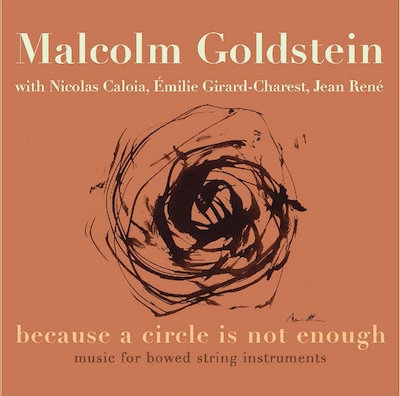
Composer, improvisor, and violinist Malcolm Goldstein was a central figure in the 1960s New York avant-garde scene, but since the 1970s he has lived in the more tranquil environs of an isolated cabin in Sheffield, Vermont. In the 1990s he became prominent in Montreal experimental music circles, and it was there in 2011 that he formed the Quatuor d’occasion (Goldstein, violist Jean René, cellist Émilie Girard-Charest, and bassist Nicolas Caloia). It is the members of this group that appear on this double CD set, which includes one string quartet, two duos, and eight solo improvisations. Written between 2018 and 2019, the works are intended to be used both pedagogically and in concert.
There are many strategies for improvising, from the completely unplanned to the carefully controlled. Goldstein calls his approach “structured improvisation compositions,” with titles that tend to be self-explanatory. For example, For Left Hand Alone is exactly that, with all sound set in motion by one hand without the usual bowing or plucking by the other. While the initial motivation for the piece was a right-hand injury, Girard-Charest’s busy interpretation displays that it need not sound like a limitation. This contrasts with her more static solo interpreting on On and On and Always Slowly Nowhere, where low-frequency drones predominate. Caloia and René tackle Statements and Responses, in which both follow specific instructions that suggest note sequences as statements and list various possible responses, such as long tones. The notes for Extraordinarily Variable, This Source could be seen as a list of the techniques Goldstein often uses in his improvisations. Noisy bowed sections with slurred notes are often followed by clearer articulations, and the overall effect is a flowing brook, which is forever changing in subtle ways. In Haiku Sounding the Girard-Charest–Goldstein duo borrows from haiku structures, with sequences of longer phrases bracketed by shorter ones. The viola solo Storytelling asks the performer to share something intimate—a reminder that music, and especially improvisation, can be very personal. The final album track, Boundless the Source, Overflowing in Song, acts as a summary of the solo and duo techniques heard previously, now performed by the full string quartet. The taut and barbed playing includes so much detail that it flows by in a smooth stream of constant invention.
Hearing this music without the benefit of the scores, one could easily think it completely improvised. Yet once you know the structure exists, it seems impossible to listen without noticing its influence. This subtle balance is what makes Goldstein’s approach unique, and the realizations by the performers on this album all the more engaging.