
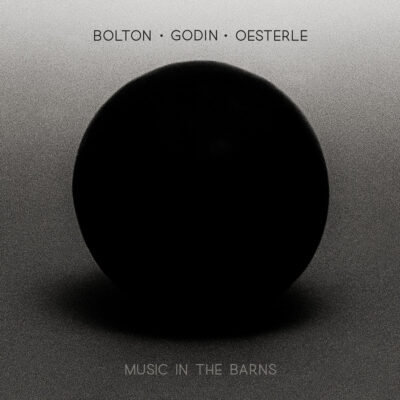
While one no longer has to adopt postmodernism’s cheeky nihilism when referring to the past in exploratory musical domains, exhibiting this hungry curiosity in concert-music circles might still earn you the regressive neoromantic label. Toronto composer Rose Bolton addresses this threat with indifference and unvarnished earnestness in her string quartet The Coming Of Sobs (2008), which opens this new disc from Canadian chamber ensemble Music In The Barns. Announcing the release online, Bolton noted her “desire to create music in the classical genre, doing what classical music is loved for, expressing heightened emotions.” Yet Bolton is no conservative. Her chosen palette reflects tradition, but this impulse audibly extends from her own identity rather than a compulsion to reconstitute the canon. Robust, brooding harmonies occupy disarmingly rectangular shapes, modulated by terraced dynamics. There’s no shortage of expressive lyricism, but it’s filtered by Bolton’s distinctive and decidedly contemporary restraint.
Scott Godin’s string quintet all that is solid melts into air wears its reckoning with modernism on its sleeve. Although his notes cite ties to Elliott Carter’s music—the piece was premiered alongside a new Carter work in 2010, before the 2012 revision that appears here—there’s a marked stylistic distinction: Carter is mostly associated with a barbed and vivid atonality; Godin’s piece has a luminous transparency to its ensemble textures and harmonies. This is especially the case in its latter two movements whose brilliant, animated gestures recall Ravel’s Quartet in F.
Daydream Mechanics (2001) by Michael Oesterle consists of lulling loops of material punctuated by short interruptions. This juxtaposition elicits a strange tension akin to being repeatedly but gently roused from a nap. The vibratoless delivery, ornamentation, and dance-like lilt impart a vague Renaissance character, yet the obstinate repetition and jolting non sequiturs feel like a transposition of so-called glitch music into the acoustic domain.
The ensemble’s approach on these recordings artfully reconciles Romantic extroversion with the more objective model favoured by many contemporary music specialists. The fact that they manage this tricky fusion with seamless cohesion, honesty, and personality speaks to the collective’s exceptional musicianship and to leader Carol Gimbel’s vision. Moreover, it’s an interpretive approach that flatters and matches the timely individualism of the three composers.
Nick Storring is a Toronto-based composer, musician, and writer, and a contributing editor to Musicworks. His music has been presented and performed by the Esprit Orchestra, Eve Egoyan, Quatuor Bozzini, Beijing’s Musicacoustica Festival, and Vancouver New Music. An avid collaborator, Storring has composed for films by Terrance Odette, Ingrid Veninger and, in collaboration with Dafydd Hughes, for the National Film Board’s award-winning Web documentary High Rise: Universe Within (2015), directed by Katerina Cizek. He’s also scored productions by Litmus Theatre and MT Space, worked with celebrated choreographers Yvonne Ng, Marie Josée Chartier, Brandy Leary, and Deepti Gupta, and created music for “ambient gaming environment” Tentacle, which was mounted at New York’s Museum of Modern Art in 2011. Storring’s writing has appeared in Exclaim!, The Wire, and AUX.tv. He also contributed liner notes to Alga Marghen’s reissue of the ’60s band Intersystems’ entire recorded output, as well as RVNG Intl.’s box of early psych trio Syrinx’s reissues and previously unreleased material Tumblers from the Vault.