
“An artist can predict the future—that’s part of the job.”
Hearing the poet Tanya Evanson speak those words while discussing her work Bothism provided a moment of clarity during the twelfth Obey Convention. I heard Evanson speak on the third day of Obey, a trip of sonic possibilities that comes to life in Halifax for a few days every spring. In the eye of the festival’s storm, her thought struck me as insightful and plainly aphoristic, like taking notice of the direction of the wind. Of course, you realize, artists can predict the future. They must. That future is one we make together, one pulled into existence by the breaths and reverberations and attention we all can’t help but throw into the present.
Evanson described Bothism as an exploration of opposites: a poem tracing how the truth of one thing might necessarily mean the simultaneous truth of its opposite. It felt like an apt thought to pause on in the middle of Obey, a festival curated not in search of one single sound—or one single truth—but rather as a way of fraying the edges of meaning altogether. The festival commits itself to both a spirit of subversion and a posture of radical openness. It’s possible, Obey suggests, to present deeply challenging performances and strive to be inclusive to all. Maybe sincerity can be subversive.
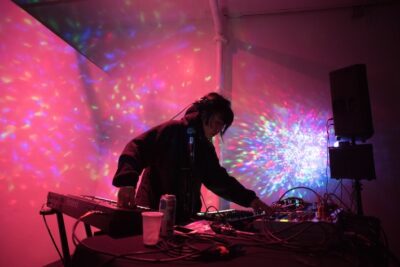
Kelly Moran’s opening night set at Fort Massey United Church was a testament to this spirit: the compositions from her 2018 LP Ultraviolet are not so much intentionally outré as they are purely singular. The New York City pianist’s playing was like crème brûlée—decadent tones cracked with sharp, continuous piano music. There was a fractal quality to the way Moran’s fast playing danced above the tectonic pull of drone; the sounds felt dissimilar in scale, but united in their movement. Before Moran, Laura Ortman explored the surfaces of Fort Massey with a tuning fork, pulling frequencies out of the surrounding objects and distorting them through her violin’s microphone. I was reminded again of Ortman after seeing Toronto-based producer Korea Town Acid later that night at the Khyber Centre for the Arts. I didn’t do much thinking during that set—dance was inevitable—but on my walk home my mind kept returning to Ortman’s performance. At that hour, I felt a kinship with her tuning fork—I, too, was encountering unlikely surfaces and being guided into resonance.
Friday afternoon woke me up from the previous night’s trance. The three-person Montreal group Strange Froots brought tight flow and deep love to a warm room at the Bus Stop Theatre; later, at the collective-run DIY venue Radstorm, the Australian performer Justice Yeldham sucked an unearthly noise out of pieces of broken glass. I couldn’t see Yeldham at work on his shards—listeners packed Radstorm’s low-ceilinged, oblong space—and without a visual referent his work sounded unsuspectingly smooth, almost sinuous.
I was still thinking about texture on Saturday afternoon, thanks to the Brodie West Quintet. West, an accomplished solo performer, guided a pianist, a bassist, and two percussionists through cuts from the group’s debut LP Clips. Their work was verdant and sensuous: a slow and steady pressure built with puddles of ride cymbal and a walking churn of plucked bass. Every so often, West’s saxophone would poke in with a short quip before folding back into his group’s flow. Audience members of all ages paid rapt attention; the toddler bobbing on kneetop next to me was thrilled. Equally thrilling was Vancouver producer Debby Friday’s set at the Marquee Ballroom that night: her loud, noisy production and rousing lyrics knocked me breathless.
On Sunday evening, I returned to Fort Massey and said goodbye to the weekend with a bath of sound. Nick Scholfield took listeners on a trip through his memory, incorporating field recordings of water into soft, shifting soundscapes. Tomoko Sauvage’s performance was also indebted to water—the artist sat on the floor of the church in front of an array of water-filled bowls and used them to generate a haunting wash of noises. As she dipped her hands in the water and found sound with their immersion, images capturing Sauvage’s performance from above were projected onto the church’s organ pipes. The grainy, black-and-white film footage dappling the rods looked like a distant memory but sounded radically new; once again, I was reminded of Evanson’s Bothism and the pull of opposites. And instead of trying to make sense of that pull—or of the innumerable connections between the sounds I’d been hearing for four days—I allowed my mind to float freely through their contrasts.
Brennan McCracken is a writer from K’jipuktuk (Halifax) living in Tiohtià:ke (Montreal). He is currently completing PhD studies at the Department of English at Concordia University.