
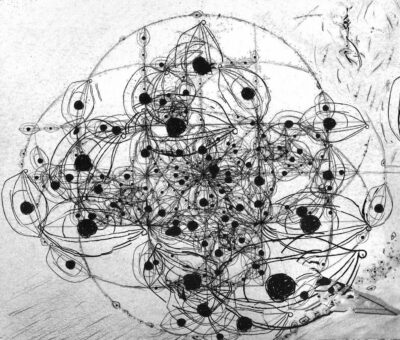
Sawyer Editions celebrates the delicacy of musical texture. Composer Kory Reeder runs the Texas-based label, which has developed a pensive esthetic around detail-oriented works accompanied by grayscale album covers. The latest batch, released in June 2024, continues along this path with five albums by Ryan Seward, Georgia Denham, Paolo Griffin, Sarah Hennies, and Eden Lonsdale and red panel. Two releases—Griffin’s Supports & Surfaces and Hennies’ Bodies of Water—emphasize the subtle, pattern- and process-oriented approach that the label champions.
Supports & Surfaces contains three pieces that highlight the breadth of Griffin’s compositional voice. The Toronto-based composer uses just intonation and microtonality in his process-based works that gently unfold with the progression of time, giving each piece a sense of contemplativeness. He loops and layers his phrases, crafting intricate webs from his stripped-down melodies. Each of the album’s pieces emphasizes his interest in process, as if he’s peering into each motif’s insides and pulling them apart. The Purpose of an Empty Room is emblematic of this idea. The piece grows from a single clarinet melody into a wave of consonance and dissonance. Its gradual shifts in colour feel like a sunrise with their subtle vibrancy and glacial changes that are unnoticeable until they’ve passed. This is the heart of Griffin’s music: an attention to slow motion, to the ways that making and listening to music are ever-evolving actions.
With Hennies’ Bodies of Water, rhythm takes centre stage. The upstate New York-based composer’s music grows from simple elements—like the scrape of a drum or the tap of a gong—creating a flow state from the timbre, texture, and rhythm of each note as it moves in relation to the others. Subtlety is core to her work; She watches every sound unfold, examining its every angle and homing in on every slight shift. In taking this meticulous approach, she unearths the hidden textures beneath a melody, unravelling musical elements into their barest parts.Bodies of Water, particularly the thirty-five-minute Abscission, exemplifies Hennies’ process. The piece begins with two notes moving in tandem yet just out of step with each other, pausing and taking their time as they land. A couple of plucks swirl around them and then crescendo, transforming into a hypnotic loop. When a new pattern enters, it doesn’t interlock; instead, it lands slightly away and inches closer with each repetition. Time is perennial, and Hennies works within it, yet she also bends it, showing how the placement of each note can adapt or warp to its own motion. Hennies’ music reminds us that every change is equally monumental—even the tiniest ones.
Vanessa Ague is a violinist and music writer currently studying Arts and Culture Journalism at the Craig Newmark Graduate School of Journalism at CUNY. She runs the experimental music blog theroadtosound.com, and her writing has appeared in The Wire, Pitchfork, Bandcamp Daily, and Tone Glow.