
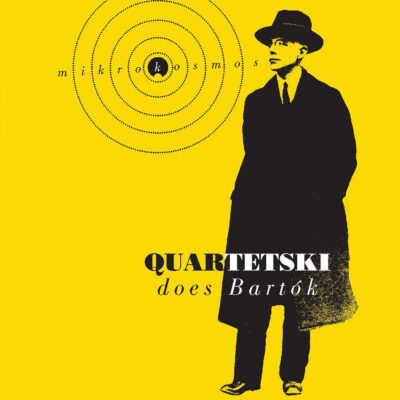
Quartetski has devoted itself to transforming well-known classical pieces through radical shifts in instrumentation, improvisation, and recomposition. The Montreal quintet has recorded works by Stravinsky, Prokofiev, and Mussorgsky, and here they take on Béla Bartók’s Mikrokosmos, the inventive and extensive set of piano exercises that introduced students to unusual modes, metres, and interval patterns. Electric bassist, synthesizer player, and musical director Pierre-Yves Martel draws from the first three volumes of the exercises (the simpler and less pianistic), sometimes assembling them in complementary sets. The treatments range from whimsical to revelatory.
The breadth of Quartetski’s reinvention is evident in something as brief as Gamme pentatonique #78: in a mere minute and twenty seconds, a passage of pitch-bending electric guitar from Bernard Falaise gives way to a serenely lyrical Far Eastern interpretation executed by reed player Philippe Lauzier and violinist Josh Zubot, playing arco at first and then pizzicato, emphasizing the cultural distances travelled in Bartók’s scalar explorations. Mélodie avec accompagnement #41 gets a thunderous rock treatment from Martel, Falaise, and drummer Isaiah Ceccarelli. Sometimes, though, the group employs more modest means: Mouvement parallèle avec changement de position #16 becomes a duet for two melodicas, played by Lauzier and Falaise. There’s a different kind of transformation in Majeur et mineur #59, first played by unaccompanied bass clarinet, then with elusive, dissonant accompaniment from metallic percussion and scraped strings.
The CD concludes with Makrokosmos, a dense, mysterious nine-minute work in which Quartetski freely reassemble and overlay some of the sonic materials employed in these explorations of Bartók’s exercises, here emphasizing the gritty electronics.
Stuart Broomer has written extensively on music, mostly improvised, for both general and specialist publications, and his liner essays have appeared on CDs by musicians from some 20 countries. The author of Time and Anthony Braxton (Mercury, 2009), he is currently writing a fantasia on the life of Memphis disc jockey Dewey Phillips. He has been intermittently active as an improvising musician since 1965; his composition Found Theme for the Age of Reason appeared in Musicworks 112. He lives in Toronto.