
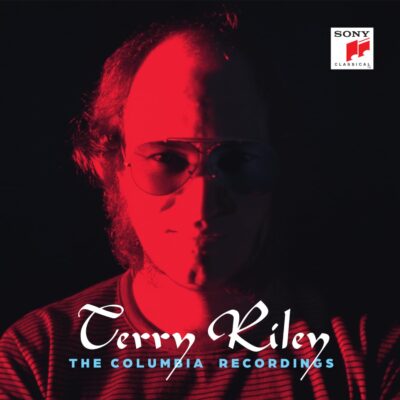
Terry Riley’s compositions are so embedded in the music repertoire, one forgets that mass dissemination of them only came in the late 1960s. That was when Riley started recording for the major record label Columbia. Complete with LP-replica CDs, miniature reproduced sleeves, and a fifty-six-page booklet, this box set collects all the music he recorded for that label.
Two sessions are justly famous, two less so, and a retrospective listen delineates why. Featuring eleven players, including Riley on soprano saxophone, the melodic transformation that characterized his jaunty and billowing 1968 composition In C perfectly fits the optimistic mood of the times. Driven by a pulsing piano continuum with accents provided by ringing marimbaphone and vibraphone clanks, the broken-octave piece defined minimalism. Creating what seems to be part of a never-ending theme, five mewling reeds, two yearning brass, and string harmonies come in and out of focus with dense blaring or floating dynamics coupled with tape delay. Rhythmic and harmonic changes transmute so gradually that only in the final sequence do trumpet trills confirm the melodic change.
A Rainbow in Curved Air and Poppy Nogood and the Phantom Band from 1969 feature Riley alone. Overdubbing and more tape delay timbres from saxophone, tambourine, dumbec, electric organ, harpsichord, and Rocksichord are affiliated into a narrative that portends ambient, new age, and electronic music. On the first composition, bongo-like and ersatz marimba tones create a backbeat interspaced with elevated calliope-like and organ-like reverberations, with the pulse becoming heavily rhythmic at the end. Poppy Nogood and the Phantom Band is more varied, with primary and secondary expositions criss-crossing the near solid narrative that piles notes upon notes and phrases upon phrases. Flutters and slurs from pinched woodwind variations meet programmed keyboard chords that vibrate at different tempos.
The Hindustani-like inflections sensed on the previous disc are intensified on Shri Camel, a 1980 album that followed Riley’s extensive study of raga-based classical Kirana singing. His modified organ, tuned in just intonation and augmented with digital delay, creates tonal ambiguity as languid dual keyboard washes are superseded by plinking tones that envelop its four compositions. By Desert of Ice, the extended final track, the resultant melody is louder and livelier.
The outlier of the set is the 1971 collaborative album Church of Anthrax, a duo with John Cale (Velvet Underground) which reflects Cale’s rock background rather than minimalism. Riley’s keyboards and sax and Cale’s keyboards and strings are enhanced by two drummers and, on one track, a vocalist singing a simple pop ballad. Some tracks could be mistaken for alt-rock, with jiggly organ riffs, overdubbed reed vamps, percussion pounding, and feedback from Cale’s viola and electric bass. Curiously enough, “Ides of March,” the standout track, sounds like jazz. Its melody includes piano clips and a relaxed drum shuffle, and it blends swing with timbral sophistication.
Designed as an objet d’art and a collector’s item, this set preserves sounds from a more risk-taking era and will interest many. Two certified classics are included, as well as glimpses of how Riley’s music might have changed, and how it did.
Ken Waxman is a Toronto-based journalist who has written about improvised and other musics for many years. Many of his articles on music can be accessed at <www.jazzword.com>.